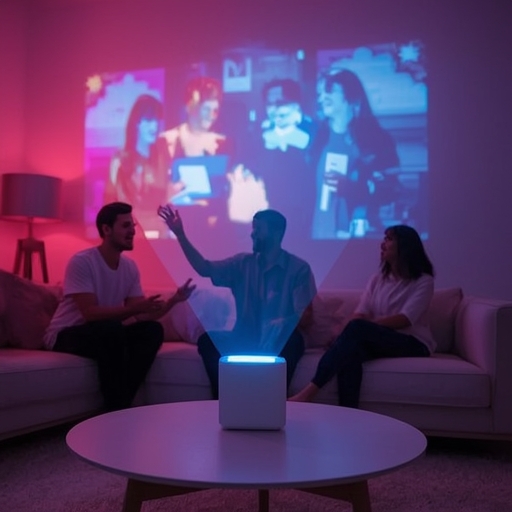
If someone had told me just a year ago that the petite Nex Playground console would outsell Microsoft’s Xbox—even if only for a brief two-week stretch—I would have laughed so hard that I’d likely have excused myself from the room. The very notion seemed absurd. After all, the Nex Playground is no formidable gaming powerhouse. It arrives as a compact three-inch cube, a miniature box that feels more like a design curiosity than a serious console. Compared to almost any modern smartphone, it is underpowered; rather than relying on advanced graphics processors or intricate hardware, it functions with a single, modestly capable camera designed primarily to track users’ bodily movements. Moreover, its library is intentionally restrictive: it offers only carefully curated, officially verified, child-safe games. While reviewers and enthusiasts have drawn frequent comparisons to the motion-sensing marvels of the Nintendo Wii and Microsoft’s Kinect, the uncomfortable truth is that the Nex Playground performs less impressively than either predecessor when it comes to translating motion into smooth, responsive gameplay.
Complicating matters further is its pricing model. The console costs $250 upfront, which is already far from trivial, and then requires an ongoing subscription—either $89 per year or $49 per quarter—to access more than a basic sampler of experiences. Individual titles can’t be purchased separately; the system is closed, its gates hidden behind a subscription wall. Many games barely surpass the level of low-effort shovelware, visually unappealing and lacking the refinement, artistry, or characteristic charm associated with Nintendo or even the highly polished offerings of Apple Arcade. Yet despite all these limitations, one particular evening caught me by surprise. Feverish and stuck in bed with a mild 99-degree temperature, I found my five-year-old pleading with irrepressible enthusiasm to play a Nex game. Before long, the energy of her excitement spread: we chose a virtual bowling game, and even Grandpa—who generally avoids video games entirely—wanted to take a turn. The household moment became unexpectedly intergenerational.
As my nine-year-old hurled her pretend airplane into a virtual crash, she giggled and exclaimed that she wanted another attempt. The Nex system uses that single wide-angle camera to track up to four players at once. No one in the room seemed to care that the visuals were basic or that the physics lacked realism. The beauty, it turned out, was in the accessibility. These games were instantly playable—no controller, no complicated setup, no preexisting gaming knowledge required. All one needed was a body, a TV, and the willingness to look a little silly. What truly captivated the kids was how the gameplay encouraged them to move, to dance, to jump, to stretch their arms, and, of course, how hilarious it was to see their dad mimicking the same wild gestures. I only wished that the laughter didn’t sometimes give way to tears.
Nearly two decades ago, Nintendo had pioneered embodied gaming with the Wii, whose motion-sensing remote relied on an infrared camera and accelerometer to detect not just direction but velocity and basic orientation. Later, Microsoft’s Kinect went a step further by eliminating the physical controller altogether, mapping an entire player’s skeleton in three-dimensional space through a structured pattern of infrared light. The Nex Playground, by contrast, takes a simpler route: a single wide-angle camera perched on the front, an HDMI output, and a USB-C power connection on the back—that’s it. Unlike the Kinect, however, it cannot perceive true 3D depth. Its software attempts to infer the user’s body pose from flat, two-dimensional images, generating an approximation of a person’s movement rather than precise spatial mapping.
During a round of bowling, the system recognizes just six skeletal joints—shoulders, elbows, and hands—to allow players to mimic the action of throwing a ball. When the algorithm behaves, the experience can be surprisingly satisfying. But without depth perception, the camera’s logic falters easily. My nine-year-old couldn’t rest on the couch while her younger sister played just a few feet closer to the console, because the Nex misinterpreted both of their arm movements as belonging to one player. When her turn was unintentionally stolen, the five-year-old cried inconsolably. Not long after, her sister felt the sting of digital injustice too, when the camera abruptly lost track of her arm mid-swing, tossing her ball into the virtual gutter. The repetition of these errors led to more frustration—and more tears.
The device’s single-camera tracking is fickle, and even Nex acknowledges it. The instructions provide a litany of warnings: avoid repetitive clothing patterns, keep your sleeves short, play in bright—but not backlit—settings, and ensure that no spectators appear within view of the lens. To its credit, the company even includes a detachable magnetic camera cover for privacy. Yet any parent knows that these directives are far easier to list than to follow. In our family, game time usually takes place after the kids’ evening baths, which means soft, long-sleeved pajamas adorned with stars, hearts, cartoon animals, or other cheerful motifs—precisely the patterns that confuse the tracking system. Thus, we resorted to rolling up sleeves, rearranging furniture, and enforcing unusual spatial boundaries. The camera’s need for an unobstructed view meant transforming the living room into something resembling a miniature film set where only the active players could remain visible.
Even then, frustration often prevailed. The small remote control packaged with the console, while handy for menus, seldom proved convenient. And the motion-based interface wasn’t always forgiving. My younger daughter, trying to guide her virtual puppy to the spa in a pet care game reminiscent of Nintendo’s Nintendogs, complained bitterly that she couldn’t keep her hand steady enough to select options. For a console that thrives on simplicity, occasionally its controls feel paradoxically demanding. Worse still, the whole system exhibits a subtle but noticeable input lag, even on an OLED television optimized for low latency. In a racing game set at high speed, steering felt sluggish, trailing just slightly behind real motion, undermining the illusion of direct control.
Nonetheless, moments of pure joy persisted, particularly in games that demanded creativity over precision. Mirrorama, for instance, converts the television into a giant mirror, overlaying fantastical filters—flashes of lightning from tiny hands, cartoonish distortions of faces, the illusion of dashing at superhuman speed, or dancing alongside one’s clone. That game provoked more genuine laughter than any other. Copy Cat, another family favorite, challenges players to strike ridiculous poses for the system’s AI to judge, while Brick Buster won me over as a clever reinvention of the classic Breakout formula. These simpler titles succeeded because they embraced accessibility rather than complexity.
Yet even amidst the successes, shortcomings continued to assert themselves. A frustrating rendition of Connect 4 left us exasperated after numerous failed attempts to make the balls land correctly. Other sports-themed games fluctuated between being trivially easy and bewilderingly difficult, depending on how well—or poorly—the camera interpreted gestures. Without true depth awareness, even aiming a virtual tennis shot became unintuitive: swinging one’s arm no longer changed trajectory; positioning of the entire body now controlled the ball’s direction.
To its credit, Nex has secured several major children’s brands—Bluey, Peppa Pig, Gabby’s Dollhouse, Sesame Street, How to Train Your Dragon, and Teenage Mutant Ninja Turtles—all promising experiences seemingly tailor-made for young players. Yet branding alone can’t guarantee enchantment. My children, for all their love of Bluey, quickly lost interest in its repetitive balloon-bouncing challenges. Unicorn Academy initially thrilled them with its promise of soaring adventures but soon disappointed with barren environments. Even the TMNT endless runner, which required constant leaping, felt less like fun and more like exercise disguised as play.
Still, every so often, a particular title would capture their imaginations anew. While my older daughter often returned to tend her virtual puppy companion, her sister’s face lit up at dinner when we announced we might bowl again—her sheer enthusiasm validating the console’s charm in spite of its missteps. Their collective favorite might be Nex’s version of a Flappy Bird-style game, in which up to four players jump simultaneously to keep their cheerful dragons aloft, nibbling fruit instead of colliding with towers.
As for me, I remain convinced that the Nex Playground costs far too much for what it offers in total substance. Nevertheless, it illustrates a powerful point: enjoyment doesn’t always correlate with technical sophistication or artistic excellence. Much like the golden age of arcade machines, with their inherently unfair mechanics and unbalanced difficulty spikes, the fun sometimes emerges not from perfection, but from the irresistible urge to take one more turn, to try again, to laugh as a family before calling it a night.
Sourse: https://www.theverge.com/games/848449/nex-playground-review-nintendo-wii-microsoft-kinect-motion-tracking-camera


