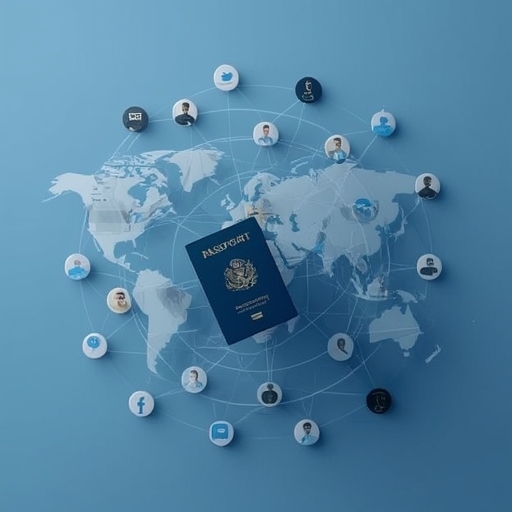
The United States has begun intensively reviewing the social media activity of certain visa applicants, introducing a new and more intricate obstacle for individuals who wish to work, study, or visit the country. Under the Trump administration, this additional layer of examination has also placed added pressure on U.S. embassies and consulates around the world, which are now required to integrate complex digital background checks into an already demanding visa processing system.
In June, the State Department initially announced that specific categories of visa applicants would be subject to thorough assessments of their online behavior as part of the federal screening process. Roughly six months later, that policy was expanded to include a broader range of visa classifications under what officials described as “online presence reviews.” This change has made an already meticulous process even more time-consuming and uncertain, producing widespread delays in visa approvals. The repercussions have been felt not only by individual applicants but also by major multinational corporations—such as Google and Apple—whose legal counsel has urged noncitizen employees requiring a new visa stamp to refrain from traveling abroad until further notice, fearing that prolonged processing times could prevent timely reentry into the United States.
As of December 15, consular officers formally began conducting social media screening for H‑1B visa applicants, a group that represents a large segment of foreign skilled labor in the American technology sector. Yet the impact of this new scrutiny extends far beyond just H‑1B workers.
According to information shared with Business Insider by a State Department spokesperson, the U.S. government has instructed both H‑1B applicants and their dependents to make their social media accounts publicly accessible so that consular personnel can evaluate posts, comments, and connections for potential security risks or inconsistencies. The H‑1B program itself was established to allow U.S. employers to hire foreign professionals in highly specialized fields—most commonly in industries such as engineering, information technology, and scientific research. Data from the Department of Labor reveal that nearly half of all H‑1B petitions come from “professional, scientific, and technical” sectors dominated by major technology corporations.
Furthermore, international students and cultural exchange participants are now also encompassed by the expanded reviews. The State Department has clarified that applicants for F, M, and J nonimmigrant visas—categories covering academic programs, vocational studies, and exchange initiatives—must also undergo “online presence” evaluations. Google’s internal legal guidance has warned that the resulting delays are affecting a wide range of visa classifications, including H‑1B, H‑4, F, J, and M holders, making travel planning increasingly challenging.
The reasoning behind this broad digital review policy lies in the Trump administration’s commitment to enforcing an especially stringent form of immigration oversight. Following an executive order issued in January, federal agencies were directed to strengthen immigration screening practices—with the stated purpose of safeguarding U.S. citizens from individuals deemed capable of committing terrorist acts, promoting extremist ideologies, or exploiting immigration pathways for malicious reasons. This mandate was subsequently reinforced through additional executive orders in June and again later that year, collectively imposing partial or full entry restrictions on applicants from twenty‑five specific nations.
In parallel, September brought another controversial policy: the imposition of a $100,000 fee on new H‑1B petitions. The administration portrayed this cost as a corrective measure designed to combat what it viewed as systemic abuse of the H‑1B system. President Trump asserted that the visa category had diverged from its original intention—to alleviate shortages in high‑skill labor—becoming instead a tool used to displace American workers by hiring less expensive foreign labor.
When the State Department unveiled the social‑media‑check policy on December 3, the agency underscored that the goal was to enhance national security. “A U.S. visa is a privilege, not a right,” emphasized an official spokesperson, explaining that additional processing time would be justified whenever necessary to confirm that an applicant poses no conceivable threat to the safety or stability of the United States.
For those navigating this new landscape, expert advice has been clear but cautious. Immigration attorneys and law firms have warned applicants against impulsively deleting or concealing social media profiles, even if doing so seems like a logical precaution. Davis Wright Tremaine, for instance, recommended that individuals carefully audit their social media content—removing misleading or contradictory information that might conflict with details presented in official forms. However, another firm, Duane Morris, strongly advised against outright deletions, noting that disappearing content may raise suspicions of evasive intent. The consensus among legal experts is that transparency, combined with accuracy and consistency, is the wisest course.
Perhaps the most critical strategic recommendation for affected applicants is to remain physically within the United States for the duration of the adjudication process. Cambridge‑based immigration attorney Shaun Foster of PampaninFoster told Business Insider that he advises clients on H‑1B visas to avoid international travel whenever possible. From his perspective, remaining on U.S. soil affords both applicants and their legal representatives significantly more control and flexibility when addressing procedural complications. “We have a much stronger position to assist and advocate for our clients within the country,” Foster explained, adding that once foreign consular operations become involved, the process becomes markedly less predictable.
Meanwhile, large corporations that depend heavily on foreign talent are scrambling to adjust to the reality of heightened processing times. Attorneys representing Google and Apple have already issued directives cautioning employees under visa sponsorship against leaving the United States, citing unprecedented appointment backlogs at American diplomatic missions abroad. In an internal memo circulated on Thursday, Google’s legal department warned staff that delays at some embassies and consulates have stretched as long as twelve months, rendering routine travel risky. Likewise, Apple’s immigration counsel at the firm Fragomen sent a similar communication last week, urging visa holders to postpone international travel plans. Their note bluntly stated that, given the volatility of current procedures and the high likelihood of unpredictable processing delays when reentering the country, employees without valid visa stamps should “avoid international travel for the time being.”
The anxiety surrounding these developments has been amplified by the September decision to impose the steep H‑1B application fee. Immediately following that announcement—before the administration clarified that the charge would apply only to new applicants—major companies like Google, Amazon, Microsoft, Meta, Salesforce, JPMorgan, and Zoom rushed to issue alerts, warning employees to remain in the United States. In one particularly dramatic incident, dozens of H‑1B workers aboard an Emirates flight preparing to depart San Francisco reportedly disembarked mid‑boarding once they learned of the policy change. The ensuing corporate panic ultimately compelled the government to issue a clarification confirming that the fee increase would not apply to existing visa holders.
In sum, the Trump administration’s introduction of social media vetting has ushered in a new era of digital scrutiny within the U.S. visa process—an era characterized by intensified security checks, prolonged timelines, and deep uncertainty for both employers and the global professionals they rely upon. While intended to strengthen the country’s defenses, the measure has also reshaped how international workers, students, and corporations strategize around immigration compliance and cross‑border mobility.
Sourse: https://www.businessinsider.com/us-visa-requirements-social-media-review-what-to-know-h1b-2025-12


