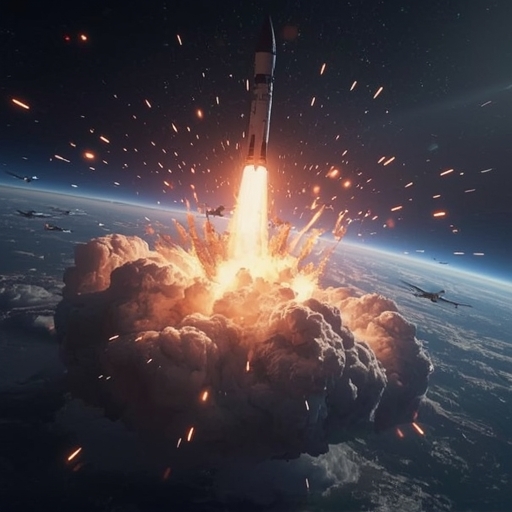
Newly disclosed Federal Aviation Administration (FAA) documents have significantly expanded the understanding of the SpaceX Starship explosion that took place over the Caribbean, exposing a scenario far more hazardous than the initial reports had suggested. According to these detailed records, the event not only represented a setback for one of the most ambitious aerospace initiatives of our time but also introduced risks that came alarmingly close to compromising air safety across one of the busiest international flight corridors. The revelation paints a picture of the immense complexity surrounding modern space operations and the delicate interplay between innovation, risk, and oversight.
In essence, what seemed at first to be a technical anomaly confined to the upper atmosphere has now been reframed as a potentially serious incident with tangible repercussions for nearby aircraft. The proximity of fragments and heat signatures, as indicated in the FAA’s analysis, underscores how even highly advanced launch systems remain vulnerable to unpredictable failures once they transcend the traditional envelope of terrestrial aviation. This finding compels both regulators and private operators to reconsider how safety assessments, airspace restrictions, and contingency protocols are coordinated before every launch.
The broader implications of this revelation reach far beyond a single company or incident. They expose the tension inherent in a transformative era where private firms have become dominant architects of humanity’s push into space. As enterprises like SpaceX accelerate the frequency and ambition of their missions, the margin for error narrows dramatically, and the consequences of oversight gaps become magnified. Ensuring public confidence in the safety of these ventures now depends not merely on innovation and technological prowess but also on the transparency and thoroughness of the agencies tasked with monitoring them.
Consequently, questions multiply: Should the regulatory framework governing private spaceflight evolve at the same pace as the industry itself? What mechanisms can guarantee both rapid advancement and uncompromising protection of human life? The FAA’s documentation invites renewed debate over how far entrepreneurial freedom in aerospace exploration should extend when shared airspace—and by extension, public safety—is at stake.
Ultimately, the story serves as a timely reminder that progress among the stars cannot detach itself from the responsibilities at home. Every launch, no matter how visionary in scope, must be weighed against the ethical and procedural imperatives that safeguard people and environments alike. By pushing beyond what was once thought possible, humanity now stands at the frontier of extraordinary achievement—yet the true measure of success may lie in how wisely that frontier is managed, ensuring that innovation and safety advance together, inseparably and in balance.
Sourse: https://www.wsj.com/business/airlines/the-spacex-explosion-that-put-flights-in-danger-016a79c0?mod=rss_Technology