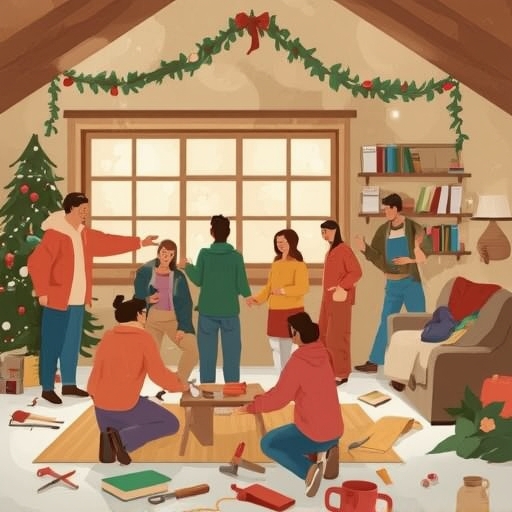
This year, I found myself once again on the phone with my sister, both of us navigating the familiar pre-holiday rush as we compared our ever-expanding Christmas to-do lists. The conversation started casually enough, but as she spoke, I began silently assessing everything still demanding our attention: the long list of gifts yet to be chosen and wrapped, countless social gatherings and school functions to attend, festive menus that needed planning and preparation, and professional responsibilities that stubbornly refused to pause simply because the calendar declared it December. The month always seems to descend with a chaos uniquely its own, enveloping families in a whirlwind of obligations and expectations—regardless of how well-prepared we think we are.
As my sister continued talking, a quiet thought arose: was all of this frenzy actually worth the effort? Beneath the surface of holiday excitement, each of us was already carrying a private mental checklist, brimming with unfinished home projects and postponed chores—those quiet burdens that accumulate in the corners of everyday life. There were cabinets still waiting to be organized, a half-built storage unit collecting dust, a child’s room that no longer fit his growing personality, and various domestic details that never quite reached the top of our priority lists. We continually postponed them, telling ourselves we were doing it for good reasons—to meet professional commitments, to care for our families, and to conjure the enchantment of Christmas for everyone but ourselves.
It was in the midst of this reflection that a simple yet transformative idea formed in my mind: what if we shifted our focus this year? What if, just once, our family prioritized our regular to-do lists—the ones tied to our homes and personal well-being—over the traditional holiday checklists filled with wrapping paper and shopping receipts? I presented this concept, which I dubbed ‘Project Home,’ to my family, suggesting it as a thoughtful alternative to our usual gift exchange. My inspiration came partly from something I’d recently read about: an emerging phenomenon known as ‘life admin parties,’ where people gather not to socialize over dinner or drinks, but to collectively tackle the many small, overwhelming responsibilities of adulthood—finances, paperwork, organization, and more. Beyond productivity, the appeal lay in the shared sense of relief and camaraderie that developed when tasks once faced alone became communal undertakings.
That spark of an idea soon evolved into a concrete proposal. Instead of exchanging presents this year—at least among the adults—what if we each gifted something less tangible yet infinitely more valuable: a full day of our time, devoted to helping one another with personal home projects? Within our family of five—three sisters and our parents—the suggestion immediately resonated with some. My parents enthusiastically embraced the concept, delighted by the prospect of doing something creative and purposeful together. One of my sisters loved it instantly, recognizing it as an opportunity to transform seasonal stress into connection. The other was more hesitant. For her, giving gifts was an expression of affection—a deeply ingrained love language—and the notion of forgoing that ritual felt, at least initially, like a meaningful tradition being stripped away. To make the idea more inviting, I promised each host household would provide hearty food, comforting treats, and perhaps a good bottle of wine, turning every project day into a relaxed, festive gathering. I painted the vision for them as something inspired by a home renovation show—the charm of Chip and Joanna Gaines, minus the production budget and cameras. To our collective surprise, the outcome far exceeded our expectations.
The first phase of Project Home unfolded at my sister’s place. With music playing in the background and endless coffee fueling our energy, we transformed her space piece by piece. Her kitchen was deep-cleaned and reorganized, the bathroom decluttered, and a half-finished deck—long an eyesore and symbol of unfinished plans—was finally brought to completion. The addition of doughnuts and laughter turned the day into something far richer than simple productivity; it carried that rare sense of forward momentum that only emerges when the physical labor of improvement is matched by shared enthusiasm and companionship.
Next came my turn. My own home had long been pleading for attention, particularly the outdoor spaces that had suffered from years of benign neglect. Together, we cleared gutters, refreshed neglected corners, built much-needed hallway storage, and reimagined my son’s bedroom so that it suited his current stage of life rather than a past one. Watching these transformations unfold in a single day was deeply satisfying, but the most profound reward extended far beyond the physical results.
The real gift, I discovered, was not the completed projects themselves but the shared experience—the moments of togetherness that naturally unfolded in between tasks. At one point, I found myself sitting cross-legged on the floor beside my 22-year-old niece as we assembled a new piece of furniture. As our hands busied themselves with tools and instruction sheets, our conversation flowed effortlessly into more meaningful territory: her aspirations, her career uncertainties, her evolving confidence, and the quiet pressures that young adulthood often carries. Those conversations, vulnerable and genuine, would never have occurred during the hurried errands or formal gatherings that usually fill our holiday calendars. They happened because we were present, engaged, and unguarded—our phones set aside, our intentions aligned not around performance but connection.
In many ways, this new tradition demanded more effort than the simplicity of shopping for gifts, but it also offered something far more substantial. Purchasing presents would undoubtedly have been faster, easier, and less physically taxing. Yet this experience—this act of rolling up our sleeves and contributing to one another’s lives in concrete ways—felt like love manifested through action. It was generosity not expressed through spending but through presence, labor, and genuine care. The tangible outcomes were lovely: my son adores his refreshed room, and my sister now enjoys her long-awaited deck. But it’s the intangible outcomes—the laughter, the teamwork, the sense of shared accomplishment—that linger most vividly.
As of now, we’re only halfway through our family projects, with two homes left to tackle. Still, even at this midpoint, it’s clear that this experiment has reshaped the way I think about the meaning of Christmas. The spirit of the season, I realized, doesn’t have to arise from wrapped boxes or glittering ribbons; it can be found instead in sweat, sawdust, and the gentle hum of connection that surfaces when family members work side by side. Building, cleaning, mending, and simply being together has restored the essence of what the holidays should represent—intentional presence and mutual support. And truthfully, as I look ahead, I can’t imagine a more worthwhile tradition to carry forward.
Sourse: https://www.businessinsider.com/family-skips-christmas-gifts-help-each-other-home-projects-2025-12


