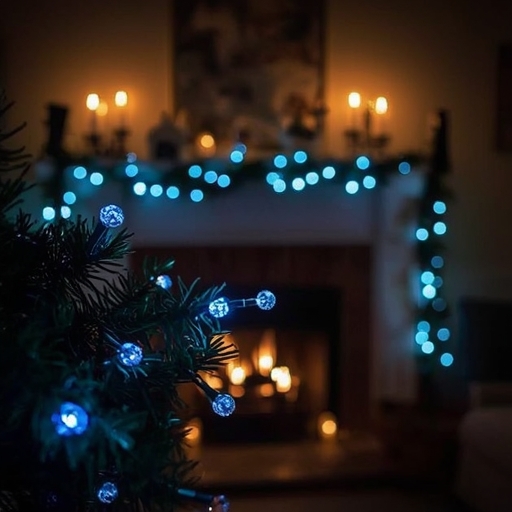
As I stroll past the elaborate holiday decorations that seem to have taken over every available space—windows trimmed with garlands, corridors draped in tinsel, and ceilings shimmering with ornaments—I am immediately struck by the brilliance of the lights. They blink rhythmically from artificial trees, casting a constant, almost hypnotic glow, and cascade from above in endless strands. The entire scene resembles a meticulously constructed winter wonderland, bathed in a haze of radiance that could easily invite admiration and childlike awe. Yet, despite its beauty, I find myself unable to pause and appreciate it fully—not because I don’t want to, but because pausing hurts too much.
The kaleidoscope of colors—especially the soft glimmer of blue—acts as an instant and piercing reminder of my father. Every flicker resurrects a particular memory: him methodically arranging his favorite strings of blue bulbs, ensuring they hung perfectly along the tree we decorated together each year. That seemingly simple ritual now leaves behind a sharp void, a hollow ache that cuts deeper with each passing holiday. It has been three years since his unexpected death, and despite the time that has passed, the season still arrives like a blow to the gut—festivity wrapped around grief.
Each December, I try once again to navigate what it means to coexist with this ‘holiday grief,’ a phrase I never imagined would become part of my emotional vocabulary. When my father died from a sudden heart attack, my entire family entered a haze of disbelief. He had seemed so healthy—his routine medical checkups showing nothing of concern—that his absence made no logical sense. In the weeks following his passing, we carried out the practical tasks that grief demands: making arrangements, consoling my mother, and trying to hold each other together. But no amount of organization could prepare us for the empty spaces woven through our traditions.
Now, statistically speaking, I know I am not alone. I belong to the seventy-six percent of adults who have lost a parent before turning fifty-nine. Yet, that awareness brings little solace, especially when I realize I also fall into the thirty-six percent who struggle to find any joy in the holiday season because of unresolved grief. Three years on, I remain certain of only one thing: I still have not mastered how to celebrate a holiday without my dad’s presence anchoring it.
It’s the smallest, most ordinary moments that catch me off guard—the ones I never thought would matter so deeply. During that first Christmas without him, I found myself passing the kitchen counter and instinctively looked for my great-grandmother’s well-worn cookie cutter. It was always my father who used it, cutting out Oma’s traditional cookie shapes while telling the same beloved story: the time in high school when his grandmother secretly baked a private batch just for him. He repeated it every Christmas, smiling as though telling it for the first time, and I would listen again, knowing exactly how it ended but never wanting it to stop.
Then there were the batteries, his emblem of preparation and parental dedication. As he loved to recount, when I was eight and my younger sister only four, Santa forgot to include batteries with our new electronic toys. My dad spent that Christmas morning driving from one gas station to the next, covering nearly thirty miles, only to discover that every store was closed because it was, quite unmistakably, Christmas Day. From that year on, he vowed to never repeat the mistake, keeping an entire drawer overflowing—though meticulously arranged—with batteries of every size. “That’s why I’m always prepared,” he would say proudly while sliding open the drawer, as if it were a personal badge of reliability.
These anecdotes—of cookies, omitted batteries, and laughter-filled stories—play in a continuous loop in my mind, wrapping themselves around every sensory detail of the holidays. And inevitably, the sequence ends the same way: a rush of emptiness, the weight of loss settling in, the quiet grief that follows. My father is inseparable from every holiday ritual that once defined my family’s winter season; it’s impossible to untangle his presence from these cherished customs. And so, the question lingers—how do I celebrate without him?
The answer, I’ve slowly come to realize, might lie in storytelling itself. By sharing the memories he once told me, I find a way to keep him alive in our celebrations. Last year, my eleven-year-old son and I were sitting near the Christmas tree, the room softened by the tranquil glow of the lights, when I suddenly felt compelled to speak. I asked him, “Did you know that Papa’s favorite lights were blue?” I explained how my childhood trees were always dressed entirely in blue because my father believed they made the tree seem to shine from within, a gentle illumination that, as he phrased it, made it ‘glow with warmth.’
My son listened quietly, eyes reflecting the faint shimmer of the lights, and then, without any prompting, he threw his arms around my neck in a spontaneous hug. “I like Papa’s stories,” he whispered. That brief, tender moment became the foundation of a new tradition—one in which my memories of my father pass naturally into the next generation, the way his stories once passed to me. In telling them, I am not merely reminiscing; I am preserving a lineage of love, humor, and connection that even death cannot erase.
Now, as I recount to my son the tale of Oma’s secret plate of cookies, I see in his expression a recognition, an understanding that binds us across time. The blue lights glint in his eyes, mirroring those that once illuminated my father’s own tree, and for an instant, I can almost believe that Papa isn’t gone at all—only transformed into the stories and traditions that continue to illuminate our holidays, year after year.
Sourse: https://www.businessinsider.com/dad-died-holiday-grief-family-rituals-traditions-2025-12


