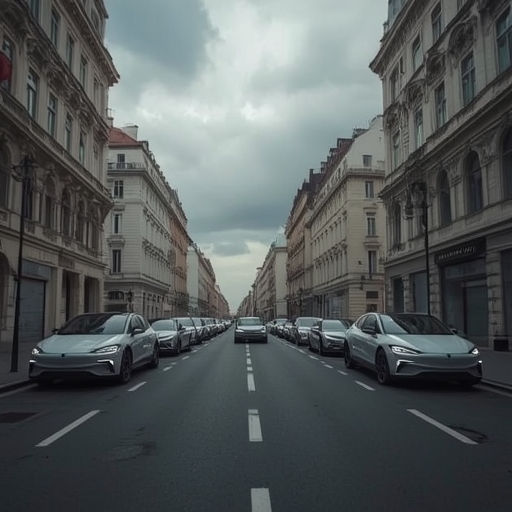
The much-anticipated transformation toward an electric automotive future remains within reach, yet that vision is now being cautiously deferred. The European Commission, which previously championed an ambitious roadmap to eliminate new gas-powered car sales by 2035, has announced a reconsideration of its target, citing the necessity of maintaining regulatory flexibility and economic adaptability during such a monumental transition. This adjustment softens what was once a bold and unwavering commitment to decarbonization, acknowledging the complexities faced by both policymakers and manufacturers in balancing environmental goals with industrial realities.
Under the revised proposal, rather than mandating that every new vehicle sold by 2035 must be entirely zero-emission, up to ten percent of newly registered automobiles may still comprise hybrid models or other low-carbon alternatives. However, these vehicles would only remain permissible if manufacturers actively compensate through verified carbon offset purchases, ensuring some level of environmental accountability. This alteration forms part of a larger set of legislative and industrial measures known as the “Automotive Package,” an initiative designed not merely to clean up the continent’s automotive industry but also to ensure that it retains its global competitiveness amid the sweeping changes redefining mobility.
Should the European Parliament formally ratify the amended framework, it will likely appease traditional automakers across the continent—many of whom have been lobbying for additional time to transition away from internal combustion and hybrid systems. These legacy manufacturers, emblematic of Europe’s long-established car culture, are grappling with fierce competition from both the trailblazing American giant Tesla and an ever-expanding wave of inexpensive electric vehicles from China. Yet, while long-standing car brands may welcome the breathing room, the decision has sown discord within Europe’s rapidly growing clean-tech sector, especially among EV startups and their investors, who perceive the move as a retreat from leadership.
Craig Douglas, a partner at World Fund, a European venture capital firm dedicated to climate-focused investment, voiced this concern bluntly. He warned that China already commands overwhelming dominance in electric vehicle production, and without a clear and ambitious policy framework from Europe, the continent risks relinquishing not only industrial leadership but also the associated economic gains from an industry central to global sustainability efforts. Douglas was among the numerous signatories of the open letter “Take Charge Europe,” which was addressed to European Commission President Ursula von der Leyen in September. Executives from major corporations such as Cabify, EDF, Einride, and Iberdrola, along with leaders from various EV-related ventures, collectively implored the Commission to maintain its original 2035 zero-emission target without concession.
Nevertheless, the organized appeal from these innovators and investors ultimately could not outweigh the mounting pressure from traditional automakers, who collectively account for approximately 6.1% of total employment within the European Union. The outcome has ignited a nuanced debate, not just within emerging startup circles but across the broader industrial landscape, about how Europe can remain economically viable and technologically progressive while still advancing its agenda for clean energy and climate responsibility.
Even within the automotive community itself, consensus proves elusive. In a strongly worded statement to Swedish media, a Volvo spokesperson cautioned against the dangers of compromising long-term strategic commitments for the sake of short-term economic reprieve. Such reversals, the representative argued, could gravely jeopardize Europe’s competitiveness for years ahead. Unlike some peers such as Mercedes-Benz, Volvo voiced little concern over meeting the 2035 emission-free deadline. Instead of loosening the restrictions, the company argued for accelerating investment in critical EV infrastructure—especially the continent’s charging network—warning that policy dilution might discourage the very progress needed to make electric adoption broadly practical.
This sentiment was echoed by Issam Tidjani, the CEO of Cariqa, a Berlin-based startup operating an online marketplace for EV charging services. Tidjani warned that softening the 2035 mandate would undermine overall progress toward electrification. Drawing from historical precedent, he argued that excessive flexibility has seldom produced the desired acceleration in industrial transformation; rather, it tends to fragment the market, decelerate scaling, and erode the learning curves required to build resilient technology hubs. For Tidjani, and many entrepreneurs who co-signed the “Take Charge Europe” letter, the risk is not merely economic but existential—Europe could exchange its leadership potential for complacency at the most critical juncture of the green transition.
To the Commission’s credit, infrastructure and supply chain considerations have not been entirely neglected. Embedded within its broader Automotive Package is the newly introduced “Battery Booster” initiative—a targeted €1.8 billion investment aimed at strengthening Europe’s ability to design, produce, and distribute batteries entirely within its own borders. This financial commitment seeks to counteract growing dependence on external suppliers while enhancing the continent’s energy security and industrial resilience. The program’s central ambition is to foster a vertically integrated supply chain that propels innovation from research laboratories to large-scale production facilities.
The initiative has already garnered praise from Verkor, a French startup specializing in the development of high-performance lithium-ion battery cells. The company, which recently inaugurated its first large-scale manufacturing plant in northern France, views the Booster as a crucial mechanism for expanding the continent’s industrial base. Verkor’s leadership described the scheme as an essential step to achieve the critical scale necessary for Europe to maintain parity with larger, more mature international battery producers—particularly as others, such as Sweden’s Northvolt, have encountered significant operational hurdles.
Despite this positive reception, skeptics question whether such measures are sufficient to counterbalance the negative market signals that the softened emission targets may send. Many investors and policymakers fear that while the Battery Booster reinforces one side of the green transition, the simultaneous relaxation of emission goals could weaken investor confidence, sending mixed messages about Europe’s willingness to make decarbonization a true engine of economic growth. Additionally, traditional automakers have voiced new complaints, claiming that the carbon offset purchase requirements could inflate production costs and, by extension, push consumer prices upward—ironically undermining the competitiveness that the revised policy ostensibly seeks to protect.
Further complexity arises when one considers the position of the United Kingdom. As an economy now outside the EU framework, it remains uncertain whether London will emulate Brussels’ flexible approach or adhere to its own, more rigid timetable for phasing out combustion engines by 2035. The U.K. has thus far refrained from imposing import tariffs on Chinese electric vehicles—a decision that contrasts sharply with both European and American trade strategies and has already sparked anxiety among domestic carmakers facing growing pressure from a surge in budget-friendly Chinese EV imports.
Ultimately, the debate encapsulates a fundamental tension at the intersection of climate policy and industrial pragmatism: how to nurture a robust economic ecosystem for established industries while accelerating the shift toward sustainable technologies. The path Europe chooses today—between cautious moderation and unwavering ambition—will determine not only whether it leads or lags in the global race toward carbon neutrality but also whether future generations inherit an automotive industry defined by innovation and resilience or by compromise and lost momentum.
Sourse: https://techcrunch.com/2025/12/21/as-eu-waters-down-2035-ev-goals-electric-startups-express-concern/


