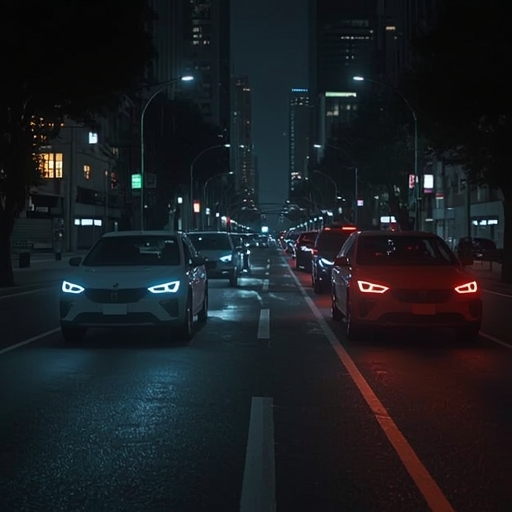
On Saturday, a significant and widespread electrical disruption swept through San Francisco, plunging large portions of the city into darkness and leaving roughly 130,000 utility customers without power at the height of the outage. According to Pacific Gas and Electric Company (PG&E), which operates and maintains much of the region’s energy grid, the blackout presented not merely a challenge of restoring electricity to homes and businesses but also produced unforeseen ripple effects across the city’s increasingly technology-reliant infrastructure—most notably affecting autonomous vehicles. Numerous reports and videos circulated widely across social media platforms, capturing scenes of Waymo’s self-driving SUVs immobilized in the middle of busy intersections and along major thoroughfares, their sensors glowing faintly while traffic began to back up around them like water pressing against a blocked channel.
Simultaneously, other observers documented a stark technological contrast: Teslas equipped with the company’s Full Self-Driving (FSD) software appeared to continue navigating those same dimmed streets with relative stability. In fact, Tesla CEO Elon Musk publicly remarked on the situation via social media, emphasizing that the company’s so-called ‘Robotaxis’ were operating without any apparent disruption, unaffected by the widespread power loss that had paralyzed much of the city’s automated competitors.
Inquiries into the situation prompted an official response from Waymo. Speaking to the technology news outlet The Verge, company spokesperson Suzanne Philion explained that Waymo had chosen to temporarily suspend its ride-hailing services throughout the San Francisco area due to the extensive power outage. She underscored that the company’s foremost concern was the safety and well-being of its passengers, as well as ensuring that emergency responders retained full and unobstructed access to city streets while they carried out critical duties during the blackout.
Meanwhile, PG&E provided continuing updates to the public as its repair crews worked through the early morning. By 7 a.m. Pacific Time, the utility reported that power had been successfully restored to approximately 110,000 customers, though around 21,000 remained in the dark. These remaining outages were largely concentrated in specific neighborhoods such as the Presidio, the Richmond District, Golden Gate Park, and select pockets of San Francisco’s downtown core. The ongoing repairs, officials clarified, stemmed in part from a fire that had broken out at a five-story substation, which complicated the restoration effort.
Despite official statements, one pressing question persisted: why exactly had Waymo’s vehicles stopped functioning so completely? The company had not issued any direct public explanation through its social media channels or blog at the time of reporting. Nonetheless, observers and technology enthusiasts offered plausible hypotheses. Chief among them was the theory that interrupted or overloaded wireless data connections might have rendered the vehicles temporarily inert. In a city suddenly deprived of Wi-Fi, many residents turned en masse to cellular networks, potentially overwhelming local towers or depriving autonomous systems of the stable, high-speed links they depend upon. Other speculations suggested that the inoperable traffic signals—key environmental cues for autonomous navigation—could have left the cars uncertain about how to proceed safely, prompting them to halt and wait for further guidance.
Importantly, this was not the first incident in which Waymo’s vehicles had struggled under similar conditions. Earlier in the year, viral TikTok videos had documented comparable situations in which the company’s autonomous cars became effectively frozen when encountering a malfunctioning traffic light or during a separate power outage in Austin, Texas. In another case from the previous year, a Reddit discussion thread featuring images of immobilized Waymo vehicles drew a revealing comment from an individual identifying themselves as a former employee. They explained that when the software encountered an ambiguous driving scenario, it would automatically transmit a request for human assistance, pausing in place until receiving a response and further instructions.
Official company materials have described this backup system in greater detail. According to a post on Waymo’s corporate blog, whenever one of its self-driving vehicles encounters what the company terms a ‘unique interaction’—a situation not fully anticipated by its onboard algorithms—it establishes contact with a remote human operator. These specialists gain access to a comprehensive data stream, including both live and recorded camera feeds as well as a dynamic three-dimensional map synthesizing information from the car’s array of sensors. Through this interface, the human agent can analyze the environment and advise the vehicle on how to resume safe operation. However, this remote-assistance mechanism depends heavily on robust data bandwidth and reliable connectivity—resources that are often scarce during major power failures, when infrastructure is strained or partially offline.
No publicly available data could be located regarding the number of remote-support staff Waymo employs at any given time to handle such interventions. Still, a company announcement from the previous November disclosed that Waymo’s remote assistance framework had successfully undergone an independent evaluation by Tüv Süd, a German technical inspection company renowned for certifying systems according to international safety and quality benchmarks. That audit affirmed that Waymo’s procedures aligned with established industry best practices for autonomous-vehicle supervision. Nonetheless, even a rigorously tested system can be stress-tested by events of the scale experienced in San Francisco—a city whose complex urban fabric and reliance on digital infrastructure have once again underscored how thin the line can be between automated progress and technological paralysis when the energy sustaining it suddenly disappears.
Sourse: https://www.theverge.com/news/848843/waymo-san-francisco-power-outage


