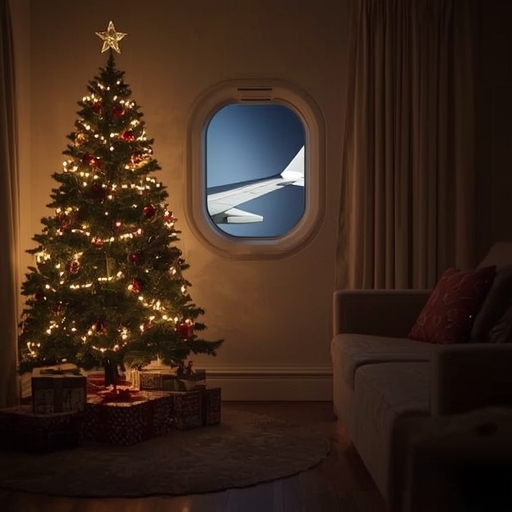
The weight of societal expectations often falls heavily on women during the holiday season — a time that the world insists must be flawless, joyful, and perfectly orchestrated for everyone involved. I came to realize, however, that such perfection was an illusion, especially in my circumstances. The well-loved, stable traditions of my childhood simply could not be replicated as the centerpiece of my adult life. My situation demanded adaptation rather than replication. With a husband whose career as a pilot required frequent absences during the most sentimental time of year, I had to surrender the vision of continuity and embrace the beauty of improvisation. Slowly, I began to cultivate new experiences, crafting memories grounded not in predictability, but in creativity and resilience.
Because of my husband’s ever-changing flight schedule, the holidays in our home rarely followed a traditional pattern. Plans shifted, celebrations unfolded on unorthodox dates, and emotions — ranging from joy to disappointment — intermingled freely. There were tears shed when the distance felt overwhelming, and some years seemed impossibly heavy. Yet, as time passed, those very seasons of uncertainty transformed into the stories our family still reminisces about with laughter and affection. The imperfections became our unique rhythm, woven into the fabric of who we are.
Being married to a pilot meant that unpredictability was an inseparable part of our reality. In contrast, the holidays of my own childhood were defined by comforting consistency. Each December followed the same gentle script: my grandparents would arrive on Christmas Eve, we’d gather around a table brimming with family recipes, exchange gifts, and listen to my great-grandmother play the piano, her hands gracefully dancing over the keys. Sleep rarely came easily that night, but dawn always brought the thrill of unwrapping presents with my parents and brother, followed by a drive to visit my other grandparents for another round of feasting and gift-giving. It was an annual ritual marked by stability — a calendar I could recite by heart.
When I married my husband, I was fully aware that his career would require him to work through holidays. Intellectually, I understood it, but emotionally, the reality hit harder than anticipated. I missed the comfort of repetition and mourned the holiday moments I had envisioned sharing with my own children. My dreams of creating the same enduring family traditions I had once known began to dissolve. Faced with that loss, I reached a crossroads: I could either dwell in frustration and sadness or redefine what joyful celebration looked like within the framework of our unconventional life. So, I chose adaptation over resistance, striving to make every holiday fun, meaningful, and memorable — no matter the date printed on the calendar.
The year I truly began to understand the richness of nontraditional celebration stands out vividly in my mind. My husband was flying on Christmas morning, so the children and I found ourselves at a Denny’s instead of around a twinkling living room tree. We sat coloring cheerful pages for my grandmother, who was then living in an assisted care facility. After breakfast, we gathered our drawings and treats from home and drove over to surprise her. Though we had already celebrated with her earlier that week, this unscripted visit proved to be one of the most meaningful moments we ever shared. My grandfather had passed away, and she often spent long hours alone in her small apartment, her fading memory causing familiar faces to blur. When she saw us walk through her door, her face illuminated with pure joy. We spent the morning flipping through old photo albums, reliving fragments of cherished history. She proudly displayed the children’s artwork and strolled with us through the halls, introducing them to other residents. That morning — unconventional, quiet, and tender — became a memory I will treasure for the rest of my life.
That same morning, while sipping coffee across from my children in that diner, clarity struck. The holidays were not about absence or compromise; they were about connection, about rediscovering togetherness in unexpected places. I understood, perhaps for the first time, that my children were not missing out on anything by living through these fluid, unpredictable celebrations. Instead, they were gaining something precious: the ability to find joy, meaning, and wonder wherever life took us. Our celebrations might not have fit the mold of my childhood, but they carried their own kind of magic — dynamic, adaptable, and deeply personal.
The following year brought an even more relentless schedule. My husband was assigned to fly on Christmas Eve, Christmas Day, and the days beyond. Preparing for that season was emotionally taxing; the anticipation of waiting longer than usual was hard for the children, who measured time by the countdown to December 25th. We chose to move Christmas to the 28th, deciding that the date mattered far less than the sentiment behind it. Then, in a stroke of unexpected luck, his schedule shifted, allowing him to return home briefly. That night, well past midnight, we woke the children, gathered around the tree, laughed, exchanged gifts, and indulged in sweet treats before drifting back to sleep. By morning, he was back on the road to the airport, off to fulfill another round of flights. It was short-lived and imperfect — and yet, it was one of the most memorable celebrations we ever had.
As the years progressed and our children grew older, we learned to anchor our joy not in rigid routines but in shared anticipation of whatever version of Christmas his flight calendar permitted. One year, we impulsively booked a cruise, returning home just in time to unwrap gifts before saying goodbye as he departed for another Christmas Day round. Another year, we discovered that his overnight layover was near enough to drive to, so we packed up presents, met him at his hotel, watched a movie, shared a meal, and opened gifts there. That improvised day together felt, in every way, like Christmas.
Now, as we approach the end of this long chapter, a profound sense of completeness accompanies the knowledge that this coming holiday season will be our last with him in uniform. His retirement next year symbolizes not just an end to his career, but also the transition into a new season of life — one where he will finally be home for the holidays. Yet, even as we prepare for this change, I recognize that the traditions we cultivated over the years — the flexibility, the resourcefulness, the willingness to redefine joy — have become the core of our family identity. We may now celebrate under one roof and on the traditional date, but we will always carry with us the spirit of those unconventional Christmases, the ones that taught us that the essence of the holiday lies not in precision, but in presence.
Sourse: https://www.businessinsider.com/husbands-pilot-schedule-taught-me-new-ways-celebrate-holidays-2025-12


