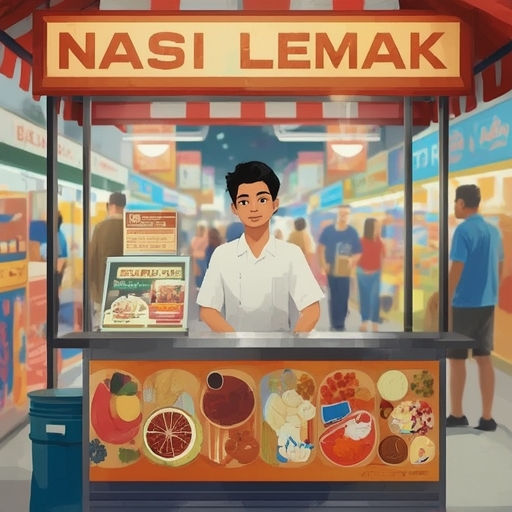
A single bite into the colossal, golden-brown fried chicken leg served at Jonas Koh’s modest food stall was enough to reveal that this young hawker had mastered his craft. The first crunch of the perfectly crisp exterior gave way to tender, succulent meat within, each mouthful carrying a delicate balance of seasoning—spices that enlivened the palate without ever overwhelming it. The chicken, easily the largest I had encountered in all my years exploring Singapore’s renowned hawker scene, was more than just generous in size; it was a symbol of care, precision, and pride. Beside it sat a small dish of vibrant red onion-and-chili sambal, a condiment described by Koh as his most treasured creation. The sambal, simultaneously fiery and slightly sweet, elevated the entire dish to another level of richness, binding every element together with a bold yet harmonious flavor.
“Our chili is what really makes us stand out from the rest,” Koh told me, his tone equal parts confidence and modesty when we spoke during my visit in November. Barely thirty years old, he already possessed the clarity of someone who knew his strengths and how they set his work apart. “Many customers come back not just for the food,” he added with a smile, “but literally to buy our chili on its own.” That statement alone captured the dedication underlying his business—an approach rooted in both flavor innovation and personal identity.
Koh founded The Kumpong Boys in September 2024, planting his stall in the heart of Ang Mo Kio, a tranquil northern neighborhood of Singapore characterized by its long-established residential blocks and steady rhythm of daily life. His culinary focus is the beloved dish nasi lemak, which originated in Malaysia but has since become an indispensable part of Singapore’s own food culture. A plate of nasi lemak traditionally features coconut-infused fragrant rice accompanied by spicy sambal, crispy anchovies, a fried egg, slices of cool cucumber, and of course, fried chicken—the centerpiece that often determines the dish’s success. Koh’s interpretation stays rooted in these fundamentals, but through subtle refinements, he manages to make it distinctly his own.
Although he dutifully completed his parents’ wish for him to earn a business degree, his ambitions clearly lay elsewhere. From the age of seventeen, Koh immersed himself in the demanding world of food and beverage work. He began by bussing tables and waiting on customers before working his way into kitchens and behind bars. Those years of experience in varied roles not only sharpened his technical understanding of service and cooking but also instilled in him a deep respect for hard work and the unpredictable rhythms of the culinary trade.
Now, as a self-employed hawker, he relishes the autonomy of being his own boss, yet he openly admits that not every decision has been ideal. The most significant challenge, he explained, was establishing his stall in a neighborhood where most residents are older and tend to be frugal. Despite the steady foot traffic, Ang Mo Kio’s demographics are not necessarily aligned with his pricing or target audience. Rent affordability was the main reason for his decision—he found a stall at SG$3,700 per month, inclusive of utilities, a rare find in Singapore’s competitive hawker landscape—but soon after setting up shop, he realized that low overhead came with an unintended cost: limited customer spending power.
Operating The Kumpong Boys demands an unrelenting routine. Each morning, Koh arrives by nine to begin the day’s preparation. Together with his single assistant, he cooks the coconut rice, fries eggs to golden perfection, and carefully marinates and seasons chicken before the doors open at ten. The stall closes at eight in the evening, after serving the dinner rush, and this pattern repeats every single day of the week. The tireless heat of the hawker center and the long working hours might deter many, but for Koh, these are small sacrifices. He has never experienced the corporate world’s nine-to-five grind, or the tension of a boss breathing down his neck, and he prefers it that way. “My friends often ask if this kind of work exhausts me,” he said with a short laugh. “But honestly, what keeps me going is passion—nothing else compares to doing something you truly love.”
Still, passion can only partially offset the challenges of maintaining a business in an area where the primary clientele prioritize affordability over experimentation. The older patrons of Ang Mo Kio often expect meals priced under SG$4, which sharply contrasts with Koh’s signature offerings—the berempah set and curry ayam set—priced at SG$6.90. With rising ingredient costs and a commitment to quality, he insists that this is the lowest feasible price point. Surrounding stalls, however, frequently sell simpler dishes for less, leaving Koh feeling that he is waging an uphill battle against both consumer expectations and market economics.
On an average day, he sells between eighty and one hundred plates, though on slower days, that number drops to roughly half. External factors influence business as well. Many elderly residents, being devout Buddhists, adhere to vegetarian diets on the first and fifteenth days of the lunar month, during which sales decline noticeably. He recounted another occasion when a nearby temple distributed free vegetarian meals for ten consecutive days—an act of generosity that inevitably drew potential customers away from his stall.
Reflecting on these struggles, Koh admitted that while Ang Mo Kio provided a practical starting point, it no longer feels like the right fit for his aspirations. “It makes me realize that the type of customer I hope to reach just isn’t here,” he said with quiet candor. “There’s so much potential for what we can do, but to unlock that, we have to move—to find new ground.” He now dreams of relocating to a livelier district, perhaps closer to universities or within the bustling central business district, where younger, more adventurous diners might appreciate his work and be willing to pay for quality.
As he continues refining his recipes and nurturing his business, Koh’s story becomes emblematic of a larger truth about entrepreneurship in Singapore’s competitive food landscape: success is as much about adaptability as it is about culinary skill. He ends our conversation with a moment of vulnerability, confessing that stories of restaurant closures often unsettle him. “When I read about eateries shutting down,” he said softly, “part of me fears that one day my name might appear in those headlines.” His words linger—a reminder that behind every plate of nasi lemak lies not only effort and passion but also the constant balancing act between hope and uncertainty that defines a young entrepreneur’s pursuit of flavor and survival alike.
Sourse: https://www.businessinsider.com/millennial-hawker-food-business-singapore-slow-sales-2025-12


