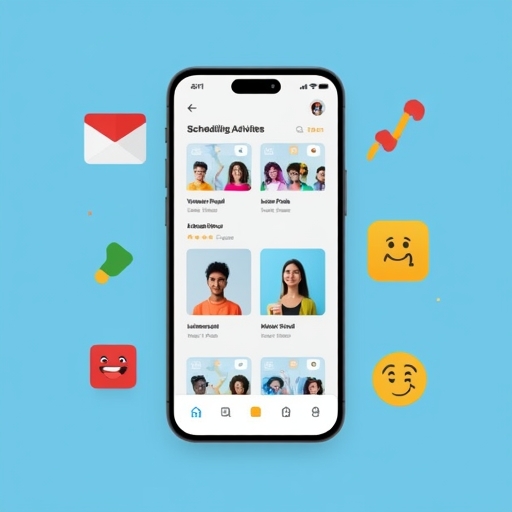
In today’s digital landscape, there seems to be an app for nearly every aspect of modern life. Dating platforms abound, matching individuals across cities and continents, while sleek productivity tools promise to tame the chaos of overflowing inboxes and endless to-do lists. Yet, alongside these familiar categories, an increasing wave of applications aims to foster something more fundamental—human connection—by helping people establish entirely new friendships. While most of these products focus on expanding social circles, *Rodeo* stands out for taking a distinctly different approach. Rather than facilitating the discovery of strangers, this innovative platform relies on artificial intelligence to simplify and elevate the process of planning experiences with the friends you already have.
Rodeo’s concept emerged from the experiences of its co-founders, Sam Levy and Tim MacGougan, both former executives at the popular dating app *Hinge*. Drawing on their background in designing digital tools for interpersonal interaction, they recognized a striking irony: although technology has given people countless ways to communicate, it has not necessarily made it easier to coordinate real-world meetups with those closest to us. Between the relentless pull of demanding work schedules, the unpredictable obligations of parenthood, and the ongoing flurry of messages across dozens of group chats, maintaining friendships can too easily slip down one’s list of priorities. The founders envisioned Rodeo as a kind of antidote to this modern fragmentation—a service designed to transform half-formed conversations and casual ideas into tangible, shared plans.
At its core, Rodeo functions as a dynamic bridge between the scattered digital chatter of everyday life and the concrete logistics required to make socializing actually happen. Its AI-driven engine can process a variety of user-generated inputs—from social media posts announcing new events or restaurant openings to simple screenshots of group messages debating weekend options—and seamlessly convert them into actionable plans. Imagine uploading an image of a movie advertisement spotted on Instagram: within moments, Rodeo identifies nearby theaters, compiles showtimes, and presents how to purchase tickets directly through the app. With a single tap, users can even send personalized invitations to the friends they hope to recruit—charmingly referred to as “wrangling” them into the adventure.
Beyond individual events, Rodeo encourages a more organized and long-term approach to social planning. Users can categorize ideas into curated lists, whether it’s a compilation of go-to restaurants perfect for date nights or a roster of potential group activities—such as a favorite local paintball venue or a beloved hiking trail—that would appeal to old college friends. The collaborative nature of these lists adds another dimension: participants can be invited to contribute their own suggestions, propose new ideas, or refine existing options together. In this way, Rodeo functions not merely as a scheduling assistant but as a shared creative space where social energy is both captured and cultivated.
Interestingly, despite its deep reliance on artificial intelligence, Rodeo’s creators have chosen not to market the app overtly as an “AI product.” In Silicon Valley, where references to large language models and machine learning trends saturate nearly every new tech announcement, Levy and MacGougan appear strikingly restrained. Their approach seems to acknowledge an undercurrent of public sentiment—many Americans, fatigued by the encroachment of AI into sensitive personal interactions, prefer such technology to operate discreetly in the background. Yet, there is no denying that this quiet, almost invisible AI layer is precisely what differentiates Rodeo from a simple collection of productivity tools. After all, anyone with basic digital savvy could manually combine a Gmail account, calendar integration, and shared note-taking app to organize an outing. What Rodeo offers, however, is the removal of friction: it automatically aggregates relevant details—from event descriptions to contact availability—and transforms them into invitations and tasks without requiring manual coordination.
Despite avoiding overt techno-jargon, Rodeo’s founders are not entirely allergic to succinct but evocative metaphors. In an interview with *Business Insider*, Sam Levy described the app as a “second brain” devoted to organizing and optimizing plans with friends and family. This analogy situates Rodeo squarely within the cultural obsession with personal knowledge management and digital organization that has propelled platforms like Notion, Obsidian, and MyMind to immense popularity. By tapping into this same desire for structured efficiency—but channeling it into something emotionally resonant rather than purely professional—Rodeo is positioning itself at the intersection of productivity and social connectivity.
Currently, Rodeo remains in an invite-only beta phase, offering early adopters exclusive access while cultivating anticipation among a broader audience. Interested users can nonetheless download the iOS application and secure a spot on the waiting list. Whether it ultimately becomes the go-to companion for effortless social planning or simply inspires the next wave of AI-assisted personal tools, Rodeo represents an intriguing experiment in how technology can simplify not just how we work, but how we stay meaningfully connected to the people who matter most.
Sourse: https://www.theverge.com/news/850398/rodeo-hinge-social-app-friends


