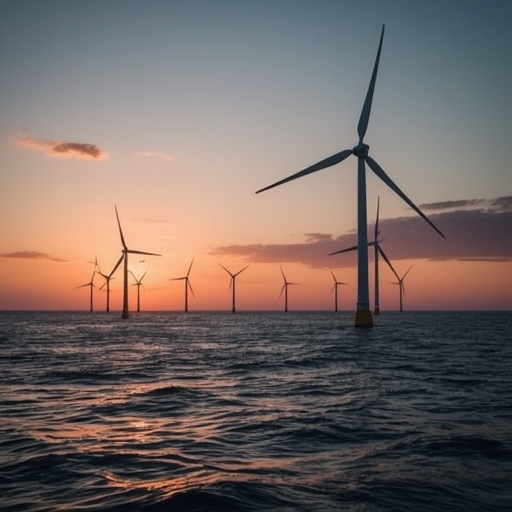
Dominion Energy, a major utility and leading developer in the rapidly expanding field of offshore wind power, has initiated legal proceedings against the Trump administration following its abrupt decision to suspend federal leasing for large-scale offshore wind projects. The company, which supplies electricity to Virginia’s technology-driven “data center alley,” contends that this sudden policy intervention has brought the ongoing construction of five offshore wind farms to an immediate, unanticipated halt. Among those impacted developments is Dominion’s own Coastal Virginia Offshore Wind project—an endeavor projected to become one of the most significant renewable energy installations on the eastern seaboard.
Filed on Tuesday, Dominion’s complaint asserts that the “stop work” directive issued a day earlier by the Bureau of Ocean Energy Management (BOEM) lacks a lawful foundation and must be deemed “arbitrary and capricious.” The lawsuit further claims that the order violates fundamental constitutional checks that limit executive action and was implemented without sufficient justification or due process. Consequently, Dominion is asking a federal court to enjoin BOEM from enforcing the restriction so that construction progress can resume uninterrupted.
According to the company, the administrative freeze not only undermines an extensive regulatory approval process that had already culminated in multiple federal, state, and local authorizations, but also jeopardizes Virginia’s capacity to meet its accelerating electrical needs. “Virginia needs every electron we can get as our demand for electricity doubles,” the company emphasized in its court filings and public statements. Dominion argues that the “sudden and baseless withdrawal of regulatory approvals by government officials” imperils the ability of energy developers to move forward with critical, capital-intensive infrastructure projects essential to sustaining the nation’s fast-growing demand for reliable, clean power.
The necessity of such projects is particularly pronounced in Virginia, which, according to Dominion’s own December 22 press release, contains the world’s largest concentration of operational data centers—a sector that consumes vast amounts of electricity to power the servers and cooling systems underpinning cloud computing and artificial intelligence. The company highlighted that “every electron” generated through renewable sources such as offshore wind will be critical in fueling the digital economy that increasingly defines both the state’s and the nation’s competitive edge in the global AI race.
Experts point out that the current surge in AI development, paired with broader trends in manufacturing growth and the comprehensive electrification of homes and transportation, has placed unprecedented stress on regional and national grids. As power demand rises sharply, so do questions about affordability and access, transforming electricity pricing into a politically charged issue in Virginia’s recent elections and in numerous U.S. communities hosting data center expansions. Dominion warns that any significant delay in the Coastal Virginia Offshore Wind initiative will inevitably inflate costs—a financial burden that will ultimately be borne by ratepayers already contending with higher energy bills.
Named among the defendants in Dominion’s legal filing is Secretary of the Interior Doug Burgum, who publicly defended the administration’s policy decision. Burgum stated that the 90-day pause on new offshore wind leases was instituted to allow federal agencies to review what he described as recently surfaced national security concerns, reportedly based on classified intelligence assessments. The Department of the Interior also cited technical issues, such as potential interference between offshore turbines and radar systems, as factors motivating the temporary suspension.
However, some defense and security professionals have questioned the rationale underlying the pause. Commander Kirk Lippold, a retired U.S. Navy officer best known for leading the USS Cole, expressed skepticism in remarks to the Associated Press, asking pointedly, “What has changed?” Lippold noted that, to his knowledge, no substantial alteration in the national security environment justifies halting offshore wind development—especially given years of prior analysis and interagency coordination designed precisely to manage such concerns.
The current freeze follows a previous pattern of interruptions under the Trump administration. Earlier, construction was halted on two other major East Coast projects—the Revolution Wind installation off Rhode Island’s coast and the Empire Wind project near New York—before federal courts and the BOEM eventually lifted their respective stop-work orders. Yet both were once again suspended as the administration renewed its stance against continued offshore development. President Donald Trump also issued a presidential memorandum in January, shortly after assuming office, which effectively withdrew vast areas of the outer continental shelf from future offshore wind leasing. However, a federal judge overturned that memorandum earlier this month, declaring it similarly “arbitrary and capricious” under administrative law standards.
Dominion asserts that, before the government’s abrupt reversal, the company had already satisfied every necessary legal requirement to advance its Coastal Virginia Offshore Wind project, which broke ground in 2024 following years of environmental review, community consultation, and interagency permitting. By the time the suspension was announced, Dominion had already invested approximately $8.9 billion of the project’s $11.2 billion total cost. The installation, once completed, was expected to begin generating electricity by the following year. At full operational capacity, it is designed to produce an estimated 9.5 million megawatt-hours of carbon-free power annually—an output roughly equivalent to the electricity consumption of about 660,000 average U.S. households.
In sum, the legal confrontation between Dominion Energy and the Trump administration represents a pivotal clash over the future of U.S. renewable power policy. It blends questions of constitutional authority, energy security, and economic modernization, while bearing directly on the pace and feasibility of America’s transition toward cleaner sources of electricity. Whether this judicial battle ultimately accelerates or impedes that transition will depend not only on the court’s ruling but on how the nation chooses to balance immediate political concerns with its long-term commitment to sustainability, technological advancement, and grid reliability.
Sourse: https://www.theverge.com/news/850461/offshore-wind-trump-lawsuit-dominion-energy-ai-data-center


