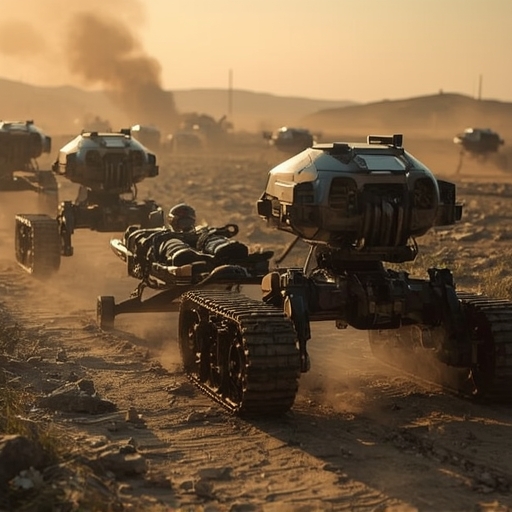
Across the war-torn landscapes of Ukraine, a remarkable technological transformation is unfolding. Autonomous robots are emerging as critical tools for battlefield rescue, serving not only as mechanical extensions of human endurance but also as instruments of survival that minimize danger for soldiers in perilous conditions. These machines—agile, adaptable, and robust—are redefining traditional notions of military logistics and on-the-ground support.
According to the observations of a U.S. veteran who has closely studied these deployments, the path toward maximum battlefield efficiency does not necessarily lie in producing a handful of highly sophisticated, prohibitively expensive robots. Instead, effectiveness arises from assembling a larger fleet of affordable, dependable, and easily replaceable machines. This insight underscores a fundamental shift in philosophy: success in modern warfare and humanitarian assistance may depend more on scalability, resilience, and accessibility than on technological exclusivity.
The logic is simple yet profound. On a chaotic battlefield, where unpredictability reigns, deploying numerous cost-effective robots increases overall adaptability and ensures continuity of operations even when some units fail or sustain damage. By contrast, relying solely on a few premium machines introduces fragility—each loss becomes a costly setback. This distributed approach mirrors trends in broader technological innovation, from cloud computing to swarm robotics, where the collective strength of many simple agents proves more powerful than the isolated brilliance of a few.
Within this evolving landscape, autonomous ground vehicles are assisting medics by transporting the wounded across treacherous terrain, navigating rubble-strewn paths, and operating in regions where human entry would be lethal. Their sensors, guided by artificial intelligence and advanced real-time mapping, can detect obstacles, assess environmental hazards, and adapt to shifting combat zones. Every successful evacuation demonstrates how these systems transform not only tactical operations but also the moral dimension of warfare—preserving human life wherever technology allows.
This approach symbolizes more than a technological advancement; it signals a humanitarian reorientation of warfare itself. The integration of robotics into combat environments shows how innovation can reconcile strategic necessity with ethical responsibility. It suggests a future where saving lives becomes as vital a mission objective as achieving victory. In this vision, the battlefield evolves into a realm where human courage is amplified, not replaced, by machines designed with empathy and purpose.
Ultimately, what is emerging in Ukraine may serve as a model for future conflicts and disaster responses alike. The veteran’s insight captures this trajectory perfectly: the future of combat support—and perhaps of technology-driven rescue at large—will belong not to the few most advanced machines but to the many affordable, intelligent, and tireless ones. In that collective efficiency lies the promise of an unstoppable, compassionate future for technological intervention in human crises.
Sourse: https://www.businessinsider.com/us-veteran-west-must-copy-ukraine-keep-ground-robots-cheap-2025-12


