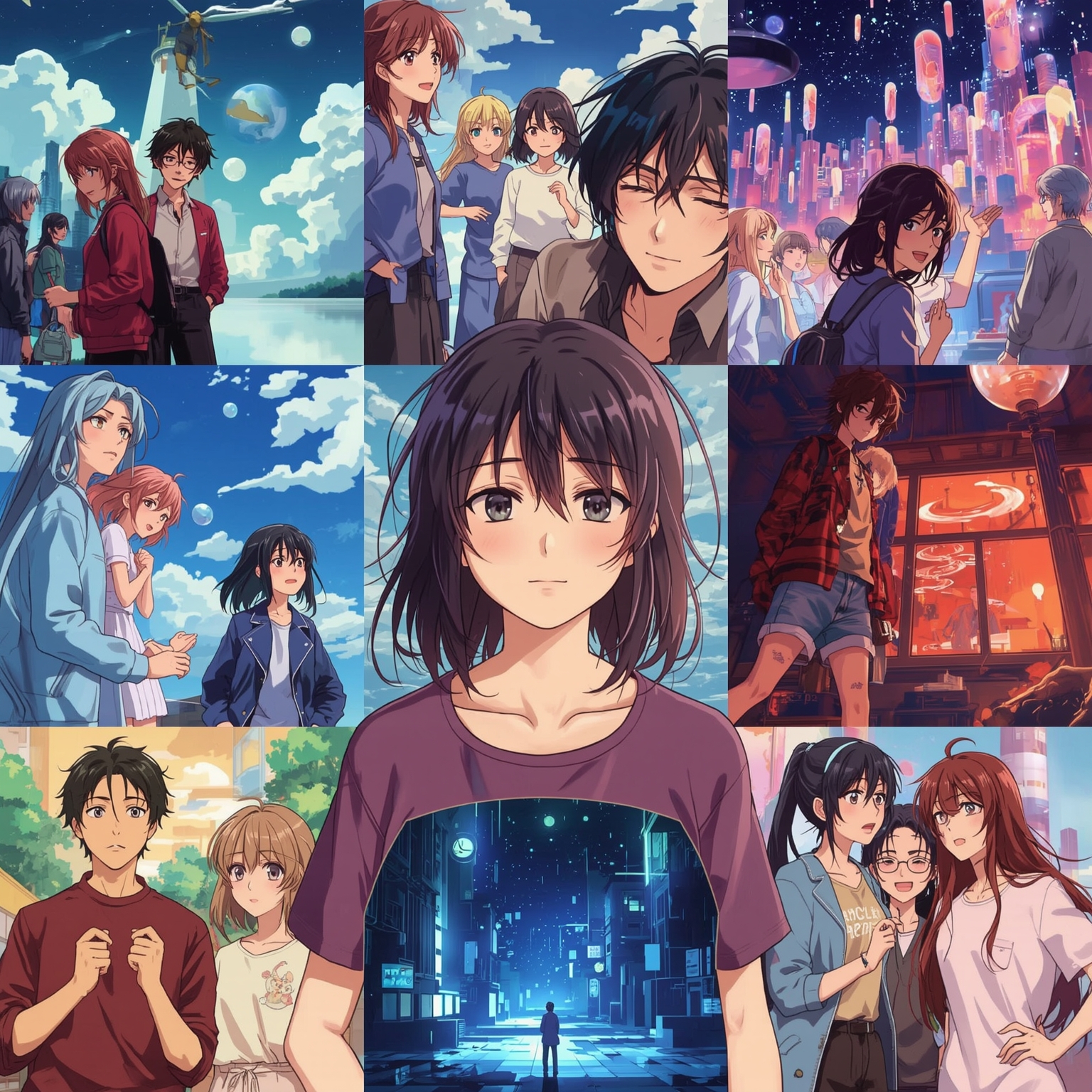
In the current landscape of Japanese animation, anthology projects have become a rarity, nearly a forgotten art form—save for a few exceptional experiments such as *Star Wars: Visions* or the eclectic *Love, Death + Robots*. The once-vibrant tradition of studios joining forces to craft multifaceted compilations has largely faded. There was an era, not all that long ago, when animation houses—each at the peak of its creative prowess—would come together to produce daring, once-in-a-generation collections like *Robot Carnival* and *Memories*, dazzling audiences with their combined artistry, aesthetic bravura, and deep understanding of anime’s singular visual language. Those works reminded viewers that animation, especially Japanese animation, need not imitate live-action cinema, but could itself stand as a sovereign art form—an expressive, imaginative mode of storytelling overflowing with boundless visual poetry and innovation.
Such anthology films didn’t just showcase technical mastery; they also served as launching pads for a lineage of visionary auteurs. Figures such as Mamoru Oshii—whose *Ghost in the Shell* would later redefine cyberpunk aesthetics—Katsuhiro Otomo of *Akira* fame, and Yoshiaki Kawajiri, known for *Wicked City*, *Ninja Scroll*, and *Vampire Hunter D: Bloodlust*, first earned recognition through these experimental collaborations. Their collective influence still reverberates across the animation industry, echoing through decades of visual storytelling. These projects offered cinematic kaleidoscopes of tone and mood: whimsical or tragic, minimalist or extravagant, yet always unmistakably alive. Through them, audiences could experience the full emotional and technical range of anime’s capacity—a reminder that the medium is not an understudy to film but a self-contained stage of infinite expression.
Now, a glimmer of that lost form is stirring again. A new anthology, *Tatsuki Fujimoto 17–26*, has emerged on Prime Video as both a resurrection of tradition and a revelatory portrait of one of manga’s most unpredictable modern storytellers. In 2025, few creators stand as prominently or as passionately adored as Tatsuki Fujimoto—the mercurial mind behind *Chainsaw Man*, whose feverish imagination merges chaos and tenderness in equal measure. Over just a short span of years, Fujimoto’s cinematic sensibility and voracious cinephilia have manifested across multiple mediums. His one-shot *Look Back* was given lavish treatment by Studio Durian, evolving into a poignant feature whose aesthetic ambition rivals the hand-drawn wonder of Studio Ghibli. Meanwhile, *Chainsaw Man – The Movie: Reze Arc*, animated by MAPPA, detonated at the global box office, overflowing with his signature blend of absurdity, romantic sensitivity, and explosive spectacle. Even the first season of *Chainsaw Man* redefined expectations, offering unique ending sequences for each episode and cheekily referencing iconic moments from Hollywood cinema—long before the franchise itself crossed over into film. Simply put, Fujimoto’s career moves with the restless momentum of a filmmaker whose ideas simply refuse containment.
As though winding back the cosmic gears of an artist’s life, Prime Video concluded Fujimoto’s extraordinary creative run that year by unveiling *Tatsuki Fujimoto 17–26*—an anthology that dives into the raw depths of his earliest storytelling impulses. The project unites six animation studios—P.A. Works, Zexcs, Lapin Track, Studio Kafka, 100studio, and Studio Graph77—in adapting eight of Fujimoto’s short manga written between the ages of seventeen and twenty-six, before his breakout series *Fire Punch* introduced him to the world. Despite being bound by a single author’s voice, the anthology never feels repetitive or formulaic. Each vignette emerges as a distinct fragment of Fujimoto’s kaleidoscopic sensibility—a mixture of delirious humor, aching sincerity, and genre anarchy that defies predictability. Rather than producing uniform sketches, these shorts feel like ritualistic exercises in creative chaos, echoes of a restless student of the craft testing every rule of manga and throwing caution to the wind.
Every segment of *Tatsuki Fujimoto 17–26* functions like a painter’s palette overturned on the table—colors spilled freely, emotions bleeding into one another, and the raw energy of invention palpable in every stroke. Within these tales we glimpse the embryonic stages of Fujimoto’s now-legendary range: the ability to leap effortlessly between post-apocalyptic tragedy, slapstick comedy, haunting romance, and existential dread. In *A Couple Clucking Chickens Were Still Kickin’ in the Schoolyard*, the fragile camaraderie between survivors amid ruin anticipates the bittersweet companionships that would later anchor *Chainsaw Man*. *Sasaki Stopped a Bullet* captures the volatile desperation of youthful love, as foolish and magnificent as it is pure. *Love Is Blind* transforms a classic romantic comedy into a surreal cosmic farce. *Shikaku* burrows into the fractured psyche of an assassin consumed by obsession. *Mermaid Rhapsody* submerges viewers in a gentle maritime romance, luminous with poetic melancholy, while *Woke-Up-as-a-Girl Syndrome* playfully interrogates themes of selfhood and gender through a lens both comic and deeply humane. *Nayuta of the Prophecy* sketches the tragic bond between siblings locked in an inexorable destiny, and *Sisters* lingers on the collision of artistry and rivalry between two sisters, capturing the fragile tension between affection and ambition.
Certain stories—most notably *Sisters* and *Nayuta of the Prophecy*—seem almost like creative premonitions of Fujimoto’s later masterpieces. Within them are the emotional templates for *Look Back*, his profoundly empathetic exploration of artistic identity and friendship, as well as conceptual groundwork for *Chainsaw Man Part 2*. Seen together, the anthology’s eight shorts form a radiant mosaic of intertwined themes: artistic striving, love’s fragility, the absurd logic of fate, and the restless humor of youth. What binds them is an unfiltered authenticity—a refusal to separate the grotesque from the tender—and an infectious creative spirit that transforms the outrageous into something acutely human.
Beyond its textual brilliance, *Tatsuki Fujimoto 17–26* also elevates the often-overlooked studios and directors who bring it to life. This ensemble of mostly unheralded production teams invests each episode with heartfelt individuality. Under the guidance of seasoned animators like Kazuaki Terasawa (*The Ancient Magus’ Bride*) for *Woke-Up-as-a-Girl Syndrome*, Tetsuaki Watanabe (*Blue Lock*) for *Mermaid Rhapsody*, and Nobuyuki Takeuchi (*Fireworks*) for *Love Is Blind*, every frame feels meticulously curated, pulsing with kinetic energy and personality. These studios work across stylistic boundaries—shifting between traditional 2D animation, intricate 3D accents, and even bursts of live action—to weave an aesthetic patchwork that feels diverse yet unified. The result is a visual feast where sunlight glows like liquid amber, moments of grief rasp like worn sandpaper, and rapid-fire action flares as if seen through dazzling fireworks. Among these, Osamu Honma’s direction in *Sisters* stands out as a final crescendo: a delicate and heartfelt portrayal of girlhood, sisterly competition, and the bittersweet process of growth.
For all its artistic bravado, Fujimoto’s anthology resists pretension. It rejects the notion that fine animation must justify itself with grand academic theses. Instead, *Tatsuki Fujimoto 17–26* invites audiences to remember the pure, boundless joy of creation—to watch stories not as intellectual puzzles but as spontaneous bursts of playfulness. Through the exaggerated passions of schoolboys who can stop bullets for love, through impossible romances and cosmic absurdities, Fujimoto reflects the unselfconscious sincerity of youth itself. Some stories unfold in brief, fleeting sketches; others take their time, wandering through memory and emotion like scenic detours. Yet together they enchant, coaxing viewers into rediscovering why storytelling—especially in animated form—remains one of art’s most liberating modes of expression.
In the end, *Tatsuki Fujimoto 17–26* is neither a museum exhibition nor a dry academic exercise. It is something much livelier: a spirited call to rediscover the unfiltered wonder that once defined anime anthologies—a celebration of experimentation, humor, and unfettered imagination. It may chronicle the early, uncertain steps of a now-renowned creator, but it also reminds us that great art often begins with the willingness to play. The anthology radiates excitement for creativity itself, embracing the chaos and vulnerability that fuel artistic evolution. Streaming now on Prime Video, it stands as both homage and renewal—a vibrant reaffirmation that animated storytelling, at its purest, still possesses the power to surprise, move, and utterly delight.
Sourse: https://gizmodo.com/tatsuki-fujimoto-17-26-anime-anthology-review-prime-video-2000682427


