From riding Japan’s futuristic bullet trains, where efficiency meets elegance, to trekking with a backpack across the varied landscapes of Europe, I have explored an impressive forty-three countries so far. Throughout these travels, I have always sought to journey by rail whenever the opportunity arose, both for the environmental benefits and for the deeper sense of connection it offers to the terrain and people along the way. However, when I recently paused to review the record of my experiences within the United States, I made an intriguing discovery. Almost every trip within the country had involved rushing from one airport to another, soaring high above most of the landscape I longed to understand — a blur of clouds and cities visible only from a great distance. Realizing how much of the country I had unintentionally overlooked, I resolved to change this pattern entirely. My new travel philosophy became centered around flight-free exploration, with the specific goal of immersing myself in as many states as possible while observing the delicate transitions of the American landscape from ground level.
Amtrak quickly emerged as the ideal medium through which to realize this vision. The extensive network allowed me to traverse immense distances without surrendering the intimacy of slow travel. Within just three months, I had covered more than 4,500 miles, an odyssey that carried me across two nations, seventeen U.S. states, and even through the heart of the nation’s capital, Washington, D.C. These journeys offered me an abundance of discoveries, and several aspects of the experience left lasting impressions.
The first revelation was the simple yet significant comfort of Amtrak’s seat arrangements. On these trains, there are no cramped, undesirable middle seats to contend with. Passengers sit in pairs, an arrangement that subtly transforms the atmosphere from that of a crowded airplane cabin to a more civil, spacious environment. On less busy routes, the luxury of having an entire row to oneself turns the journey into a tranquil retreat. One can stretch out, read, or simply watch the world drift by through large panoramic windows, unbothered by the sense of confinement so familiar to air travel.
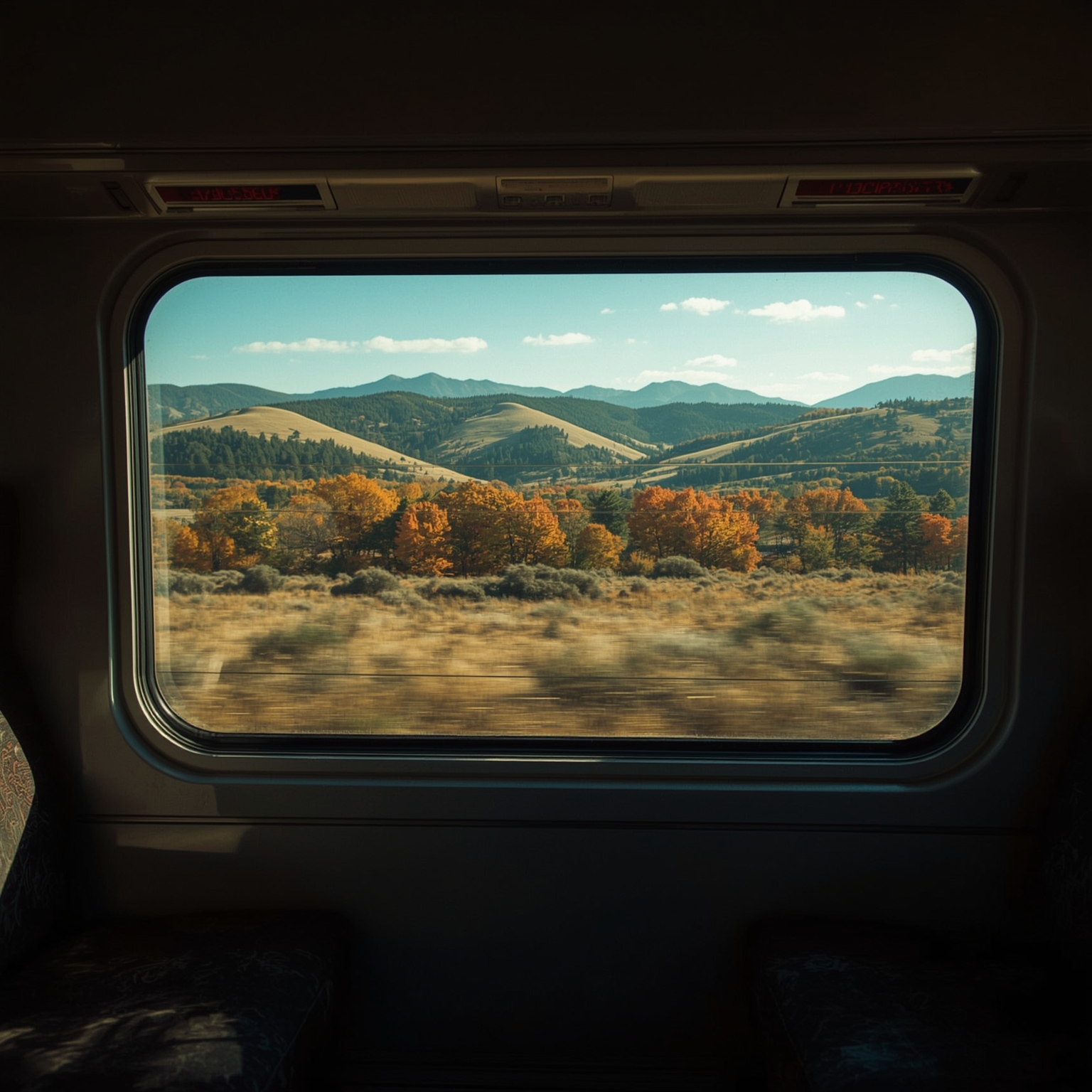
Perhaps my favorite aspect of traveling by train is the opportunity it provides to witness life across different regions of the country in real time. The train’s long, winding routes become moving galleries of human and natural landscapes. Through the wide windows, I have watched the sun bleed into the horizon at dusk, seen shrouds of morning mist unfurl over distant hills, and traced the contours of serene lakeside towns. Every so often, glimpses of ordinary life appear — a family walking their dog along a path parallel to the tracks, a group of friends laughing outside a small-town beer garden, or children pausing their play to wave enthusiastically as the train roars past. These scenes, fleeting yet intimate, reveal the quiet rhythms of communities that might otherwise remain invisible to travelers confined to highways or airports. Inspired by such encounters, I often add new destinations to my ever-expanding travel wish list.
To map these places of intrigue, I prepare a digital itinerary before each journey, creating a personalized Google Map of every station the train will pass through. This evolving chart becomes both a visual guide and a living record. As I notice particularly beautiful views or quaint railroad towns, I place new pins on the map, adding brief notes that serve as reminders for future adventures. This method helps me remain aware not only of where I am going, but also of the rich tapestry of places I am momentarily passing through.
Another delightful surprise has been the social aspect of Amtrak travel. While I enjoy those peaceful times when I have a row to myself, I’ve also come to genuinely appreciate sharing a seat with strangers. Contrary to what many expect, the proximity rarely feels intrusive. I have never opted for one of Amtrak’s private cabins, largely because I value the spontaneity and serendipity of meeting people along the way. Often, what begins as a polite exchange — a greeting or a brief conversation about the route — naturally unfolds into something warmer. By the time the journey ends, my fellow passenger and I may be exchanging snacks, sharing stories of our hometowns, and discussing the curiosities of life on the move. These unplanned interactions remind me that travel, at its best, is not only about observing; it is also about connecting.
Adding another layer of richness to certain journeys is Amtrak’s collaboration with the National Park Service through a program known as Trails and Rails. When routes overlap with protected parklands, volunteers from the National Park Service board the train to offer travelers a deeper understanding of the landscapes unfolding outside their windows. During a recent passage from Washington, D.C. to Chicago, the route cut through West Virginia’s striking New River Gorge National Park. As we glided past dramatic cliffs and vast valleys, our onboard guide narrated the region’s history and natural significance, weaving personal anecdotes of growing up in West Virginia into her stories. Her presence transformed what might have been a simple transit experience into an educational and emotional journey. Through her stories, the land itself seemed to speak. I came to realize that slow travel is enriched not only by scenery, but also by storytelling — the merging of place and human memory that brings geography to life.
Lastly, each train station along the route offers its own distinct charm, revealing yet another layer of America’s diversity. Take Moynihan Train Hall in New York City, for instance — an architectural marvel of light and space, where skylights flood the concourse with sunlight that dances across the marble floors. By contrast, Newark Penn Station in nearby New Jersey evokes another era entirely, its Art Deco details and luminous chandeliers conjuring the timeless glamour of early twentieth-century travel. The intricate metalwork above the doorways glimmers with the craftsmanship of a bygone age. Stepping into such spaces feels like traversing history itself, a reminder that even stationary places can hold as much wonder as the journey between them.
Through these many miles and countless moments, I have come to recognize that traveling by rail offers far more than transportation. It is an immersion — in landscapes, stories, architecture, and the essence of humanity in motion. Whether watching morning light pour over distant fields, listening to a stranger’s tale, or pausing beneath a dome of stained glass in a historic station, the experience reveals the quiet power of slowing down. In trains and tracks, I have rediscovered what it means to truly see not just where I am going, but everything along the way.
Sourse: https://www.businessinsider.com/surprising-things-about-train-travel-from-frequent-amtrak-traveler-2025-10