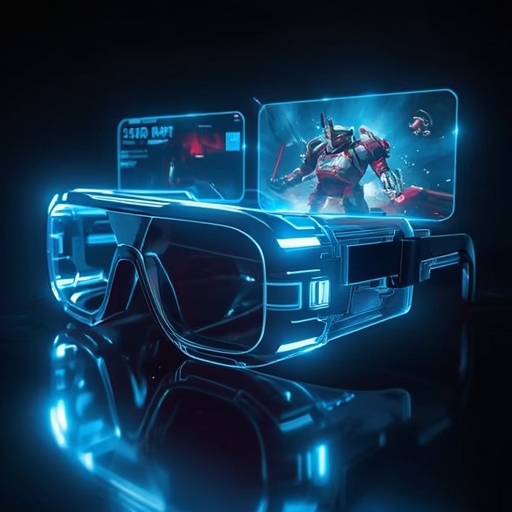
Augmented reality gaming glasses are swiftly transcending the boundaries of science fiction to establish themselves as a tangible and revolutionary step forward in immersive entertainment. Envision engaging in gameplay projected onto an expansive virtual screen that materializes anywhere you choose—whether reclining on your couch, strolling through a park, or traveling on a long flight. This technology represents not just convenience but the profound evolution of digital interaction, fusing the physical and virtual worlds seamlessly into an all-encompassing visual experience.
Having explored the most recent offerings from leading AR manufacturers, I have begun to conceptualize what would constitute the ideal pair of gaming glasses for true enthusiasts. At the core of this vision lies the demand for exceptional precision engineering and flawless design harmony. Such a device must offer instantaneous synchronization with multiple platforms, ensuring that transitions between console, mobile, and cloud gaming remain effortless and uninterrupted. Furthermore, adaptable display quality—capable of automatically adjusting brightness, contrast, and field of view according to environmental lighting—would be indispensable for sustained immersion under any condition.
Comfort and durability represent equally significant priorities. For extended gaming sessions to remain enjoyable, the glasses must be feather-light yet resilient, designed with advanced ergonomic balance to eliminate strain during prolonged use. Imagine lenses engineered with adaptive polymers that contour gently to the user’s face while maintaining optical clarity comparable to high-end virtual reality headsets. Integrating heat dissipation and anti-fogging technology would further refine the physical experience, allowing uninterrupted play regardless of intensity.
Audio fidelity, often overlooked, must reach a level that complements the realism of visual immersion. Spatially aware sound systems embedded within the frames could render multidirectional audio without external accessories, simulating the dynamic depths of in-game environments. Paired with gesture and voice control, users could execute complex commands or navigate interfaces through intuitive and natural interaction rather than mechanical input.
Battery endurance and intelligent power management are non‑negotiable aspects of practicality. The dream AR device should sustain hours of continuous use through hybrid charging—perhaps even through kinetic or solar-assisted technology—to minimize downtime. Equally, privacy and safety features, such as discreet screen opacity modes for public spaces, could ensure that immersion never compromises awareness of one’s surroundings.
Ultimately, the convergence of these nine essential capabilities—ultra-clear adaptive optics, seamless connectivity, ergonomic minimalism, advanced soundstage integration, extended power autonomy, intuitive controls, lightweight resilience, temperature regulation, and context‑aware display intelligence—would culminate in a device that transforms any environment into a personal digital domain. The dream pair of AR gaming glasses symbolizes not simply a tool for play but a pioneering platform for reimagining how humans engage with interactive media. The future of gaming is not confined to a console or display—it is worn, experienced, and lived through the fusion of sophisticated technology and pure imagination.
Sourse: https://www.theverge.com/gadgets/906586/best-ar-glasses-viture-xreal-gaming-steam-deck-switch-2