Having traversed the vast expanse of America’s natural wonders and witnessed every one of the 63 designated national parks, I’ve discovered that a select few stand out not merely for their beauty, but for their ability to transport visitors beyond the familiar boundaries of Earthly landscapes. These extraordinary sites evoke the sensation of venturing onto an alien world — terrains sculpted by time, wind, and incomparable geologic imagination. Consider, for instance, Bryce Canyon National Park, where a surreal array of crimson spires and intricately weathered hoodoos rise like clustered cathedrals under a shimmering atmosphere. Standing amidst these odd and fantastic formations, one might feel as though they’ve wandered into an extraterrestrial amphitheater created by forces both ancient and unknowable.
Death Valley National Park offers a different sort of transcendence — an immense basin of shimmering salt flats, rugged ridges, and echoing canyons painted in burnt ochres and soft violets. This landscape, both severe and sublime, embodies extremes: blistering heat, striking silence, and ethereal horizons that seem to dissolve into the universe itself. It is an environment where the interplay between life and desolation becomes astonishingly poetic, demonstrating not absence but resilience.
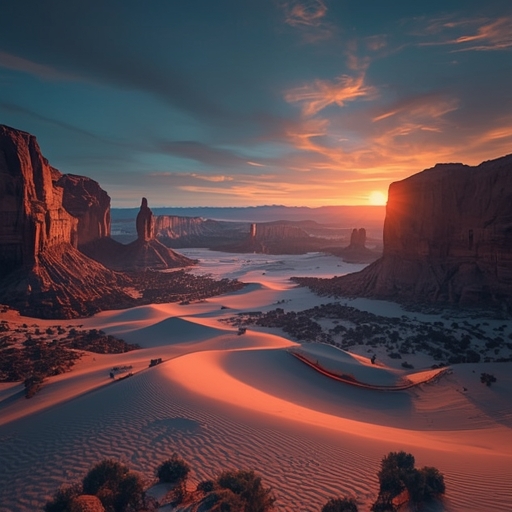
Then there is White Sands National Park, an expanse of alabaster dunes that ripple under the sun like frozen waves. As one walks across its pristine gypsum fields, the world grows quiet, and even the concept of distance seems to blur. The luminous landscape reflects light in such a haunting way that day and twilight feel indistinguishable — as if time itself has slowed to accommodate the profound serenity of the place.
The Badlands, too, evoke this cosmic unfamiliarity. Geological layers fold and crumble into labyrinthine canyons painted in color bands of pink, gray, gold, and rust, bearing silent witness to millions of years of Earth’s history. The wind whispers through the arid terrain, carrying the ancient voice of a planet still in transformation, reminding visitors of both the enormity and fragility of natural creation.
To wander these parks is to encounter not just variation in scenery, but glimpses into what feels like other planets—each with its own language of stone, light, and silence. They compel one to reconsider what it means to belong to Earth at all, revealing how alien—and how profoundly beautiful—our own world can be when experienced through the lens of wonder and humility. Whether you stand before Bryce’s fiery amphitheaters, trek across White Sands’ ghostly dunes, or listen to the voiceless expanse of Death Valley, these places transcend geography. They are invitations to step outside of human scale and into the vast, luminous mystery of nature itself.
Sourse: https://www.businessinsider.com/national-parks-that-feel-like-another-planet-frequent-traveler-2026-4