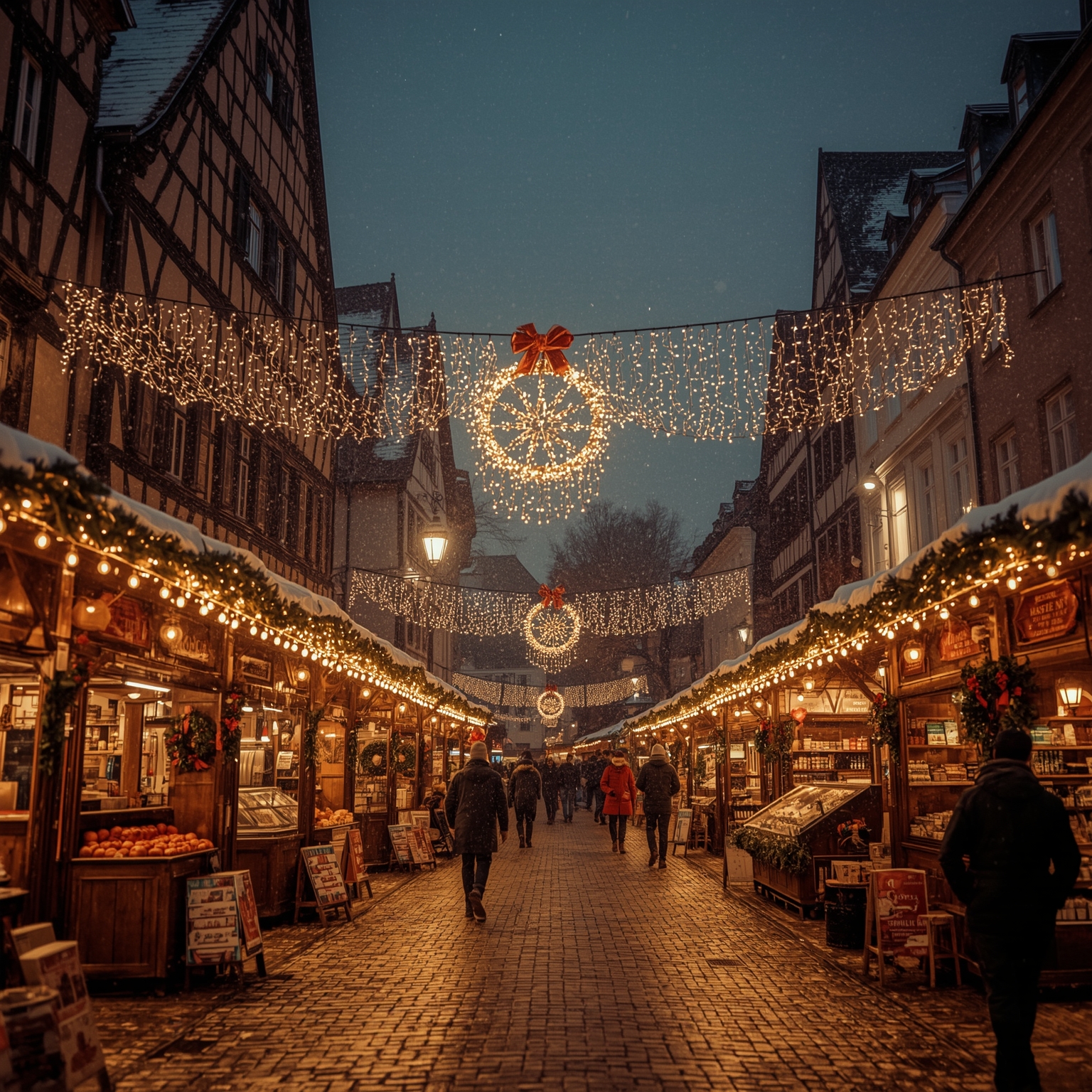
Taking a day trip to Strasbourg, France, during the height of the Christmas season felt like stepping directly into the heart of a winter fairy tale. The journey turned out to be the very embodiment of the festive reverie I had always cherished — a living dream drenched in golden lights, gentle music, and the irresistible scent of cinnamon and roasted chestnuts wafting through the air. Strolling down the famously enchanting Rue du Maroquin — affectionately nicknamed ‘Teddy Bear Street’ — I delighted in every carefully arranged decoration, every half-timbered building adorned with garlands and oversized plush toys, and every glimpse of the city’s centuries-old charm. Next time, though, I intend to pace myself more deliberately — exploring fewer of the bustling Christmas markets and exercising greater restraint in purchasing souvenirs, so I can linger longer in quiet corners and soak up Strasbourg’s tranquil beauty.
Having grown up in India, my understanding of Christmas had been shaped almost entirely by cheerful cinematic depictions — glossy holiday films where snowflakes dance through lamplight, small towns sparkle with fairy lights, and the entire world seems wrapped in a shared moment of warmth and celebration. Back home, festive décor rarely extends beyond brightly adorned shopping centers, and the few Christmas markets that do exist are typically organized at embassies or private clubs, often accompanied by entry fees and modest displays. Thus, my image of a true European Christmas — complete with cobblestone streets dusted in snow and stalls brimming with handcrafted ornaments — long felt like an unattainable fantasy. That distant dream finally took form last winter when, while traveling through Europe, I planned a single, perfect day in Strasbourg — the city known internationally as the ‘Christmas Capital of the World.’ After seeing countless dazzling photos and videos online, I knew I would regret skipping it.
With only a day in the city, my goal was simple yet ambitious: to immerse myself in the Christmas wonderland as deeply as time allowed. Out of all the experiences, there were five highlights that completely lived up to their reputation — and two lessons I resolved to apply next time. The most delightful part, without question, was beginning the morning in Strasbourg’s historic old town, wandering through its cobblestone lanes when the streets were still calm, the crowds had not yet gathered, and the early light illuminated the pastel façades. Arriving early has always been my personal rule when exploring a new city, but in Strasbourg, that practice transformed my visit entirely. From bakeries displaying artistic gingerbread creations to shop windows overflowing with ornaments and ribbon, the entire district shimmered as though competing for the title of ‘most festive street.’
Dominating the skyline, Strasbourg Cathedral stood as the crown jewel of the city. I have always found myself drawn to Gothic architecture — with its soaring arches and intricate stone carvings — and standing beneath this monument before the arrival of the tourist rush felt like quiet reverence. Built gradually between 1015 and 1439, the cathedral’s monumental 466-foot spire still commands awe centuries later. Stepping inside to admire the dimly lit nave and the play of light through stained glass turned out to be as inspiring as viewing its grand exterior — all the more so since entry was entirely free. Just outside, in the lively Place de la Cathédrale, one of the city’s most iconic holiday markets thrived beneath the spire’s shadow, with a small carousel spinning nearby, transforming the entire square into something that seemed lifted from the cover of a storybook postcard.
One of my most unexpected discoveries was the charming Petit Train, a miniature tourist train that winds its way through Strasbourg’s old town. Initially, it was not part of my itinerary — I had planned to continue exploring on foot — but sudden rain altered those plans, offering pleasant serendipity. The small train provided a comfortable vantage point from which to survey major landmarks while an engaging audio guide narrated the city’s complex history. The route conveniently began and ended near the cathedral, which meant I could fit the 45-minute tour neatly into my schedule. It proved to be both informative and restful — a welcome interlude from walking without sacrificing the chance to learn more about the place.
As dusk fell, the city began to shimmer even more intensely, and I made my way to Place Kléber — the heart of Strasbourg’s festive celebrations — to witness the lighting of the renowned Grand Sapin, a towering Christmas tree standing approximately 98 feet high. Surrounded by a lively crowd, I watched as thousands of lights flickered to life in harmony with music, illuminating the plaza in a dazzling spectacle of color. Despite the packed square, I felt no frustration, only gratitude at experiencing this quintessential symbol of Strasbourg’s holiday identity. It was, in many ways, the moment that best summarized the city’s personality — a blend of communal joy, artistry, and unabashed Christmas spirit.
Of course, nothing quite captured the intimate magic of Strasbourg like Rue du Maroquin, the legendary ‘Teddy Bear Street.’ Having seen it countless times online, I was determined to witness it for myself. The afternoon visit revealed its delicate, fairy-tale charm — whimsical teddy bears clinging to façades, soft garlands framing century-old timber structures, and warm daylight reflecting off windows trimmed in gold. Later, I returned after dark, eager to experience its well-known illumination. While the shimmering spectacle was undeniably enchanting, it was also teeming with people, making the narrow lane feel far more frenetic than romantic. In retrospect, I realized the street’s magic was best enjoyed under the gentler light of day, when its intricate details could truly be appreciated without the bustle.
If I could adjust anything about my visit, my first decision would be to resist the urge to explore every single Christmas market. Strasbourg hosts numerous markets scattered across its squares, each with its own character; however, attempting to visit them all within a single day left me weary and short on time for genuine enjoyment. After exploring six different locations, I noticed that some smaller markets began to blend together, their offerings increasingly repetitive. In hindsight, visiting just three — particularly those near the cathedral, Place Broglie, and Place Kléber — would have struck a far more balanced rhythm, capturing the festive essence without the fatigue of constant movement.
The other adjustment would be financial — or at least mindful — discretion regarding souvenirs. Though many stalls displayed exquisite examples of traditional Alsatian craftwork, including hand-painted ornaments, straw stars, delicately embroidered table linens, and carved wooden toys, others sold mass-produced trinkets found across Europe. Realizing that I was paying premium prices for items that lacked authenticity prompted a small but valuable lesson. Instead of spending on generic keepsakes, I now recommend indulging in Strasbourg’s culinary offerings — particularly the warm pretzels at Place Broglie, which turned out to be not only the best snack of my trip but perhaps the most satisfying way to remember the city.
And so, my day in Strasbourg ended just as it had begun — wrapped in wonder, illuminated by twinkling lights, and filled with that subtle, almost ineffable joy that defines the Christmas season. Though brief, the visit fulfilled a long-held dream, offering me a tangible encounter with a world I had only imagined from afar. Next time, I plan to move a little slower, spend a little less, and savor a little more — because, as I learned beneath the glow of Strasbourg’s lamps, the true magic of travel often lies not in how much you see, but in how deeply you experience it.
Sourse: https://www.businessinsider.com/christmas-capital-of-world-things-to-do-strasbourg-france-markets-2025-11