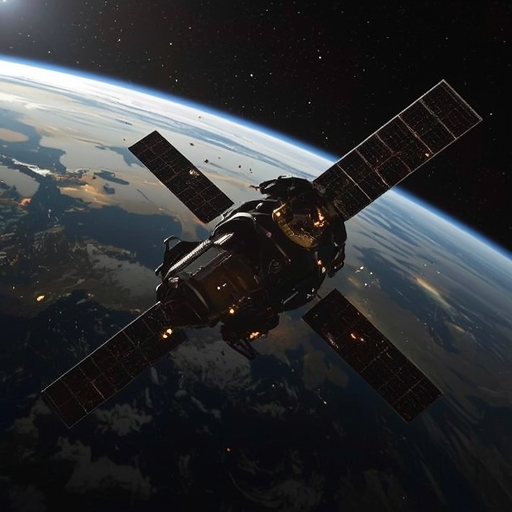
SpaceX has announced that it has lost operational control of one of its Starlink satellites, which is now gradually descending back toward Earth following the occurrence of a significant anomaly. According to the company, the unexpected event led to an abrupt and total loss of communication with the spacecraft, a noticeable and continuing decline in its orbital altitude, and evidence of propellant release from its propulsion system. In addition, sensors and ground-based tracking networks detected the emergence of several small, independently moving objects with comparatively low relative velocity—an observation typically consistent with a partial structural breakup or controlled explosion within the satellite itself. While SpaceX has not yet confirmed the precise cause of the anomaly, these converging indicators strongly imply that a sudden internal malfunction, potentially an explosive event, took place onboard. Despite the apparent severity of the failure, the company has emphasized that the disabled satellite poses no danger to the International Space Station or its crew and is expected to burn up harmlessly as it reenters Earth’s atmosphere within a matter of weeks, leaving no sizable debris capable of reaching the surface.
This technical failure follows closely on the heels of another concerning episode reported just a week earlier, when SpaceX documented a near-collision between one of its operational Starlink satellites and a Chinese spacecraft. Both developments highlight the growing challenges and inherent risks facing operators in near‑Earth space as orbital traffic intensifies. The incident occurred approximately 418 kilometers (260 miles) above the planet’s surface, in a region classified as low Earth orbit—a dynamic and increasingly congested altitude band where more than 24,000 trackable objects, including active satellites as well as fragments of discarded upper stages and other debris, currently circulate. Each additional malfunction or unplanned fragmentation event adds to this complex orbital environment, where even tiny pieces of debris traveling at high velocity can threaten the structural integrity of other spacecraft.
Experts warn that by the end of the current decade, projections suggest as many as 70,000 satellites could be operating within this same orbital range. The vast majority of them are expected to serve as components of large-scale space‑based internet constellations, such as Starlink, along with similar initiatives being advanced by both private companies and government agencies across the United States, China, and Europe. While these constellations promise to revolutionize global communications by extending high‑speed internet access to remote regions, their growing density also introduces mounting complications. Astronomers have voiced concerns that the brightness of these satellites interferes with ground‑based observations, while orbital safety experts caution that the risk of collisions rises exponentially as more spacecraft share limited orbital corridors. In the worst‑case scenario, such collisions could trigger a cascading chain reaction, known as the Kessler syndrome, wherein debris from one impact generates further impacts—potentially rendering segments of low Earth orbit increasingly hazardous for both current and future missions.
Sourse: https://www.theverge.com/news/847891/a-starlink-satellite-seems-to-have-exploded