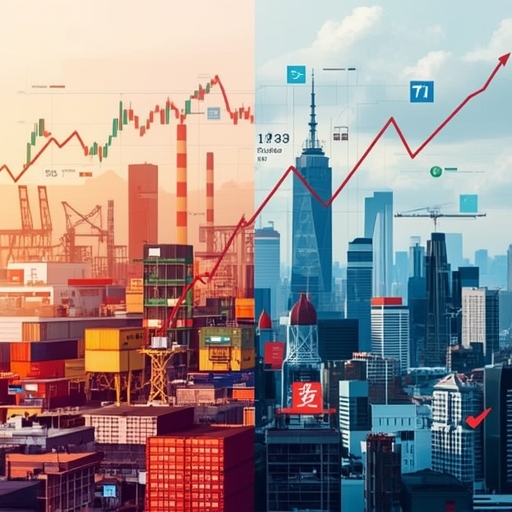
China’s stock market is currently experiencing a pronounced and somewhat paradoxical transformation, unfolding in the form of a two-speed economy that vividly reflects the country’s evolving role in global trade. On one side of this divide, industrial exporters — companies that manufacture and supply goods to international markets — are enjoying an impressive resurgence. Their growth has been driven by a confluence of favorable factors: strong overseas demand, resilient global supply chains, and supportive industrial policies promoting manufacturing excellence. These firms, ranging from high-tech component producers to large-scale machinery and equipment manufacturers, are capitalizing on the renewed emphasis placed by global partners on diversified and dependable production networks.
In sharp contrast, consumer-facing sectors, including retail, tourism, and domestic services, are grappling with persistent challenges. Sluggish household spending, lingering uncertainties about income stability, and cautious sentiment among urban consumers have collectively weighed on these industries. Despite tentative policy support intended to boost consumption, structural headwinds — such as a slow property recovery and shifting demographics — continue to dampen domestic confidence. This divergence has resulted in two vastly different trajectories within the same market: one propelled by international momentum, the other constrained by domestic fatigue.
For investors, this dual-speed dynamic has profound implications. Market participants are increasingly shifting their capital allocations toward companies and industries embedded within the global production ecosystem, such as exporters of industrial components, green technologies, and electronic goods, while scaling back exposure to sectors reliant on internal demand. The current environment thereby rewards strategic flexibility and an informed appreciation of global value-chain interdependencies. Rather than viewing China as a monolithic economy, sophisticated investors are now compelled to recognize its internal asymmetry — a system in which manufacturing strength and consumer weakness coexist, each telling a different story about China’s ongoing economic recalibration.
In essence, China’s equity landscape today offers a nuanced narrative of adaptation and divergence. Industrial exporters have emerged as the protagonists of resilience and renewal, while consumer-focused enterprises remain caught in a cycle of recovery and restraint. Together, these contrasting forces are redrawing the investment map, defining not only short-term opportunities but also the deeper structural shifts shaping China’s path in the global economy.
Sourse: https://www.bloomberg.com/news/articles/2026-01-25/a-tale-of-two-economies-is-reshaping-china-s-stock-market