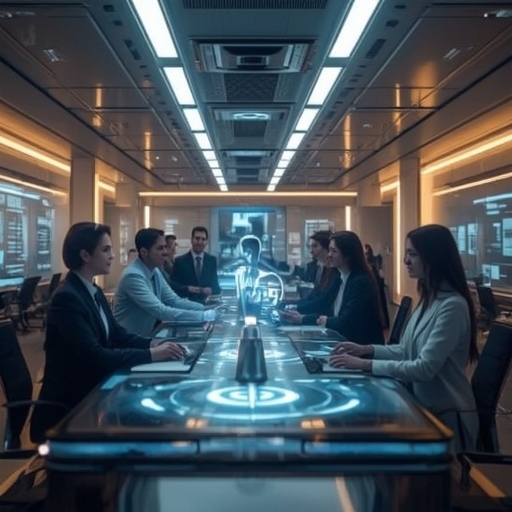
In the rapidly evolving landscape of technology and industry, artificial intelligence and robotics are not forces of replacement but rather catalysts of empowerment for the human workforce. Contrary to popular fears of mass automation leading to wide‑scale job loss, advances in machine learning and autonomous systems are, in many cases, unlocking a new era of collaboration and productivity. When automation excels at repetitive, precision‑based tasks, it liberates human talent to focus on creativity, problem‑solving, and strategic innovation—the very qualities that define human ingenuity.
This growing partnership between intelligent machines and people is redefining the essence of work itself. As organizations like Tesla demonstrate, increased productivity through automation does not signal a shrinking workforce but rather an expanding mission that invites more skilled individuals to contribute. Each technological stride enhances efficiency, allowing more complex goals to be pursued, from scaling sustainable manufacturing to advancing the frontiers of clean energy and beyond. The human contribution becomes not diminished but magnified, as workers engage more deeply in roles that demand emotional intelligence, ethical reasoning, and visionary thinking—dimensions that no algorithm can authentically replicate.
Moreover, this symbiosis between humans and robotics underscores an emerging paradigm of interconnected growth. The tools and systems powered by AI become extensions of human capability—amplifying accuracy, accelerating output, and providing insights that would otherwise remain hidden within vast data landscapes. For example, automated analytics can identify production inefficiencies within seconds, enabling engineers to devise creative improvements in real time. Such cooperation exemplifies how technology can elevate rather than erase human contribution.
The future of work, therefore, is not a contest between humans and machines but a partnership shaped by mutual reinforcement. With each leap in technological sophistication, a corresponding opportunity arises for people to rethink their purpose, reskill, and engage in higher‑order innovation. This dynamic interplay marks the dawn of a new industrial evolution—one where progress is not defined by the displacement of workers, but by the harmonized potential of human intellect and machine precision working in concert toward shared ambitions. In this vision, the path forward belongs to collaboration, creativity, and the relentless pursuit of collective advancement.
Sourse: https://www.businessinsider.com/elon-musk-tesla-headcount-to-increase-ai-robotics-productivty-2026-3