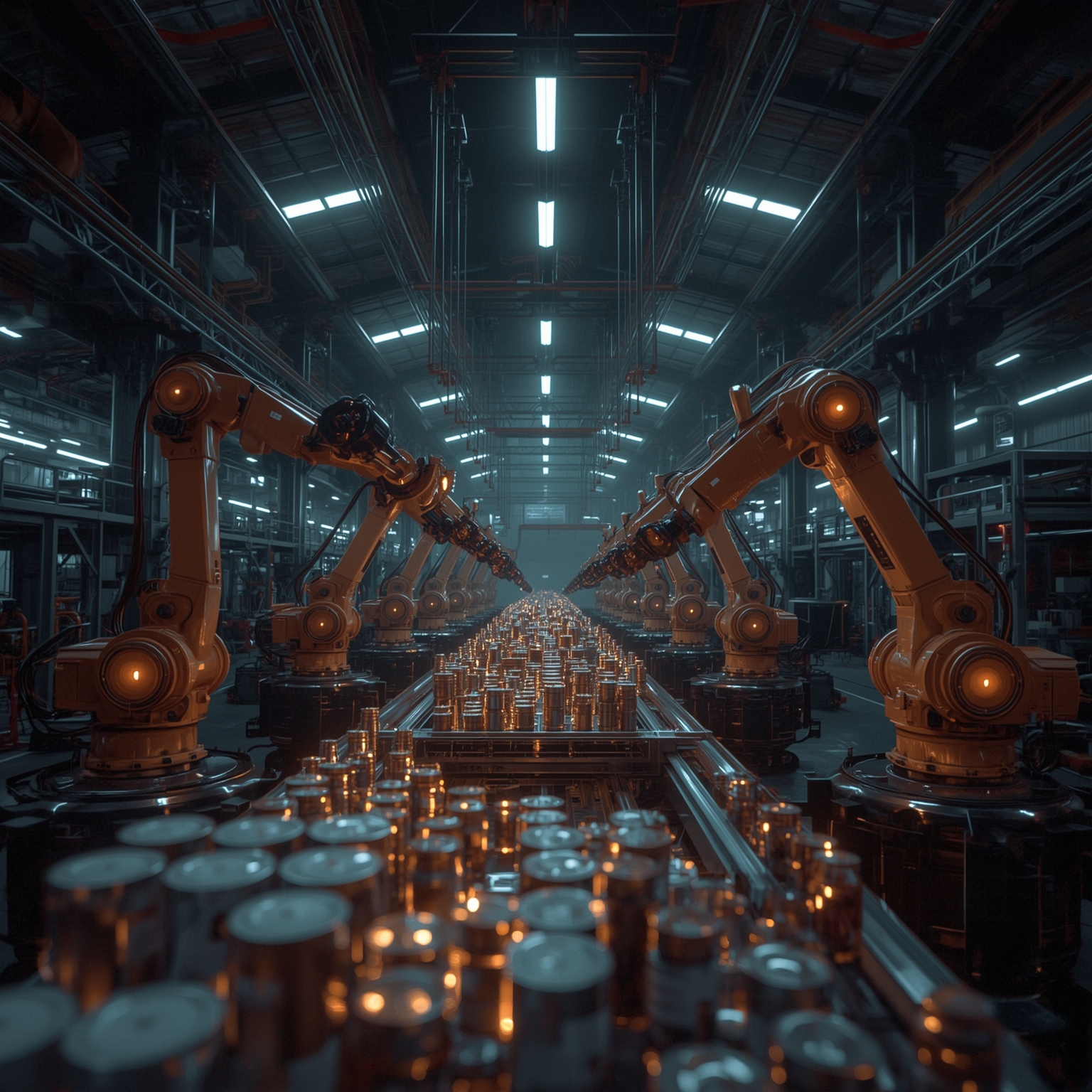
The accelerating consumer demand for Bausch + Lomb’s daily disposable contact lenses, which have gained significant traction in the vision-care market, created a formidable challenge for the company’s large-scale manufacturing operations. The sudden surge in popularity placed extraordinary pressure on existing facilities, compelling the organization to quickly expand production capabilities across two major sites—one located in Ireland and another in New York. Without this strategic and rapid scaling of capacity, the company would not have been able to meet the growing appetite of consumers who increasingly prefer the convenience and hygiene benefits of single-use contact lenses.
This dramatic escalation in manufacturing volume not only required physical expansion but also drove Brent Saunders, Bausch + Lomb’s CEO, to embrace advanced technological solutions. Among these was a next-generation artificial intelligence system that assists factory-floor employees in a variety of critical functions, including monitoring machinery health, conducting diagnostic tests, and identifying mechanical failures before they disrupt production. The AI platform, branded as **Atlas** and developed by Arena AI, functions as a predictive maintenance tool. Its primary purpose is to foresee potential malfunctions in industrial equipment, issue proactive alerts to skilled maintenance teams, and thereby reduce costly downtime by ensuring problems are resolved before they escalate into full-blown disruptions.
Saunders explained that initial trials of Atlas were conducted at the company’s Rochester facility in 2023. Following these successful pilot tests, the system was integrated into three new contact-lens production lines the following year. The impact was immediate and measurable: millions of additional lenses were manufactured that otherwise would have been unattainable with traditional methods. As Saunders shared with *Business Insider*, Atlas is not merely an efficiency enhancer but a transformative enabler of production capacity at a critical moment for the company.
Bausch + Lomb’s move aligns with a broader trend across the global manufacturing sector. According to a survey conducted by KPMG in July, which gathered insights from 183 business leaders responsible for artificial intelligence strategies across eight countries, approximately 77% of manufacturers intend to increase their investments in AI technologies within the next twelve months. This growing commitment is evident not only in large, established corporations but also in smaller, agile startups that are embedding AI capabilities directly into their newly built facilities. Examples of such companies include personalized beauty brand Prose, pet food innovator Spot & Tango, and sustainable energy-storage producer FranklinWH—all of which have integrated AI and automation into their operations in order to refine supply chains, streamline production processes, and ensure consistent product quality.
Take, for instance, Spot & Tango, a rapidly expanding startup specializing in healthy and customized dog food. Its chief operating officer and cofounder, Dylan Munro, stated that the company embarked on building its inaugural manufacturing facility near Allentown, Pennsylvania, in late 2022. The motivation was clear: by moving production in-house, Spot & Tango could exercise greater control over the nutritional integrity and quality of its dog food products. In the early stages, however, the production process was heavily labor-intensive. Employees had to manually coordinate raw ingredients with multiple suppliers, carefully schedule production runs in accordance with ingredient availability, and arrange for logistics such as the booking of trucks to transport finished goods to retailers or directly to consumers.
AI fundamentally altered this landscape. With the implementation of advanced tools, Spot & Tango succeeded in expanding production volumes substantially without the parallel requirement of expanding its workforce. Munro explained that the company began experimenting with an AI-driven platform designed by Didero, a startup specializing in supply chain automation. This agentic AI system was capable of autonomously logging purchase orders, verifying them with suppliers, and producing adaptive production schedules based on the real-time availability of essential ingredients. Human logistics personnel retained oversight, supervising the AI’s recommendations and ensuring accuracy, but the system effectively relieved employees of much of the repetitive administrative burden.
The rollout was carefully managed. A select group of employees first tested Didero’s AI system in genuine procurement scenarios over a three-month period. Only after this successful pilot phase did the startup deploy the system at scale. Today, the platform reliably automates nearly 60% of purchase orders for the company, representing a substantial reduction in manual labor and an efficiency enhancement that was previously unattainable.
Meanwhile, in the energy storage sector, FranklinWH Energy Storage—a provider of home batteries that serve as backup power sources during outages—introduced AI capabilities into its California-based facility, which opened earlier this year. According to Vincent Ambrose, the company’s COO, AI applications extend beyond customer service, offering benefits within the production process itself. One particularly transformative implementation is an AI-powered visual inspection system. Using a network of cameras, the system scrutinizes the production of lithium iron phosphate home batteries with precision that exceeds human capability. While workers once performed this painstaking inspection manually, the AI is capable of learning from continuous flows of production data, allowing it not only to identify quality defects in real time but also to predict and preempt future problems before they interrupt production cycles. Although FranklinWH also operates in Asia without AI integration, Ambrose indicated that knowledge gained from the U.S. facility could influence upgrades abroad in the future.
AI’s promise is not confined to energy and pet food. In the beauty industry, Prose, a company crafting highly individualized shampoos and moisturizers tailored to consumers through hair-care surveys, has likewise experienced a transformation. CEO and cofounder Arnaud Plas described how, when the company was first launched in 2017, its factory workers participated in largely manual processes, such as hand-assembly of bottles. This reliance on manual labor inflated costs by approximately $5 per unit, which was an obstacle for a startup emphasizing customized, premium products. The introduction of autonomous robotics that now handle the precise mixing of formulas and the automated filling of bottles changed the economic equation dramatically. Plas explained the company’s objective: to reduce incremental production costs from $5 down to less than $1. By 2024, that target was thoroughly achieved.
Multiple innovations contributed to this outcome. Beyond robotics, Prose deployed approximately 200 sophisticated algorithms created by its internal team of data scientists and machine-learning experts. These algorithms guide various aspects of the manufacturing lifecycle: from demand forecasting to ensuring machinery undergoes predictive maintenance, from optimizing formula composition to structuring production schedules that minimize downtime related to cleaning and reconfiguration. A second facility in California, inaugurated in June, further expanded these capabilities, consolidating AI and automation into 90% of Prose’s production lines—a testament to the scalability of such technologies in consumer goods manufacturing.
Yet, despite these compelling advancements, industry leaders remain cautious in their adoption strategies. Munro of Spot & Tango acknowledged that while AI solutions hold immense promise, they are not without potential pitfalls. Some vendor proposals, he noted, have encountered unforeseen technical limitations or slower-than-anticipated uptake by employees who must adapt to new workflows. His philosophy is one of measured skepticism: the company is eager to innovate but determined not to rush implementation until solutions are rigorously validated.
This cautious optimism captures the current state of AI in modern manufacturing. On one hand, technologies such as predictive maintenance, automated procurement, and robotic production offer companies the ability to scale production, reduce costs, and heighten quality control. On the other hand, leaders recognize that not every AI application will deliver as advertised, and careful oversight is essential to ensure that adoption truly enhances efficiency rather than introducing new complications. What emerges is a landscape in which artificial intelligence is steadily transforming factories into smarter, more adaptive production environments, paving the way for an era of manufacturing characterized not merely by speed but by intelligence, foresight, and resilience.
Sourse: https://www.businessinsider.com/automated-robotics-ai-algorithms-boost-manufacturing-in-new-factories-2025-9