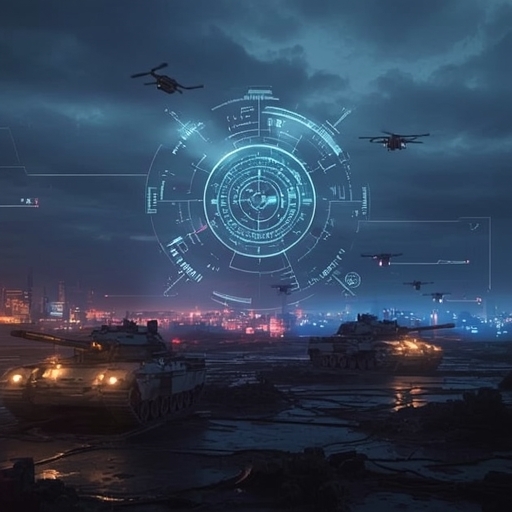
Artificial intelligence is no longer a distant or futuristic concept confined to the speculative imaginings of strategists — it has decisively entered the realm of modern warfare, transforming how conflicts are planned, executed, and resolved. What was once envisioned as a theoretical possibility has become an operational reality, as militaries around the world actively integrate AI technologies into their defense infrastructures, weapon systems, and decision-making processes. This technological revolution is unfolding at an unprecedented pace, redrawing long-established boundaries between human and machine capabilities, and forcing governments, defense agencies, and policymakers to reassess what constitutes power and security in the twenty-first century.
From autonomous drones capable of independent navigation and target selection to algorithmic warfare platforms that process data faster than any human command center ever could, artificial intelligence is reshaping not only battle tactics but also the strategic foundations that underpin global geopolitical stability. These systems operate across domains — air, land, sea, cyberspace, and even the electromagnetic spectrum — seamlessly analyzing vast streams of information to generate insights and recommendations in real time. For instance, AI-driven situational awareness tools can transform ambiguous satellite imagery into actionable intelligence within seconds, enabling militaries to outmaneuver adversaries before a single shot is fired. Similarly, predictive maintenance algorithms ensure that fleets, weaponry, and robotic units function at peak efficiency, reducing downtime and increasing operational readiness.
However, as much as these innovations expand the possibilities of defense and deterrence, they simultaneously introduce a host of ethical, legal, and societal dilemmas. The increasing autonomy of lethal systems raises urgent questions about accountability: when an AI-controlled drone makes a fatal error, who bears responsibility — the programmer, the operator, or the machine itself? Moreover, the opaque nature of algorithmic decision-making challenges traditional notions of transparency and moral judgment in warfare. Nations must now navigate a complex landscape where the race for technological superiority may outpace the creation of international norms and treaties designed to restrain misuse or unintended escalation.
Beyond ethics, the geopolitical ramifications of AI-driven militarization are equally profound. The nations that master algorithmic warfare will not merely gain tactical advantages; they will redefine global power dynamics, potentially shifting the balance of influence and deterrence that has governed world affairs since the dawn of the nuclear age. Smaller states, equipped with advanced machine-learning models and autonomous systems, could, in theory, challenge the dominance of established superpowers, while alliances may evolve based on shared technological priorities rather than geographic or ideological proximity.
Yet amidst the strategic complexity and potential peril, there also lies opportunity. Artificial intelligence offers tools for enhanced defense precision, improved humanitarian response in post-conflict zones, and the prevention of collateral damage through more accurate targeting and data-driven risk assessment. By embracing rigorous ethical frameworks, transparent oversight, and international collaboration, societies can shape the evolution of AI in warfare toward increased stability and reduced harm rather than greater chaos.
Today’s battlefield, therefore, is no longer merely a physical territory marked by trenches, tanks, and troops — it extends into the digital realm, where data, algorithms, and neural networks play decisive roles alongside human strategy. The story of AI and warfare is still being written, but what is already certain is that the integration of intelligent systems into military affairs marks one of the most transformative turning points in modern history. The critical task before us is to ensure that as artificial intelligence continues to enhance the capabilities of nations, it also remains firmly grounded in human values, oversight, and responsibility.
Sourse: https://www.bloomberg.com/news/videos/2026-03-27/bloomberg-tech-asia-3-27-2026-video