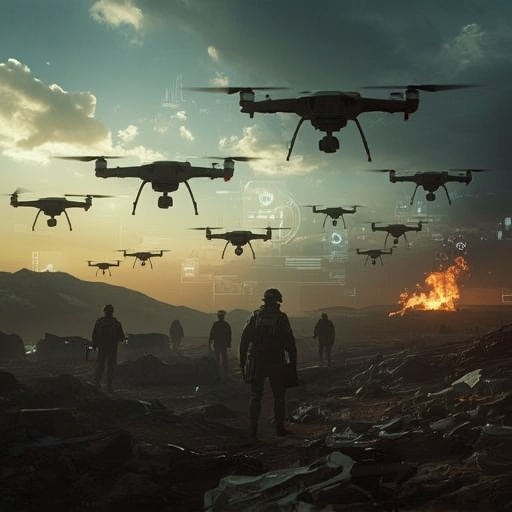
Across the modern theater of war, a dramatic evolution is unfolding—one that is both technologically astonishing and strategically unsettling. Recent intelligence from the CIA sheds light on this transformation: the rapid development and deployment of artificial‑intelligence‑driven drones have begun to redefine how conflicts are fought and how survival itself is measured. Where entire battles once stretched over days or weeks, combat survival can now be calculated in minutes. This acceleration underscores a sobering truth: the rules of engagement, and even the concept of human presence on the battlefield, are being rewritten by machines capable of autonomous decision‑making and precision execution.
These AI‑powered drones, designed to identify, track, and attack with minimal human input, represent far more than a technological innovation—they are a convergence point between algorithmic intelligence and military strategy. On the frontlines of Ukraine and similar conflict zones, they serve as both scouts and strike units, merging surveillance with lethality in a way no traditional weapon ever has. Their capacity to analyze vast streams of data instantaneously allows armed forces to predict movements, target infrastructure, and respond to changing conditions with unprecedented speed. Yet such capability comes at a moral cost: every advance in efficiency amplifies the urgency of addressing questions of accountability, human oversight, and the potential loss of ethical restraint during combat operations.
For defense organizations and policymakers worldwide, this growing dominance of AI‑enabled warfare is a resounding call to action. It demands not just technical adaptation but a complete re‑examination of doctrines that govern armed conflict. Nations must now invest not only in research and innovation but also in frameworks that ensure transparency, equitable development, and adherence to international humanitarian law. Strategic thinkers speak increasingly of a future in which deterrence is defined not by troop strength or nuclear capacity, but by an ecosystem of intelligent machines learning and reacting in real time. To neglect this shift would be to risk obsolescence on the geopolitical stage.
Equally pressing is the ethical dimension. As the lines between human judgment and artificial cognition blur, societies must ask whether delegating life‑and‑death decisions to code is ever justifiable. The integration of AI into lethal force introduces dilemmas that cannot be solved solely through engineering. What safeguards prevent an automated system from misclassifying a target or perpetuating unintended harm? How does one encode compassion, discretion, or the understanding of proportionality into lines of statistical reasoning? These questions linger at the heart of the debate, reminding us that progress without principle may lead to outcomes no algorithm can remedy.
At the intersection of technology and defense, opportunity coexists with peril. The organizations that succeed in navigating this volatile terrain will be those that treat innovation as a responsibility, not merely an advantage. Harnessing artificial intelligence for defense must therefore go hand‑in‑hand with cultivating moral intelligence within leadership—ensuring that in the race for supremacy, humanity itself is not left behind. The world now stands at a pivotal juncture: the dawn of AI‑defined warfare is not just changing how battles are fought, but challenging what it means to be human in the act of war.
Sourse: https://www.businessinsider.com/russian-troops-life-expectancy-battle-minutes-john-ratcliffe-ukraine-2026-7