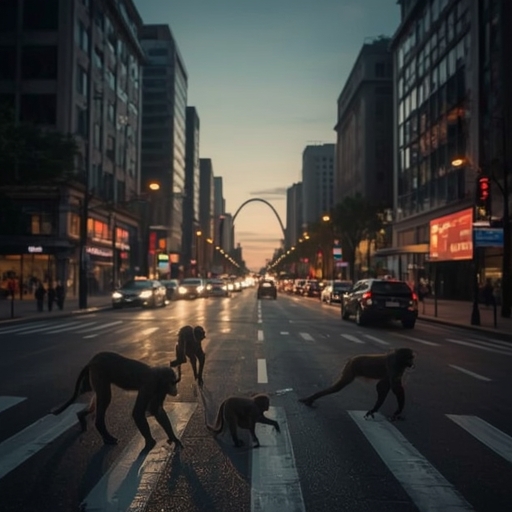
In recent days, the city of St. Louis has found itself at the center of a truly bewildering story that intertwines the tangible world with the realm of advanced technology. Reports began circulating online, accompanied by a flood of compelling images, depicting what appeared to be a lively group of monkeys roaming the residential streets and parks of the city. Yet as the story gained traction, the line between fact and fabrication became increasingly obscure, leading both residents and officials to question what was truly unfolding around them.
The origin of the confusion can be traced to highly convincing AI-generated images, created with astonishing realism, that portrayed groups of monkeys interacting against familiar St. Louis backdrops—swinging from lampposts, lounging near fountains, or perching atop parked cars. For many viewers scrolling through social media feeds, the photos seemed authentic at first glance. Some individuals even claimed to have glimpsed the animals in person, further fueling the sense of uncertainty. However, after numerous local investigations, no verifiable evidence of actual monkeys was discovered. Authorities confirmed that animal control units and police patrols had found nothing to substantiate the extraordinary claims.
This unusual incident offers a striking illustration of how rapidly evolving artificial intelligence technologies, especially generative image models, can blur the boundary between reality and digital invention. Just as manipulated photographs once challenged perceptions of authenticity, AI-crafted imagery now possesses an even greater power to deceive the untrained eye by capturing minute visual details such as lighting, texture, and natural movement. The incident has ignited public conversation about our collective vulnerability to misinformation, particularly when it arrives in visually persuasive forms that mimic the truth almost perfectly.
For residents of St. Louis, the “monkey gang” mystery proved both amusing and unsettling—a modern urban legend born of machine learning rather than mischief of nature. While the streets remained monkey-free, the digital jungle thrived: online debates erupted, memes multiplied, and experts weighed in on the need for critical media literacy in the age of synthetic content. This episode serves as a compelling reminder that as technology advances, so too must our discernment. The event has essentially become a local parable about how reality, perception, and innovation can converge to create confusion that feels entirely real.
Ultimately, the St. Louis monkey saga may have begun as a fleeting internet sensation, yet it leaves behind a valuable insight into twenty-first-century life. The more realistic our digital creations become, the more necessary it is for communities, journalists, and everyday citizens to question, verify, and understand the sources of their information. What once could be dismissed as a simple prank now reveals the profound cultural challenges of distinguishing human authenticity from the artistry of algorithms. As the dust settles, one undeniable truth remains—artificial intelligence, while remarkable in capability, compels us to rethink the very definition of what we consider real.
Sourse: https://gizmodo.com/ai-images-create-confusion-as-real-gang-of-monkeys-roams-st-louis-2000709419