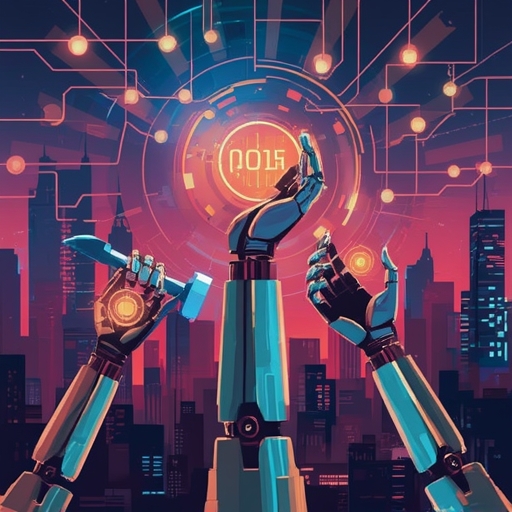
Palantir’s CEO, Alex Karp, has put forward an intriguing and somewhat provocative idea: that artificial intelligence could dramatically alter the long-standing dynamics of social and economic power. In his view, the progression of AI technologies may initiate a profound realignment by transferring influence away from traditional elites — those who historically derived their authority from specialized education, institutional access, or professional pedigree — and placing it more firmly in the hands of everyday workers.
This vision suggests that AI, frequently perceived as a tool of automation and control, might serve instead as an unexpected equalizer. By amplifying the capabilities of individuals across industries, AI could enable those who were previously excluded from high-impact decision-making to participate more directly in shaping outcomes. For example, imagine entire sectors where the combined efficiency of human skill and intelligent systems allows workers to contribute at levels once reserved for managers, strategists, or technical experts. Such changes could recalibrate how societies assign value to different kinds of labor.
If this trajectory unfolds, the political and economic order could experience a reshuffling unlike any seen since the industrial revolution. The concentration of technical expertise in small, elite circles might gradually diminish as intuitive and accessible AI tools democratize sophisticated reasoning, data analysis, and production processes. The working class, often bound by the constraints of time, training, and resources, could find itself newly empowered to innovate, negotiate, and compete. In turn, this shift may push established elites — academic, bureaucratic, and corporate — to share or redefine their authority in response to an increasingly capable workforce.
However, alongside this optimism runs an undercurrent of uncertainty. AI’s transformative potential cuts both ways: while it promises empowerment, it also carries risks of inequality, displacement, and systemic dependency. Karp’s statement therefore invites a deeper debate about whether technological advancement inherently brings balance or whether it simply reshapes the contours of power under new terms.
As AI continues to weave itself into the fabric of daily life and economic production, questions multiply. Could this technology genuinely serve as a social leveler, dismantling hierarchies that have persisted for centuries? Or will it evolve into another mechanism through which influence consolidates around those with the best resources and strategic vision? Whatever the outcome, Karp’s perspective encourages a crucial reflection — that the rise of AI is not merely a technical revolution but also a fundamentally human one, redefining agency, opportunity, and equality in the process.
Sourse: https://www.businessinsider.com/alex-karp-ai-job-displacement-humanities-democratic-voters-2026-3