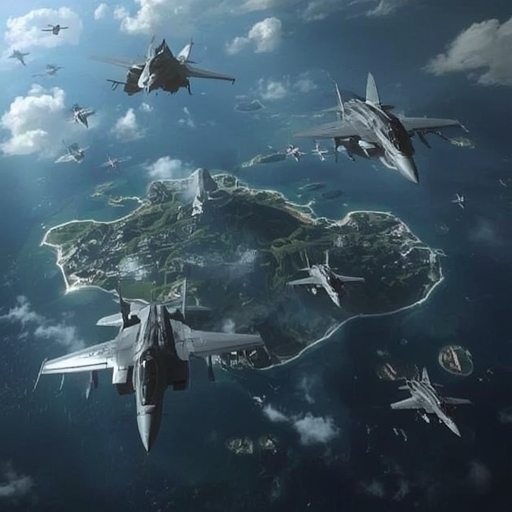
Recent large-scale Chinese military exercises conducted in close proximity to Taiwan transcend the boundaries of routine drills or mere demonstrations of power. They form a sophisticated and deliberate display of evolving strategic capability—offering a glimpse into how Beijing might operationalize a future offensive, should diplomatic tensions ever escalate into open conflict. These exercises, meticulously choreographed and multi-dimensional in nature, reveal a distinct emphasis on achieving air superiority and mastering the coordination of precision long-range strikes—two pillars that constitute the foundation of modern warfare.
What makes these maneuvers particularly significant is not simply their scale, but the integrated choreography between air, sea, and missile assets. Fighter jets executed sweeping sorties that simulated suppressing Taiwan’s defensive network, while missile forces rehearsed synchronized precision strikes against hypothetical high-value targets. Naval elements, meanwhile, conducted containment operations intended to replicate an encirclement strategy, effectively demonstrating that China seeks to project readiness for rapid, decisive action. This form of sophisticated multi-domain warfare illustrates an operational philosophy shaped not by symbolism alone, but by tactical foresight.
Beijing’s official rhetoric has downplayed the drills as a ‘warning’ to external interference and what it perceives as separatist movements in Taipei. However, the sheer complexity of the exercises suggests objectives that go far beyond political signaling. To observers in neighboring capitals, these moves constitute a sobering study in escalation control—showcasing the extent to which China’s People’s Liberation Army has modernized its capabilities and grown increasingly adept at integrating cyber, intelligence, and kinetic operations into a single strategic framework.
From a geopolitical standpoint, the message radiates across the Indo-Pacific with undeniable clarity: Beijing seeks not only to deter but also to dominate. These exercises serve as both preparation and provocation, a multifaceted warning that underscores China’s willingness to align its military proficiency with political ambition. Regional actors—such as Japan, the United States, and key ASEAN members—interpret these developments as signs that Taiwan’s security is inextricably linked to the balance of power throughout the entire region.
The broader implications extend into the global economic sphere, given Taiwan’s indispensable role in advanced semiconductor production and high-technology supply chains. Were hostilities to erupt, disruption would ripple far beyond the South China Sea, affecting everything from global trade flows to supply of essential microchips. Thus, each tactical formation, every missile trajectory, and all airspace incursions observed during these drills resonate as both military rehearsal and strategic communication.
Ultimately, China’s latest maneuvers reveal a nation intent on refining the art of deterrence through demonstration. By visibly practicing rapid coordination across domains—air, sea, land, space, and information—it projects a fusion of resolve and capability designed to unsettle adversaries while reinforcing domestic narratives of strength. Whether perceived as preparation for war or a calculated high-stakes message, these war games encapsulate the uneasy intersection of power, ambition, and regional insecurity that defines twenty-first century geopolitics across the Taiwan Strait.
Sourse: https://www.businessinsider.com/chinas-war-games-taiwan-show-air-superiority-long-range-strikes-2025-12