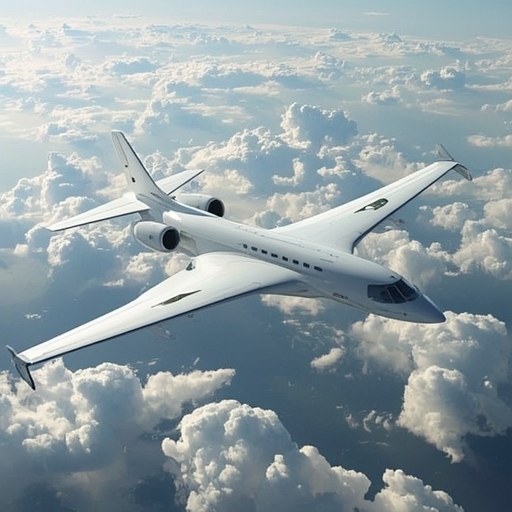
The vision for the future of aviation may, perhaps surprisingly, mirror the simple triangular paper airplanes many of us crafted during childhood. In a thoughtful conversation with Tobias Fuchs and Martin Murphy from the German newspaper *Bild*, Airbus Chief Executive Officer Guillaume Faury outlined a bold prediction: within the next three to four decades, aircraft manufacturers may largely abandon the familiar tubular fuselage and separate wing structure that has defined modern airliners for over a century. Instead, they may embrace an entirely new configuration — a cohesive, streamlined structure built around a single, thick, and expansive wing that ingeniously houses the passenger cabin within its body.
This revolutionary design, known in aerospace terminology as a *blended-wing body* (BWB), represents a dramatic departure from the conventional “tube-and-wing” form. In a BWB aircraft, the lifting forces are evenly distributed across the entire, gracefully contoured surface rather than concentrated at discrete wing panels. This allows for improved aerodynamics, substantially enhanced fuel efficiency, and the potential to carry heavier payloads. According to Faury, widebody airframes — the large passenger jets designed for long-haul flights — would be the most appropriate candidates to adopt such a concept, as their size and range would best capitalize on the configuration’s aerodynamic advantages.
However, Faury also made clear that these benefits come with considerable engineering and human-factors trade-offs. A primary challenge lies in the passenger experience: traditional windows could be eliminated entirely, leaving the cabin dependent on artificial lighting systems. Without access to natural light or an exterior view, travelers might experience disorientation, discomfort, or even claustrophobia — a psychological consideration that aircraft designers must take seriously. Early computer renderings of the proposed economy-class section of Airbus’s ZEROe BWB concept further illustrate these complexities.
Beyond comfort, the unconventional form introduces safety and logistical concerns. Emergency evacuations could pose new difficulties, as occupants would lack visual awareness of outside conditions such as fire, smoke, or debris. Moreover, those seated in the inner portions of the curved cabin would be situated significantly farther from emergency exits than passengers in today’s more linear, tube-shaped jets.
Faury’s comments align with a broader pattern of sustained interest from Airbus in blended-wing research. The company’s investigations form part of its ZEROe program — a pioneering initiative aimed at achieving emissions-free flight. The concept of a BWB design is not entirely new: its lineage stretches back several decades. One of the most striking historic precedents is the Northrop B-2 Spirit stealth bomber, widely recognized as one of the most iconic “flying wing” aircraft ever built, which first took to the skies in 1989. Yet the underlying idea predates even that. In the early 1990s, McDonnell Douglas, working alongside NASA, explored the notion of a blended-wing transport aircraft that matured into the experimental model designated as the BWB-17.
When McDonnell Douglas merged with Boeing in 1997, the research initiative continued. Boeing and NASA collaborated for more than a decade on a series of unmanned subscale demonstrators known as the X-48 program, which concluded in 2013. Though these test vehicles delivered valuable aerodynamic and control data, no full-scale BWB airliner designed to carry passengers has yet been certified or flown, and Boeing currently has no public plans to develop one.
Airbus, by contrast, has made more visible progress. Since 2017, the company has dedicated significant resources to its own BWB exploration efforts. Its ambitious 200-passenger design remains a cornerstone of the ZEROe concept, devoted to achieving zero-emission aviation. A breakthrough arrived in 2019 when Airbus successfully flew a small-scale prototype that demonstrated remarkable efficiency, with projected fuel savings of around 20 percent compared with current aircraft. Additionally, the broadened cabin cross-section created entirely new opportunities for interior layouts and passenger experiences. Airbus envisions that, in the long run, these aircraft could operate using hydrogen propulsion rather than conventional jet fuel.
Nevertheless, formidable challenges persist. Airbus has already delayed its initial 2035 target for ZEROe entry into service by as much as a decade, citing the daunting complexity of certification processes, the underdevelopment of global hydrogen supply infrastructure, and serious uncertainty around passenger acceptance — particularly concerning how travelers might react to seating configurations that place them far from natural light sources or familiar exterior views.
The push toward a blended-wing future is not confined to Airbus alone. Several innovative startups have entered the race, openly seeking to challenge the long-standing Airbus–Boeing duopoly that dominates the commercial aircraft market. Among them are two California-based firms: San Diego’s Natilus and Long Beach’s JetZero, both of which are advancing their own BWB models and aiming for market introduction in the early 2030s.
Natilus has focused on a narrower, shorter-range BWB platform named *Horizon*, intended to compete with widely used single-aisle aircraft such as the Airbus A320 or Boeing 737. Impressively, the company claims its design could cut fuel consumption by roughly 25 percent while offering up to 40 percent more cabin space — and all while maintaining compatibility with existing airport gates and infrastructure. Chief Executive Officer Aleksey Matyushev has predicted that the global aviation industry could face a staggering shortage of approximately 40,000 narrowbody jets over the next two decades, a demand level far beyond what Boeing and Airbus alone are likely capable of meeting.
The expanded interior volume of the Horizon design could allow airlines to creatively reimagine their passenger experience: wider seat configurations, dedicated family zones, relaxation areas, or other amenities currently impossible within traditional narrow fuselage limits. Visual renderings released in mid-2024 reveal a cabin with up to three aisles rather than the customary one or two, alongside assurances from Natilus that windows will be included throughout the aircraft. Passengers seated near the center would inevitably be more distant from these windows, but the company proposes mitigating the effect through innovative lighting systems and integrated skylights to simulate natural daylight conditions.
Meanwhile, approximately one hundred miles to the north, JetZero is concentrating on a larger, widebody variant designated the *Z4*. This aircraft is envisioned as a full-sized passenger replacement for models such as the Boeing 767 and Airbus A330 and is projected to deliver fuel efficiency improvements of up to 50 percent compared with current long-haul jets. The Z4 shares the same operational advantage as Horizon in terms of being compatible with today’s airports and ground handling systems. Its spacious interior, however, offers additional potential for transforming how passengers experience long-distance travel.
JetZero’s progress has already captured the attention of major airlines. United Airlines Ventures — the carrier’s investment arm focused on emerging aerospace technologies — announced in April its intent to purchase up to 200 of JetZero’s 250-seat Z4 aircraft. United’s managing director, Andrew Chang, described the design’s vast cabin as a potential “living room in the sky,” emphasizing its wide, open atmosphere and sense of comfort uncommon to modern airliners. Further solidifying its ambitions, JetZero achieved a milestone in 2024 when it successfully flew its subscale test vehicle, known as *Pathfinder*, marking an important step toward validating the performance of a full-sized demonstrator.
Taken together, these advances — from the deep research programs at Airbus to the aggressive innovations of Natilus and JetZero — suggest that the era of the blended-wing body aircraft may be approaching faster than expected. Although significant engineering, regulatory, and perceptual hurdles remain, the prospect of a more efficient, spacious, and environmentally sustainable way to fly continues to inspire engineers, investors, and travelers alike. The next generation of flight could indeed look uncannily like those folded triangles from childhood — but far more sophisticated, silent, and sustainable, pointing toward an entirely new chapter in the story of aviation.
Sourse: https://www.businessinsider.com/airbus-ceo-said-future-passenger-jets-blended-wing-body-2025-12