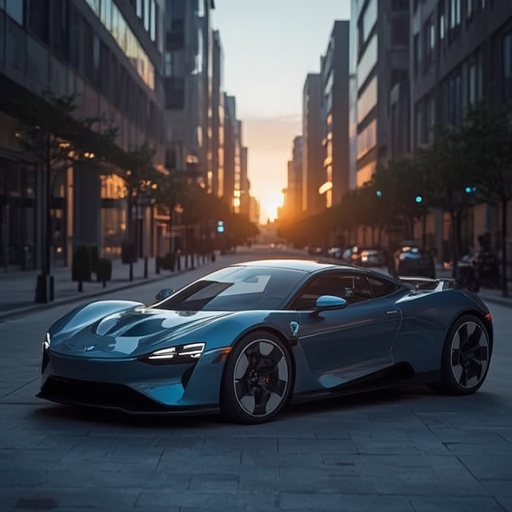
The Alpine A390’s propulsion system begins its life in one of France’s most advanced manufacturing sites, a specialized facility located in Cléon that has become synonymous with precision and electric innovation. It is here that the car’s highly efficient electric motors are meticulously produced, ensuring they meet Alpine’s exacting standards for performance and reliability. The power that drives these motors is drawn from sophisticated NMC (nickel–manganese–cobalt) batteries, which originate from the renowned French battery company Verkor. However, the creation of these batteries is a multi-stage process that highlights both regional collaboration and Renault Group’s integrated approach to production. While Verkor supplies the core battery cells, the modular components are assembled in Dunkirk before reaching their final configuration within the Renault Group’s cutting-edge facility in Douai. Parallel to this process, the A390’s chassis — a fundamental element determining both handling and driving feel — is not outsourced but instead conceptualized, engineered, and built entirely in Alpine’s Le Mans plant, the legendary cradle of motorsport engineering excellence.
In spirit and execution, the A390 follows the lineage of Alpine’s smaller sibling, the A290, and even evokes the ethos shared by several contemporary Renault models such as the 4, 5, and the soon-to-arrive Twingo. It is undeniably a car crafted for those who feel a deep affection for France’s automotive legacy — the dedicated Francophiles who value distinctive Gallic design and mechanical flair. Alpine’s endeavor here transcends mere nostalgia; the company is not simply mining its eccentric past. Instead, the A390 stands as a vivid emblem — an avatar — of the Renault Group’s modern technological mastery, serving as proof that heritage and high innovation can coexist harmoniously in the age of electrification.
Beneath its sleek exterior lies a platform that represents a thoughtful evolution of the AmpR Medium architecture, a structural foundation already proven in several notable electric vehicles, including Renault’s own Megane E-Tech and Scenic, as well as Nissan’s Ariya and Leaf. This collaborative engineering underscores the necessity of shared technological ecosystems, given the enormous financial and developmental investment required to create modern electric architectures. Yet Alpine did not simply inherit this platform in a passive manner. Instead, substantial refinements and bespoke calibrations have been introduced to ensure that the A390 possesses a distinct personality worthy of its badge. These modifications serve a double purpose: they justify the financial commitment behind the project and, perhaps more audaciously, position the A390 as a legitimate rival in the performance realm long dominated by Porsche.
As Robert Bonetto, Alpine’s Vice President of Vehicle Projects, explains, the underlying vision for the A390’s dynamic character was to replicate — and, where possible, reinterpret — the agility and speed that define the revered A110 sports car. This was a daunting engineering challenge, considering the heavier nature of electric vehicles due to their large battery packs. The team therefore sought advanced technical solutions capable of neutralizing the physical burden of that weight, replacing it with what Bonetto aptly describes as an enhanced sense of “perceived lightness.” This phrase is crucial: while the physics of mass cannot be fully defeated, Alpine’s engineers have strived to recreate the experience of agility and responsiveness traditionally associated with lightweight combustion cars.
To appreciate this accomplishment, one must recall that the classic A110 earned its cult status among motoring purists largely because of its exceptionally low weight — a mere 1,140 kilograms, an achievement almost incomparable in today’s regulatory and safety-driven automotive environment. By contrast, the A390 inevitably carries roughly twice that mass, an unavoidable reality given the heavy electrified drivetrain. Yet Alpine remained faithful to its founding formula of nimbleness and mechanical balance. The car’s 89 kWh battery benefits from newly developed chemistry and an advanced liquid-cooling system, enabling it to deliver sustained peak performance while improving both charging efficiency and thermal management. This innovation ensures that power output remains consistent even during extended driving, reducing performance fade and maximizing the vehicle’s endurance under demanding conditions.
Distinguishing itself further in the segment, the A390 boasts a tri-motor configuration — a rare and technically ambitious setup. Up front, a compact coil motor provides instantaneous torque delivery, enhancing front-axle traction and steering responsiveness. Meanwhile, at the rear, two sophisticated permanent synchronous motors independently drive each wheel, allowing for exceptional torque vectoring and precision handling. In its standard GT configuration, this layout produces a formidable combined output of 396 brake horsepower. Opt for the more performance-focused GTS variant, and that figure climbs to an impressive 463 bhp. Together, these numbers are not merely about raw speed; they represent an intricate orchestration of power, control, and engineering artistry — a testament to Alpine’s intention to redefine what a French performance EV can truly be.
Sourse: https://www.wired.com/review/review-alpine-a390/