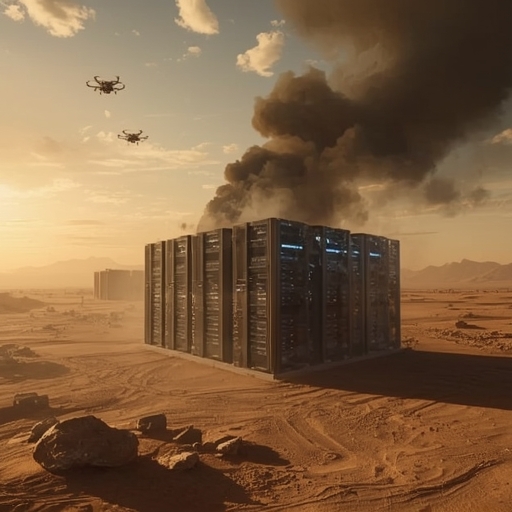
Amazon has officially confirmed that a series of drone strikes in the Middle East have inflicted substantial damage on three of its data centers, while a fourth facility has suffered additional fire-related harm due to the broader impact of the assaults. This revelation underscores, with striking clarity, how the highly interconnected nature of global digital infrastructure remains deeply susceptible to tangible, physical threats that occur far beyond the realm of cyberspace.
In today’s hyperconnected economy, cloud computing and data storage underpin virtually every facet of modern industry—from financial networks and critical government systems to social media platforms and e-commerce operations. The reported attacks serve as a sobering reminder that technological ecosystems, despite their apparent virtuality, are ultimately dependent upon real-world installations—massive facilities filled with servers, cooling systems, and power grids situated within complex geopolitical landscapes. When those locations become targets in regional conflicts, the ripple effects can be immense, potentially disrupting businesses, services, and communications on a global scale.
The incident also brings renewed attention to the concept of resilience within the technology sector. Distributed network design, geographic redundancy, and disaster recovery strategies are more than merely technical considerations—they constitute vital safeguards ensuring that operations can continue even amidst crises. For multinational corporations like Amazon, such circumstances highlight the need for ongoing investment in risk assessment, diversification, and advanced security protocols that integrate both cyber and physical protections.
Beyond the immediate consequences of facility damage, the situation poses profound strategic questions for business leaders and policymakers alike. How can nations and industries better coordinate to secure essential digital infrastructure? What measures should be prioritized to reinforce continuity across cloud networks that power everything from healthcare services to global finance? The answers will define the trajectory of technological resilience for years to come.
Ultimately, this event illustrates that the digital age, for all its progress and convenience, cannot escape the vulnerabilities of the physical world. As organizations continue to rely ever more heavily on data-driven processes, it becomes imperative to view resilience not as an abstract technical metric but as a core component of strategic survival. The damage to Amazon’s data centers is therefore not only a disruption to operations—it is an unmistakable warning that the line separating digital systems from real-world conflict is far thinner than many might imagine.
Sourse: https://www.businessinsider.com/amazon-data-centers-middle-east-drone-strukes-us-iran-conflict-2026-3