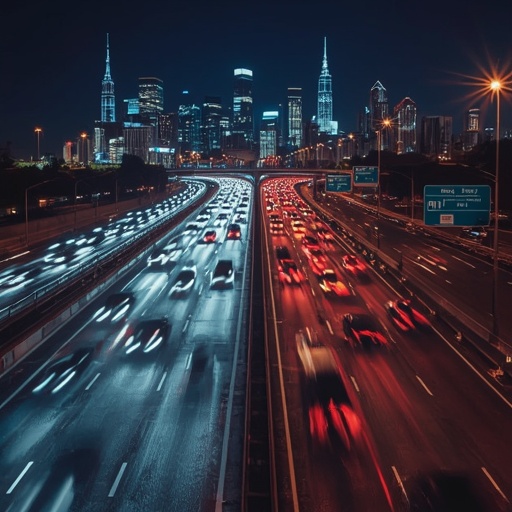
In the past, the concept of ‘rush hour’ was a clearly defined period, typically occurring twice a day when office workers commuted to and from their jobs. Today, however, that predictable rhythm of traffic congestion has dissolved into a continuous, almost cyclical flow of vehicles. What was once a short burst of roadway activity has evolved into an unending pattern of movement, extending throughout the day and evening. This transformation has been driven by the widespread adoption of flexible and hybrid work schedules, which have altered not only when people travel but also how urban traffic behaves.
Across countless American cities, commuters now embark on their daily journeys at varied hours — some starting before dawn, others venturing out late into the afternoon. This dispersion of departure times was initially expected to ease congestion, yet paradoxically, it has resulted in a nearly constant level of gridlock. Highways and city arteries hum with energy well beyond what would traditionally be considered ‘peak time.’ The result is that traffic, instead of concentrating within fixed time frames, stretches like an elastic band across the entire day.
The implications of this phenomenon reach far beyond mere frustration behind the wheel. Urban planners must now account for infrastructure that is perpetually burdened, rather than periodically overwhelmed. Public transportation systems, designed for morning and evening peaks, must adapt to serve a population in motion at all hours. Employers, too, are recognizing the impact of persistent congestion on worker productivity, commuting costs, and overall well-being.
For individual drivers, this endless rush hour represents a new form of modern fatigue — one that blends the pressure of time management with the unpredictability of traffic dynamics. Streets that once offered reprieve during midday are now active zones, teeming with deliveries, rideshares, and remote professionals heading to coworking spaces or client meetings. This continuous churn of movement reflects not chaos but adaptation: society adjusting to the fluid boundaries between home, office, and everywhere in between.
Ultimately, America’s evolving commute underscores a grand paradox of modern flexibility. The freedom to choose when to work has provided autonomy but has also eroded the natural pauses that once brought order to urban life. As we reconsider mobility, it becomes clear that managing this ‘always-on’ traffic era will require new strategies — from smarter city design to more thoughtful transportation policies. The never-ending rush hour, while symbolic of progress and change, stands as both a challenge and an invitation to rethink how we move through the modern world.
Sourse: https://www.businessinsider.com/never-ending-rush-hour-remote-work-flexible-schedules-commutes-2026-6