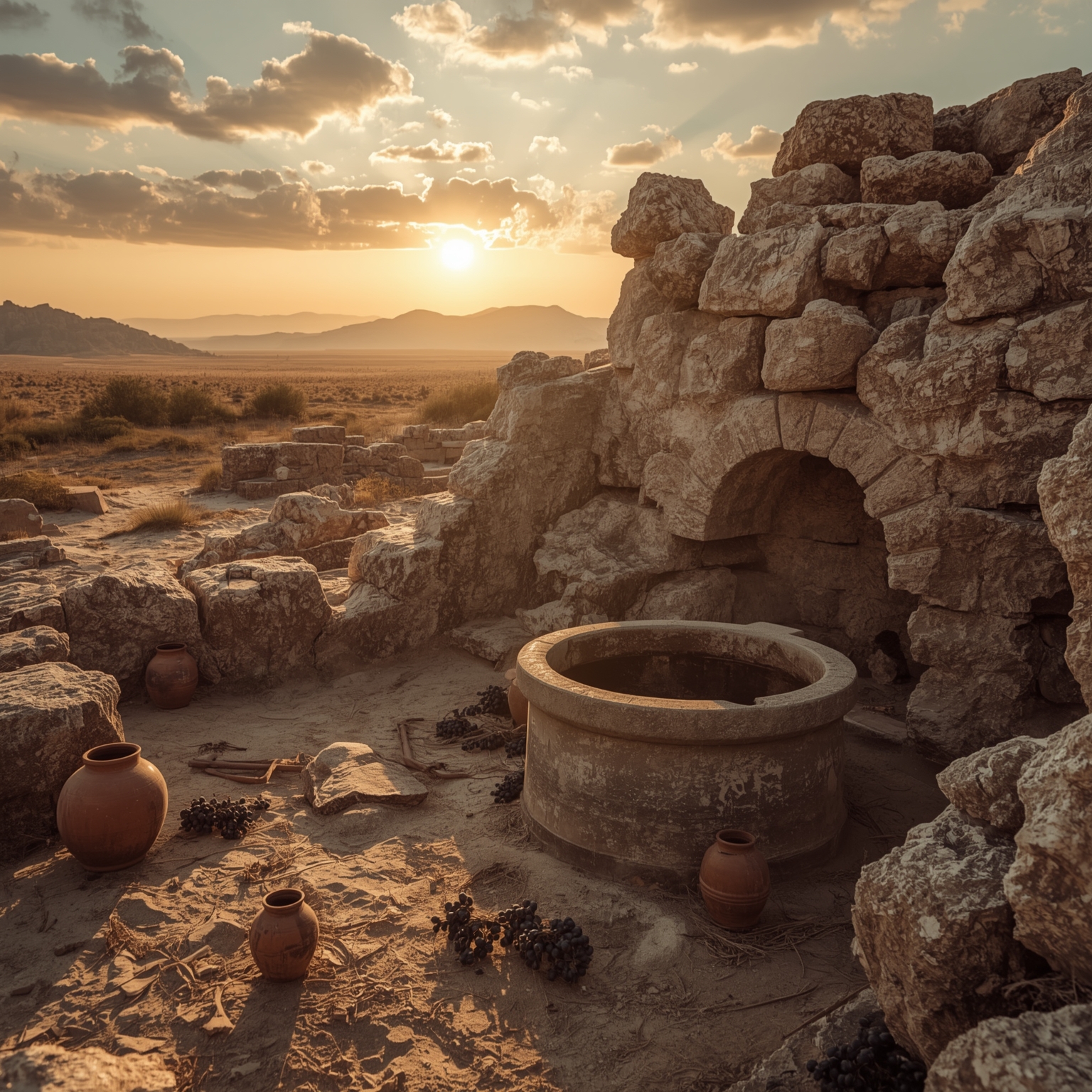
Archaeologists working in northern Israel have recently uncovered a remarkable collection of ancient artifacts, among them a meticulously carved 5,000-year-old winepress and an intricately designed 3,300-year-old vessel shaped like an animal. These remarkable discoveries emerged during large-scale excavations conducted as part of a highway expansion initiative situated to the east of the ancient city of Megiddo—one of the Levant’s most storied archaeological sites. The findings open an illuminating window into the region’s deep Bronze Age past, vividly portraying aspects of daily life, religious customs, and the technological ingenuity of the Canaanite people who flourished in this area around 3,000 BCE. In particular, the newly unearthed installations shed light on early winemaking practices and reveal intriguing evidence of ritual activity that might have played a central role in the community’s spiritual life.
Although Megiddo has been under excavation for more than a century and is already recognized as a cornerstone in the study of early urban civilization and Canaanite religion, these recent explorations conducted just beyond the main mound—known archaeologically as a tel, a stratified hill formed by the successive construction and destruction of ancient cities—are offering an entirely new perspective on the city’s broader environment. The archaeologists involved explain that their work extends understanding beyond the walled settlement found on the tel itself, connecting the material culture of the densely inhabited urban core with that of its surrounding landscape. In doing so, they are beginning to map the relationship between domestic life, agricultural production, and ritual practice that likely coexisted just outside Megiddo’s defensive boundaries.
Among the most striking discoveries is a small, carefully engineered winepress carved directly into the bedrock, securely dated to the Early Bronze IB period, approximately 3300 to 3100 BCE. Excavation directors Amir Golani and Barak Tzin of the Israel Antiquities Authority have emphasized the exceptional nature of the find. Very few winepresses have been documented from this early stage of the Bronze Age, when urbanization in the southern Levant was just emerging. The existence of this installation thus indicates that organized wine production—a process involving the systematic cultivation of grapes, their pressing, fermentation, and storage—was already an important economic and cultural activity nearly five millennia ago. Golani described the discovery as the earliest known evidence of winemaking in the region, a revelation that not only broadens our understanding of agricultural development but also highlights the sophistication of Canaanite society during its formative phases.
The team’s research also revealed the remains of residential structures situated near the winepress, suggesting that this installation served not merely as an isolated production site but as a focal point for the surrounding community. Its proximity to domestic architecture implies that wine production was integrated into everyday life and possibly into communal or ceremonial events, reinforcing the notion that Megiddo’s influence extended well beyond the main tel and into the agricultural hinterlands that sustained it.
Equally compelling are a series of artifacts dating to the Late Bronze Age II period between 1400 and 1200 BCE, many of which appear to have been deliberately buried as ritual deposits. Among these were a finely crafted miniature model of a temple, large storage jars, imported jugs and juglets likely originating from Cyprus, and a striking set of vessels apparently used for libations—the ceremonial pouring of liquid offerings to deities. According to the archaeologists, the miniature temple model provides a tangible representation of what Canaanite sanctuaries may have looked like during this period, offering scholars a rare opportunity to study religious architecture in symbolic form. Each item found in association with this deposit seems to have held spiritual significance, serving as an offering, symbol, or instrument within a ritual context.
Particularly noteworthy among the discoveries is a beautifully preserved set of ritual vessels that includes a ram-shaped container accompanied by several small bowls. Such finds are exceptionally rare, as archaeologists typically uncover only fragmented examples of similar ceramics. The intact condition of this set and the deliberate manner in which it was buried suggest that it was purposefully placed as part of a ceremonial act. Researchers believe the vessel was designed for use in liquid offerings, possibly involving milk, oil, wine, or another precious substance. A small handled cup would have been used to channel the liquid into a funnel-like opening carved into the ram’s back, allowing the content to flow through the animal’s spout-shaped mouth into a waiting bowl positioned before it. This ingenious design embodies both artistic creativity and ritual functionality, bridging the practical and the sacred.
The vessel’s location also offers clues about its broader cultural significance. It was discovered in a position overlooking the great temple area of Tel Megiddo’s Late Bronze Age II levels, leading scholars to hypothesize that it may have been associated with a local folk cult operating outside the main sanctuaries of the city. Such a cult could have been patronized by nearby farmers or rural inhabitants who, for reasons of social hierarchy or geographic distance, were unable to participate in the formal rituals conducted within Megiddo’s central temple precincts. The presence of offerings beside a large natural rock outcrop suggests that this site may have functioned as an open-air altar, a space for worship under the sky where ordinary devotees could perform acts of devotion and thanksgiving.
Taken together, these discoveries offer profound insights into the cultural and spiritual life of ancient Canaan. They illuminate a spectrum of human activity—agricultural innovation, artisanal production, and religious expression—revealing how intimately intertwined these domains were in shaping early urban societies. The findings serve not only as an archaeological breakthrough but also as a reminder of the continuity between humanity’s distant past and its enduring quest for meaning, creativity, and connection to the land. In a region whose ancient history is intricate and compelling, yet whose modern future remains uncertain, such discoveries reaffirm the enduring importance of unearthing the narratives that lie buried beneath our feet.
Sourse: https://gizmodo.com/archaeologists-discover-an-ancient-wine-press-older-than-the-pyramids-2000683977


