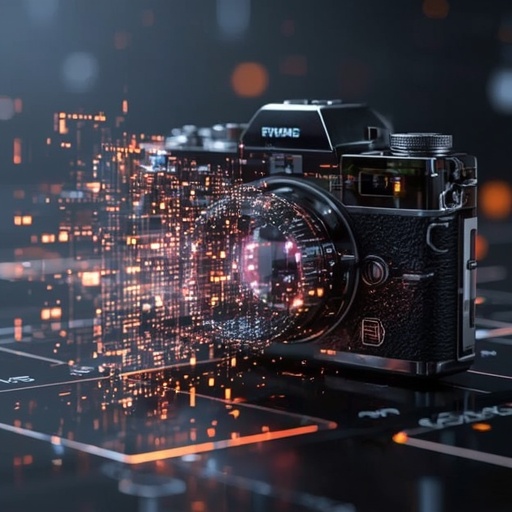
Apple’s forthcoming Photos application in iOS 27 represents a profound leap forward in the evolution of mobile photography, promising to merge the tangible world we capture through our lenses with the limitless possibilities of intelligent creation. According to Jon McCormack, Apple’s esteemed Camera Chief, this initiative goes far beyond the fleeting fascination with artificial intelligence as a technological novelty. Instead, it signals Apple’s deliberate attempt to endow users with authentic creative empowerment—what he refers to as “creative superpowers.” By integrating generative AI into the very core of the Photos experience, Apple aims to fundamentally transform how individuals perceive, edit, and enhance their images.
In practice, the new Photos app employs highly advanced algorithms capable of analyzing visual information and intelligently supplementing what the human eye may have missed. The system can fill in realistic details, refine lighting, and enhance textures, all while preserving the inherent spirit and integrity of the original shot. This delicate balance between augmentation and authenticity lies at the heart of Apple’s design ethos. McCormack emphasizes that every improvement should feel natural, as though it could have existed in the photograph all along—never artificial, never forced. The result is not merely an edited image but a deeply personalized collaboration between human intuition and machine intelligence.
What distinguishes Apple’s approach is its commitment to emotional truth and aesthetic coherence. Rather than overwhelming users with flashy, hyper-stylized results, the company’s engineers have constructed a system that acts more like a skilled artistic partner than a machine-driven manipulator. For instance, a user capturing a serene sunset might find the algorithm subtly deepening the color gradients to mirror the memory of what the scene felt like rather than what the camera sensor strictly recorded. In this way, Apple’s AI works as a conduit for creative expression, translating perception into imagery that resonates on an emotional level.
McCormack also notes that Apple’s reliance on AI aligns with its broader philosophy of using technology to amplify, not replace, human capability. While some competitors tout AI as a fully autonomous tool, Apple conceives of it as an augmentation layer—a digital collaborator designed to enhance what photographers, both amateur and professional, are already capable of achieving. The company envisions AI as an unobtrusive, almost invisible force, seamlessly integrated into the user interface, providing subtle guidance and optional enhancement rather than commanding control.
From a technical perspective, this marriage between human vision and computational intelligence involves sophisticated data modeling trained to recognize not only shapes and lighting conditions but also artistic context. The Photos app’s AI differentiates between scenes, tones, and moods, allowing it to make creative decisions tailored to the subject matter. A landscape photograph, for example, might receive nuanced depth-of-field corrections that draw the viewer’s attention to natural elements, while a portrait could benefit from precise texture mapping that maintains the organic warmth of skin while eliminating unwanted distortion.
Ultimately, iOS 27’s Photos app symbolizes Apple’s continuous pursuit of innovation where design, emotion, and technology converge. McCormack’s assertion that AI should never exist “for AI’s sake” encapsulates the brand’s strategy: to ensure that technological advancement is always rooted in human purpose. Through generative intelligence, Apple is not just reimagining mobile photography—it is redefining creativity itself, empowering every user to become an artist capable of bridging imagination and reality with unprecedented precision and grace.
Sourse: https://www.wired.com/story/apple-camera-chief-thinks-ai-can-give-you-superpowers/