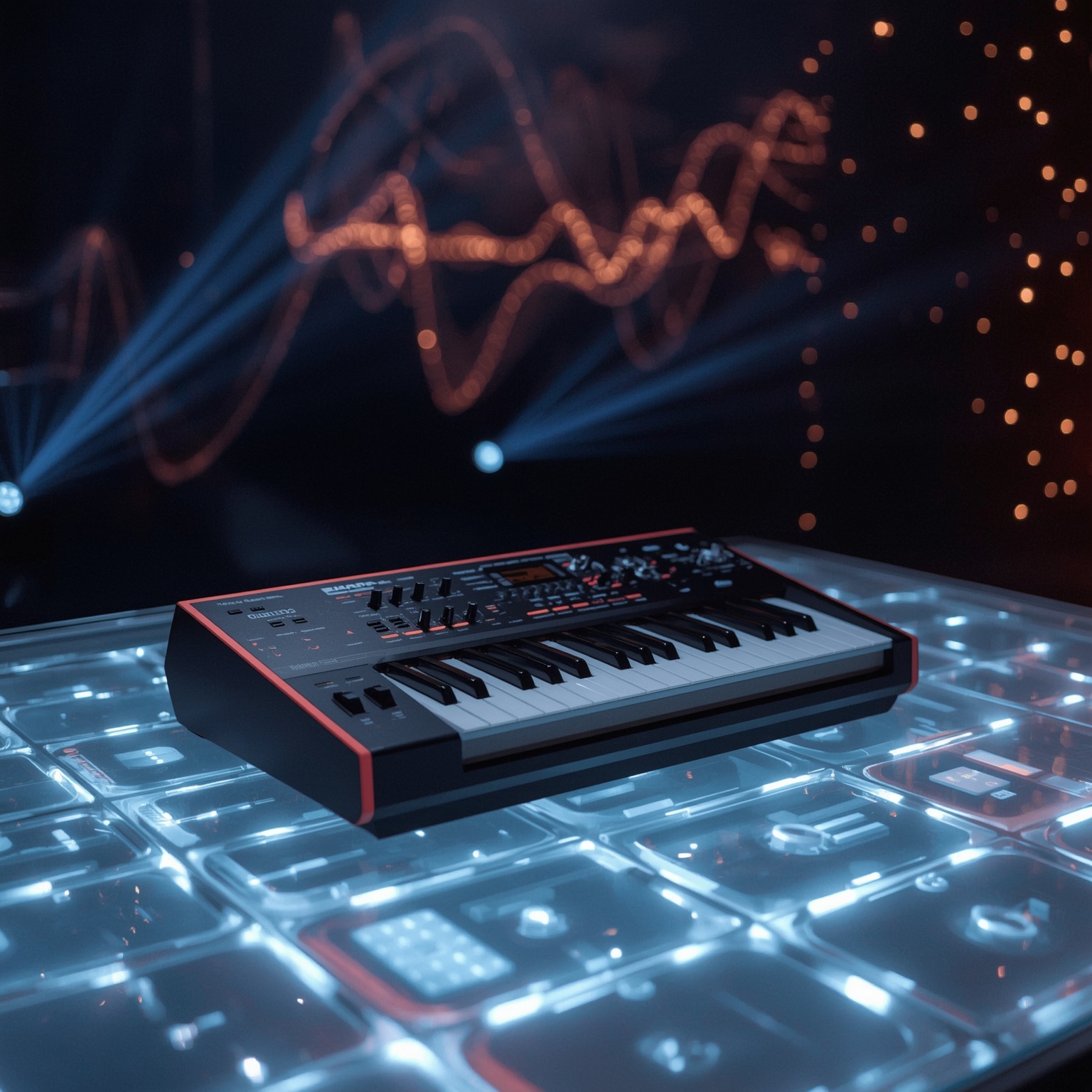
In the previous year, Arturia made a significant leap into the world of live performance instruments with the introduction of its first dedicated stage keyboard, the AstroLab. Whereas a traditional synthesizer often prioritizes extensive sound design capabilities—enabling users to sculpt tones from the ground up—stage keyboards such as the AstroLab place greater emphasis on immediacy, stability, and performance readiness. They cater specifically to professional musicians and touring artists who require fast access to an extensive palette of polished presets, rather than hobbyists who enjoy spending hours fine-tuning oscillators and filters. Initially, the AstroLab line consisted of full-sized, premium models priced at $2,999 for the 88-key version and $1,999 for the 61-key edition. The newly released AstroLab 37, however, delivers the same impressive sonic library and performance features in a far more compact and economical package: a streamlined 37-slimkey instrument priced at just $699, making it an accessible entry point into Arturia’s ecosystem of high-quality performance tools.
What differentiates the AstroLab family from many other competitors in its category is its unique lineage—these keyboards effectively bring Arturia’s renowned AnalogLab software, celebrated for its meticulous emulations of classic synthesizers, into a self-contained hardware format. Arturia’s suite of virtual instruments achieved immense popularity in the music production world for their impeccable sound quality and faithful recreations of legendary analog and digital synths. Until the AstroLab arrived, these sonic treasures were confined to a computer environment. Now, performers can harness most of the same sounds, though with some limitations, directly from a standalone instrument that requires no laptop or software host.
Arturia’s V Collection—the massive software library from which AnalogLab sources its content—provides deep layers of control for users seeking precision and authenticity, offering virtual renditions of iconic instruments like the Yamaha CS-80 and the Fairlight CMI. These legendary synthesizers are nearly impossible to obtain today, and even when found, their prices often soar well into the tens of thousands of dollars. In contrast, AnalogLab and, by extension, AstroLab act as curated gateways to this universe of sound: they function as preset browsers that present users with a thoughtfully assembled collection of the most impactful tones from the broader V Collection suite.
The AstroLab 37 arrives loaded with more than 1,800 preset sounds that span 44 different instruments. These encompass everything from expressive acoustic pianos and vintage analog stalwarts like the Minimoog to nostalgic digital workhorses from the 1980s such as the Ensoniq SQ-80. The quality across most of these emulations is strikingly high. The Rhodes electric piano reproduction, for instance, stands out as particularly satisfying—an impressive feat given the abundance of software and hardware alternatives available. Additionally, the inclusion of Arturia’s Pigments sound engine, which many consider one of the most sophisticated modern synths, elevates the unit’s sonic potential. The primary compromises appear in the organ and acoustic piano sounds: while they remain thoroughly usable, performers whose repertoire heavily emphasizes these tones might find superior realism in products from specialty manufacturers such as Nord.
Adding new sound content is straightforward. Users can expand their AstroLab library via the AnalogLab desktop software, connecting through USB, or wirelessly through the AstroLab Connect mobile app. Although wireless transfer offers impressive convenience on paper, in practice it remains unreliable. Attempts to sync through a Wi-Fi network may fail entirely, and though direct hotspot connections between the AstroLab and a device are more dependable, even this setup can periodically drop out. Consequently, USB connectivity remains the more stable and professional solution for managing the onboard sound library.
Given its vast collection of over a thousand presets, navigating AstroLab’s library could easily become daunting. Thankfully, Arturia has implemented a smart browsing system that simplifies exploration. Users can search or filter by sound category—such as basses, pads, or leads—or by specific instrument model, sound bank, or user-defined favorites. Beyond these, the keyboard includes features called Songs, which allow musicians to link several presets together for seamless one-button recall during a performance, and Playlists, which group multiple Songs into a setlist-like sequence for live shows. Such workflow considerations reveal that AstroLab was designed foremost for stage reliability and creative efficiency.
The performance section provides a modest but useful level of hands-on control. Four macro knobs on the left panel can manipulate different parameters depending on the selected patch—sometimes adjusting filter sweeps, other times shaping modulation depth or envelope characteristics. On the right side, another set of four knobs is dedicated to handling core effects such as chorus, delay, and reverb, enabling performers to make quick expressive adjustments in real time. However, the AstroLab intentionally does not include advanced synthesis editing; it is not a sound designer’s workstation but rather a playback-oriented instrument. For deep sound crafting, musicians must turn to the V Collection software (starting at $199), create their own patches there, and then transfer those custom creations to the keyboard. This minimalistic approach to onboard control is quite typical of stage instruments, though the AstroLab’s relative lack of physical tweaking options feels slightly restrictive given the sophisticated engines inside.
When moving from the larger AstroLab models to the compact 37-key version, no sonic compromises are made—the difference lies strictly in physical form and construction. The AstroLab 37’s chassis employs durable plastic that manages to avoid any sense of cheapness, retaining the classy wooden side panels found on its bigger siblings. The main visual distinction is that the 88- and 61-key versions feature a prominent color screen integrated into a large multifunction control wheel, whereas the 37 substitutes this setup for a smaller display paired with an independent encoder. Another omission is the locking power connector, which could be a mild inconvenience for energetic live performers who prefer extra cable security.
The keybed represents the most notable point of differentiation. The AstroLab 88 employs a hammer-action Fatar keybed that closely replicates the nuanced resistance of an acoustic piano, while the 61-key model opts for a semi-weighted design. Both feel robust and satisfyingly premium. The AstroLab 37, in comparison, uses a synth-action keybed equipped with miniature keys and aftertouch. The playability remains responsive and enjoyable—it is likely based on the same design featured in Arturia’s popular KeyStep mk2 controller—but seasoned pianists accustomed to weighted keys will immediately notice the lighter touch and reduced expressiveness.
Some advanced functions, such as the ability to split the keyboard into two zones (for example, bass sounds on the lower range and leads or pads on the higher), feel somewhat constrained by the instrument’s smaller format. Serious performers—particularly those who rely heavily on keyboard range and nuanced dynamics—will naturally gravitate toward the 61- or 88-key versions. Nevertheless, for musicians seeking a balance of portability, immediacy, and sonic diversity, the AstroLab 37 represents an ideal travel companion or compact performance hub. It allows players to experience Arturia’s world-class software instruments without the anxiety of a laptop crash or the hassle of managing software updates in the heat of performance.
Ultimately, the AstroLab 37 captures Arturia’s philosophy of merging modern technology with classic musicality: a self-contained, streamlined tool that empowers performers to deliver inspiring soundscapes anytime, anywhere. While smaller in scale, it embodies the same ambition and sonic depth as its larger predecessors, proving that great musical potential can indeed come in a remarkably compact form.
Sourse: https://www.theverge.com/tech/828658/arturia-astrolab-37-synth-stage-keyboard