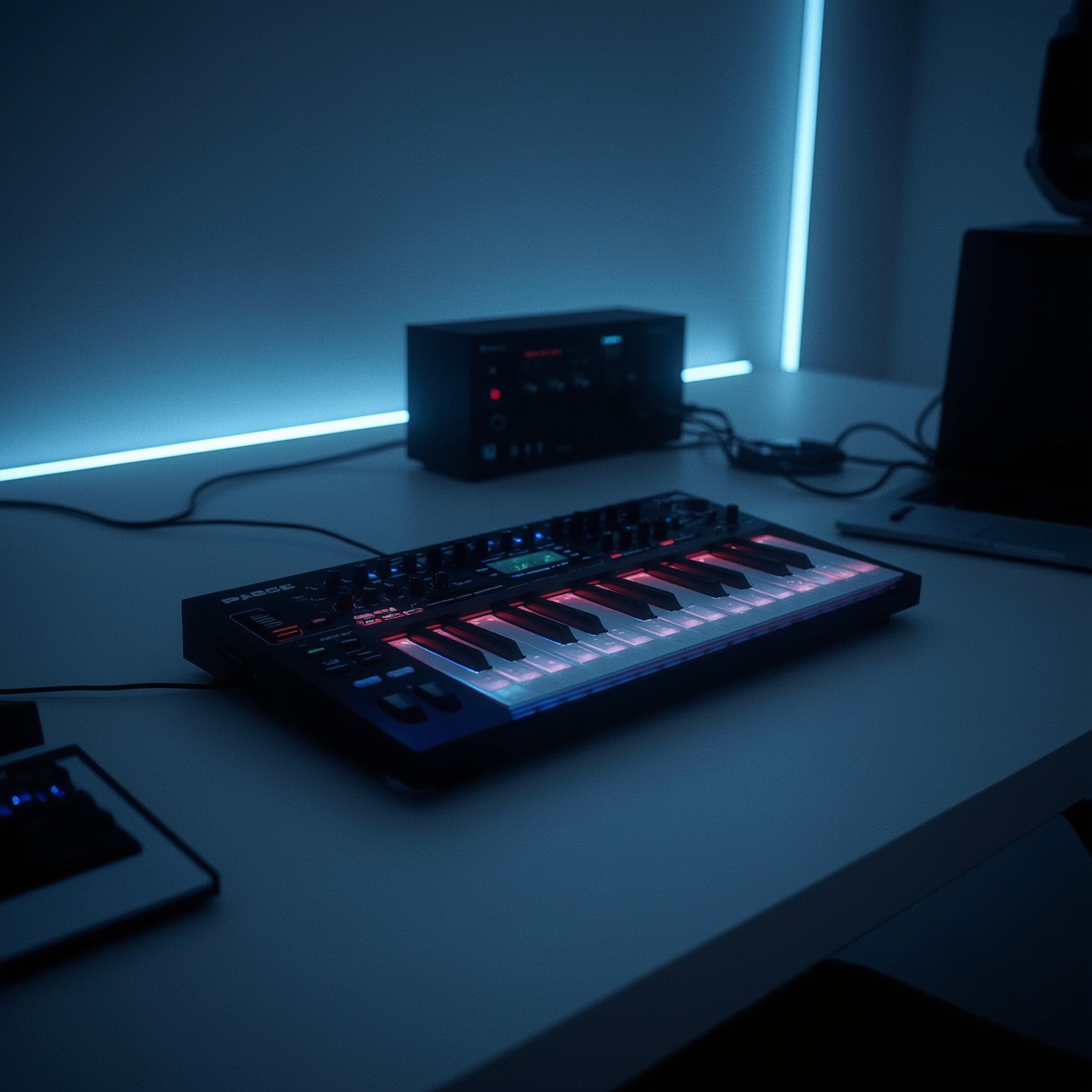
Arturia’s KeyStep has long earned its place as one of the most celebrated and widely adopted MIDI controllers ever produced, particularly adored by musicians working with modular synthesizer setups and performers who prefer to create without a computer-based digital audio workstation. Its enduring popularity can be attributed to a combination of practical factors: it is compact enough to slip into almost any music rig, remarkably affordable considering its capabilities, and designed around a sequencer that is both intuitively simple and musically versatile. Moreover, its connectivity options — spanning USB, analog, and MIDI — make it a connective bridge between old-school gear and modern digital systems. Yet, in spite of its long-standing reputation, it’s worth remembering that the original KeyStep debuted back in January 2016, a significant span of time in the world of technology. While the evolution of musical instruments typically proceeds more gradually than, say, the relentless cycle of smartphone updates, even within Arturia’s own catalog, numerous controllers have advanced into their second or even third generations since that first KeyStep release.
The brand’s newest iteration, the $139 KeyStep mk2, represents a thoughtful and carefully refined evolution of this classic device. Rather than reinventing it wholesale, Arturia revisits the original blueprint with the benefit of nearly a decade of user feedback and in-house technological advancements, integrating a host of new features aimed squarely at creative sequencing and compositional flexibility. The mk2 doubles the variety of arpeggiator modes, now offering sixteen distinct algorithms for transforming chords into rhythmic motion. It also multiplies the number of sequencer save slots eightfold, expanding the palette for live performance or layered studio experimentation. With newly added generative tools, as well as dedicated chord and scale modes, the mk2 extends the boundaries of what its compact form can achieve. The scale mode, for instance, can automatically constrain every note to remain within a chosen tonal center — a particularly helpful safeguard for those of us who may not possess the finger fluency of trained pianists — though some users may find the resulting tactile experience less natural on a traditional keyboard layout than on a pad-style controller.
What truly distinguishes this new model are the more experimental and stimulating features — especially the extended arpeggiator modes and the generative functions named “Spice” and “Mutate,” which now interact deeply with the sequencer. For many artists, the most significant barrier to creativity lies not in technical limitation but in the difficulty of reaching a productive “flow state.” Inspiration rarely strikes on demand; it must be cultivated through exploration and momentum. When personal time is scarce — perhaps due to demanding work hours or family responsibilities — the ability to initiate a musical idea quickly becomes invaluable. The KeyStep mk2 facilitates this by turning creative inertia into motion. Its generative tools spark fresh patterns instantly, nudging the musician beyond blank-page paralysis toward something tangible and musically active.
A typical workflow with the mk2 might begin with a simple arpeggio built from a modest three- or four-note chord. With a press of the Mutate button, the device begins to creatively rearrange the chosen notes, inserting octave leaps, rests, and subtle rhythmic variations that inject new energy into the phrase. A brief tap introduces minimal variation — just enough to suggest a new direction — while a longer press can twist the sequence into something almost unrecognizable. Through this process of controlled randomness, entirely new motifs often emerge unintentionally, encouraging discovery rather than deliberate construction.
Once a satisfying phrase has surfaced, attention can turn to the aptly named Spice control, another generative layer that adjusts gate lengths and adds ratcheting effects to create intricate, stuttering rhythmic textures. If the current configuration doesn’t yield something inspiring, the musician can invoke a randomization routine by holding the Shift key and tapping the Spice touchstrip three times. This rolls a new set of parameters to explore, producing subtly different rhythmic personalities each time. These continuous trials often lead to new grooves that might never have been consciously programmed.
The inclusion of a compact but crisp OLED display and a smooth-turning endless encoder adds significant usability. Together, they make navigation between parameters faster and more precise — small but meaningful enhancements that streamline experimentation without interrupting creative flow. After landing on a compelling short loop or phrase, it can be saved directly into one of the sequencer’s memory slots. From there, the idea can easily be developed into a longer melodic sequence, stretching to 32 or even 64 steps, with the added benefit of polyphonic overdubbing. This means you can record harmonies, counter-melodies, or basslines layered on top of your evolving composition — transforming a fleeting experiment into the beginnings of a structured piece.
When the sequence feels complete, the KeyStep mk2 even allows that material to be fed back into the arpeggiator using a “user sequence” mode. This clever feature transforms the previously recorded sequence into an adaptable pattern template. It doesn’t merely replay the stored notes; instead, it maps the sequence’s rhythmic and structural characteristics onto whatever new chords are played. As a result, a sequence can dynamically mirror a chord progression, injecting vitality and unpredictability into music that might otherwise sound static. For someone sitting on a lifeless progression or uninspired loop, this feature can breathe new motion into the composition.
This approach changes the creative mindset altogether. Instead of burning valuable time scrolling through presets or aimlessly improvising with no direction, the musician can engage directly with sound generation, even if the resulting output isn’t intended for a final track. The process itself becomes the goal — a mechanism for renewing inspiration and finding momentum within moments of uncertainty.
In terms of design philosophy, Arturia has wisely retained the overall compact footprint, minimalist layout, and approachable control scheme that defined the original KeyStep. The mk2 still offers 32 slim keys within a lightweight chassis, maintaining the balance between portability and performance functionality. However, several tactile elements have been modified: the former combination of knobs and toggle switches has been replaced by smaller, clickier buttons, while the introduction of the endless encoder and central OLED represents a noticeable modernization.
The most substantial physical change, however, lies in the construction materials — and not necessarily for the better. While the mk2 does not feel fragile or insubstantial, it lacks the reassuring sturdiness that made the original KeyStep feel unusually premium for its price class. The earlier version’s metal bottom plate gave it surprising heft and durability, projecting a sense of professional ruggedness suited for live touring or heavy studio use. The new iteration’s plastic base, though serviceable, sacrifices some of that solidity. The controls, too, feel slightly less firm to the touch, suggesting a small compromise in tactile confidence.
Despite this single drawback, the KeyStep mk2 succeeds admirably in refining an already beloved creative instrument. It doesn’t promise to eradicate writer’s block or to summon instant inspiration, yet it meaningfully reduces the friction between intent and execution. For those moments of frustration — facing a blank Ableton Live session, surrounded by silent hardware — its accessible, playful features can reignite imagination and momentum.
Ultimately, the strength of the KeyStep mk2 lies not only in its expanded technical toolkit but also in its ability to gently guide musicians toward spontaneous creativity. Arturia has managed to preserve the accessible charm of the original while modernizing it for today’s rapidly evolving landscape of hybrid music production, offering a rare blend of practicality, immediacy, and depth that few compact controllers can match.
Sourse: https://www.theverge.com/tech/817387/arturia-keystep-mk2-midi-controller-generative-sequencing-writers-block


