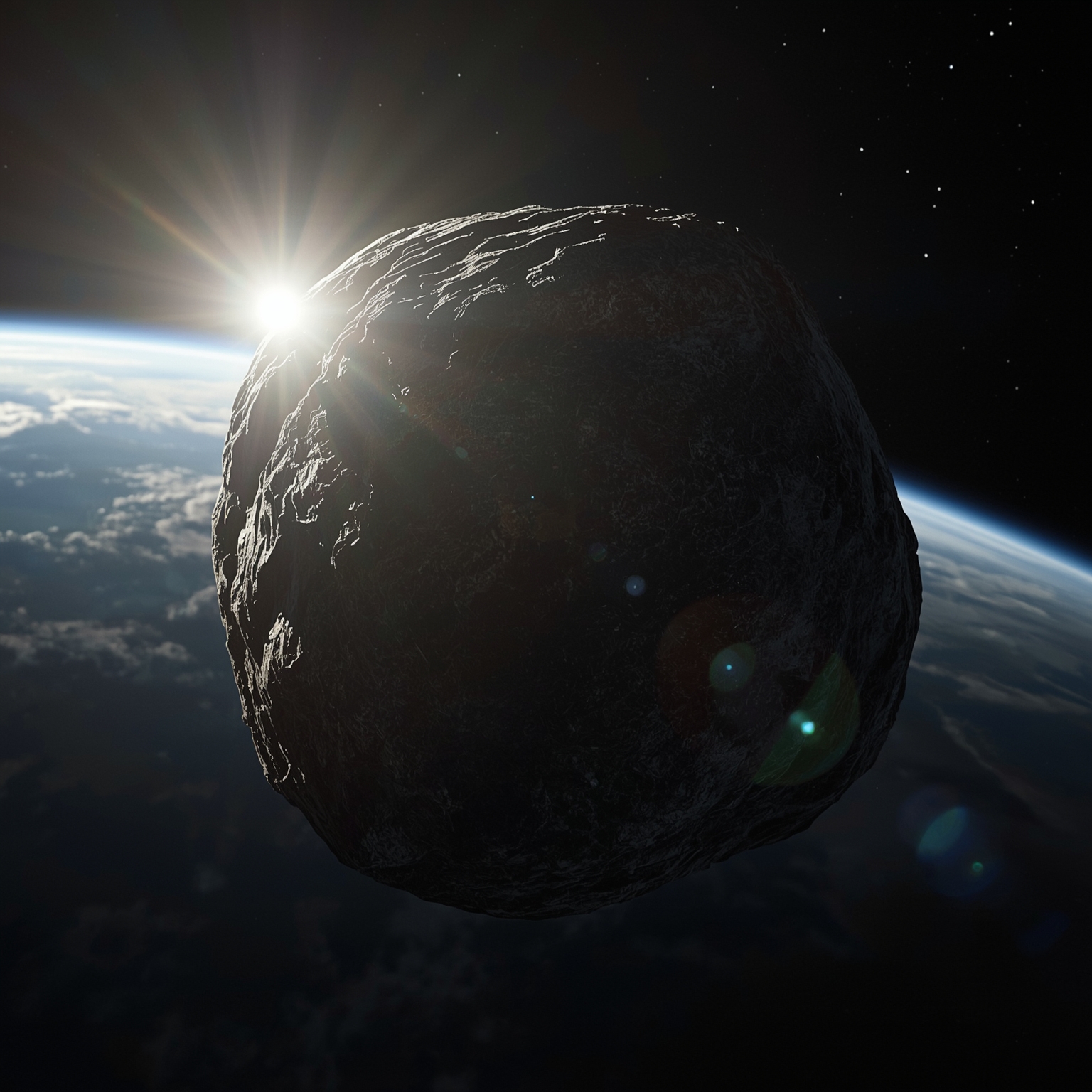
Across the vast expanse of our solar system, an unimaginable multitude of asteroids—ranging in size from small rocky shards to enormous celestial fragments—continuously hurtle through space at incredible speeds. These countless objects are the residual building blocks of our cosmic neighborhood’s infancy, relics left over from the earliest stages of planetary formation billions of years ago. While they primarily traverse predictable orbits far from Earth, their presence occasionally sparks concern when one of these itinerant travelers strays close enough to our planet to warrant heightened vigilance. Fortunately, advances in modern astronomy, coupled with sophisticated tracking techniques and powerful telescopes, usually allow scientists to forecast and monitor such close encounters before they pose any actual danger. Yet, a pressing question remains: what if one of these wayward bodies eludes detection entirely until it is alarmingly close?
This worrisome scenario becomes particularly relevant when considering a class of celestial objects known as “twilight asteroids.” These are bodies whose orbits situate them perilously close to the Sun’s brilliant glare—an unfortunate alignment that makes them exceedingly difficult to detect from Earth. From our perspective, these asteroids dwell in a blinding region of the sky visible only during fleeting moments of dawn or dusk, when the Sun hovers just below the horizon. Their invisibility during most of the day renders them nearly undetectable to conventional observational surveys. As if their evasive nature were not unsettling enough, one of the most recently identified members of this elusive group, designated 2025 SC79, has drawn extraordinary attention from the scientific community. According to researchers at Carnegie Science, this particular asteroid possesses an astonishingly rapid orbital period of a mere 128 days around the Sun, making it the second-fastest asteroid ever recorded.
The story of its discovery is as fascinating as it is concerning. Astronomer Scott Sheppard, a distinguished researcher affiliated with Carnegie Science, first spotted faint traces of 2025 SC79 while employing the Blanco 4-meter Telescope’s Dark Energy Camera during an observation session in September. The initial findings, intriguing yet uncertain, prompted further scrutiny through follow-up observations conducted with two of the world’s most powerful optical instruments—the Gemini and Magellan telescopes. These subsequent measurements confirmed that the faint, fast-moving speck was indeed a new asteroid that had long escaped detection due to its proximity to the Sun’s blinding radiance.
Further analysis revealed that 2025 SC79 is far from insignificant in scale. Astronomers estimate its diameter to be roughly 2,300 feet, or about 700 meters—nearly twice the soaring height of the Empire State Building. The asteroid’s remarkable combination of sheer size and extraordinary orbital velocity confers upon it a sobering distinction: it fits the criteria of a so‑called “planet killer,” a term reserved for celestial objects large enough to cause catastrophic consequences should they ever collide with Earth. In fact, Sheppard has devoted much of his scientific career to the careful pursuit and identification of exactly such formidable space bodies—objects whose discovery can drastically improve humanity’s understanding of potential cosmic threats.
To underline the gravity of the situation, Sheppard offered a candid reminder of the fundamental challenge facing planetary defense efforts. “The most dangerous asteroids are the most difficult to detect,” he explained, emphasizing that the majority of asteroids are typically discovered against the dark, star-specked canvas of the night sky, when optical telescopes can distinguish their faint motion more easily. By contrast, objects lurking near the Sun’s radiant disk—visible only during the brief windows of twilight—are effectively camouflaged by the overwhelming brightness of daylight. This natural concealment creates what astronomers often describe as a “blind spot” within our surveillance of near‑Earth space, rendering twilight asteroids a uniquely vexing category of potential threat.
For researchers like Sheppard, the difficulty lies not only in locating these stealthy objects but also in accurately plotting their trajectories once identified. Predictive modeling becomes far more complex when observational opportunities are limited to narrow time frames near sunrise or sunset. Given the critical importance of forewarning in the event of possible close approaches to Earth, he warns that these twilight bodies could “pose serious impact hazards” if their orbits intersect with our planet’s path. This concern reinforces the urgent need for continuous, innovative observation techniques that can pierce the Sun’s dazzling veil and detect faint, fast-moving hazards before they surprise us.
Of course, as Sheppard acknowledges, humanity cannot alter the natural alignment of celestial mechanics. We are powerless to reposition the Sun or redirect asteroids born of ancient cosmic collisions. Even so, he expresses optimism that persistent monitoring of this particular twilight object—2025 SC79—will enable astronomers to gather valuable insights about its physical composition, surface reflectivity, and orbital evolution. Such information, in turn, might reveal new strategies for spotting other, similarly hidden bodies in regions close to the Sun—zones of space historically underexplored because of observational limitations.
Sheppard also situates this discovery within a broader cosmic context. He notes that most asteroids in the solar system occupy well-known zones collectively referred to as belts—vast circumstellar regions, such as the main asteroid belt between Mars and Jupiter, where gravitational stability allows these rocky remnants to persist over eons. However, gravitational perturbations, including those triggered by planetary interactions or resonances, can disturb these asteroids’ stable orbits, sending them careening inward toward the Sun or outward toward the edges of the solar system. When such deviations occur, some asteroids end up in perilously close orbits like that of 2025 SC79, where both their detection and long-term tracking become formidable challenges. Understanding the precise mechanisms that push them into these inner solar regions, Sheppard emphasizes, is not merely an exercise in astronomical curiosity. It plays a vital role in safeguarding our planet from unforeseen impacts while simultaneously deepening our comprehension of how the solar system’s architecture has evolved since its earliest days. In this way, every discovery—even one that initially seems alarming—ultimately contributes to the greater cause of planetary defense and the continuing quest to unravel the story of our cosmic origins.
Sourse: https://gizmodo.com/astronomers-just-found-a-sneaky-asteroid-near-the-sun-and-it-highlights-a-dangerous-blind-spot-2000675481


