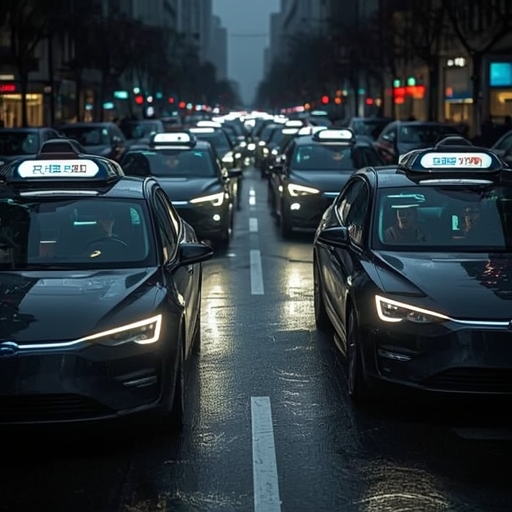
In the bustling city of Wuhan, an unexpected disruption occurred that captured global attention and reignited the conversation about the dependability of autonomous transportation. Baidu’s Apollo Go robotaxis—advanced self-driving vehicles designed to operate without direct human control—suddenly came to a halt during operation, reportedly leaving several riders stranded mid-journey. The incident was brief yet symbolically powerful, underscoring the persistent tension between technological innovation and public safety. It also prompted renewed scrutiny over whether society can indeed place complete trust in artificial intelligence when it governs complex, real‑world systems such as urban mobility.
For many observers, this malfunction serves as a compelling reminder that despite rapid progress in machine learning, sensor integration, and navigation algorithms, driverless cars remain vulnerable to system errors, connectivity issues, and unpredictable environmental variables. Autonomous vehicles, while often celebrated as embodiments of future transportation, must still undergo rigorous and transparent testing to ensure that their decision-making mechanisms perform reliably under every imaginable circumstance—from congested city intersections to sudden weather changes or unexpected pedestrian behavior.
Baidu’s situation in Wuhan consequently raised not only technical questions but also regulatory and ethical ones. If a fleet of AI-operated taxis can abruptly freeze on a major city street, what levels of redundancy, oversight, or human intervention should be mandated to prevent similar occurrences? For city planners, engineers, and technology companies, such an incident reinforces the urgent necessity of developing clearly defined safety protocols, auditing mechanisms, and emergency response strategies. Transparency about how autonomous systems detect and respond to faults is crucial for cultivating public confidence.
The implications extend beyond a single episode. As artificial intelligence continues to transform transportation paradigms worldwide, this event acts as a case study in both the promise and fragility of machine autonomy. It compels policymakers, innovators, and commuters alike to reconsider how much trust can—or should—be placed in systems that operate without direct human guidance. Ultimately, the conversation transcends Wuhan. It touches on the shared aspiration for efficient, intelligent, and safe future cities, reminding us that progress in mobility must advance hand in hand with accountability and trust. Would you, given such an event, feel comfortable entrusting your daily commute to a fully autonomous taxi?
Sourse: https://www.bloomberg.com/news/articles/2026-04-01/baidu-robotaxis-freeze-in-wuhan-sparking-flurry-of-police-calls