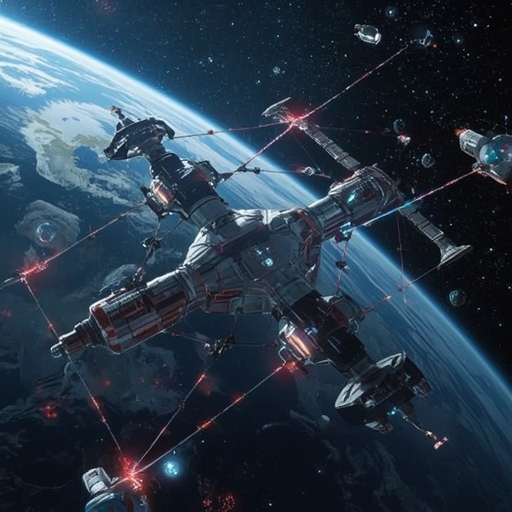
In an age defined by relentless technological progress, the convergence of space exploration and artificial intelligence stands as one of the most daring and visionary pursuits undertaken by humanity. The phrase “beyond Earth” no longer refers merely to voyages into the unknown; it signifies a comprehensive strategy through which human aspiration, corporate innovation, and scientific ingenuity unite to transcend traditional boundaries of progress. The growing network of partnerships between aerospace pioneers and AI innovators has created a synergistic ecosystem where advancements in one domain directly accelerate breakthroughs in the other. Space, once perceived solely as a frontier of discovery and adventure, has evolved into a proving ground for data-driven intelligence and autonomous reasoning—domains that shape the next generation of smart systems capable of analyzing, adapting, and learning from the cosmic environment itself.
At the heart of this transformation lies the recognition that artificial intelligence is essential for navigating the complexity of modern space missions. From autonomous robotic explorers traversing distant planetary surfaces to self-correcting algorithms that manage satellite constellations, AI’s capacity for decision-making under uncertainty redefines what humanity can achieve in environments where human presence remains limited. Similarly, the challenges posed by space—its isolation, unpredictability, and scale—provide the ultimate testing conditions for refining machine learning models and computational systems built to process vast amounts of sensory data with precision and speed. This symbiotic exchange ensures that every advance in one field contributes directly to enhancements in the other, creating a positive feedback loop of innovation.
Collaborations between private enterprises and research institutions further amplify this momentum. Visionary billionaires and global technology companies are investing in joint ventures that combine orbital engineering with advanced neural networks, effectively transforming satellites and spacecraft into intelligent, responsive instruments of exploration. These initiatives are not simply about reaching new celestial destinations; they are about redefining how we interpret, utilize, and learn from the data generated beyond our atmosphere. The implications extend far beyond science and commerce—touching energy systems, climate monitoring, telecommunications, and even the very architecture of future AI itself.
Ultimately, what emerges is a portrait of humankind at a pivotal crossroads: a species that looks skyward not only to satisfy curiosity, but to cultivate the intelligence necessary for steering its own destiny. As partnerships in space continue to evolve, they reveal a profound truth—the pursuit of the stars and the refinement of artificial intelligence are not separate endeavors, but interdependent expressions of the same unyielding drive to know, create, and transcend. In this union of cosmic ambition and cognitive technology lies the essence of our future: a future in which innovation, guided by collaboration and imagination, carries us far beyond the boundaries of Earth into realms shaped as much by thought as by exploration itself.
Sourse: https://www.wsj.com/tech/ai/the-out-of-this-world-reasons-for-elon-musks-spacex-deal-7c075951?mod=pls_whats_news_us_business_f