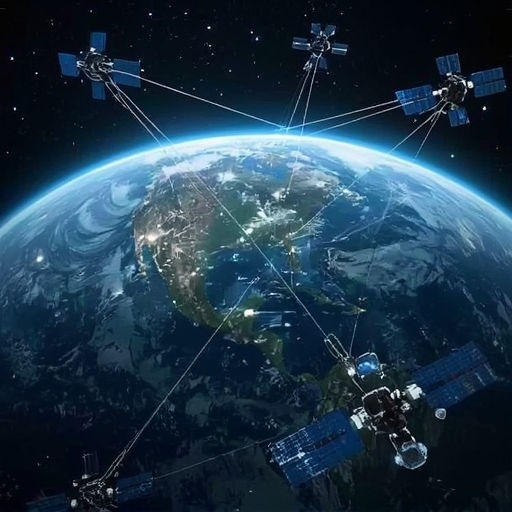
Blue Origin has formally entered the rapidly evolving and highly competitive satellite internet arena with the unveiling of its ambitious project, *TeraWave*. This next-generation orbital network is designed to deliver up to an astounding six terabits of global connectivity, a figure that signals an extraordinary leap forward in the scale and scope of space-based communications technology. By making such immense bandwidth accessible worldwide, TeraWave aims to reshape digital access and transform the way humanity connects across continents, oceans, and remote environments.
While SpaceX’s Starlink currently leads the charge in the commercial satellite internet industry, Blue Origin’s move positions it as a formidable challenger. The two enterprises now stand at the forefront of an expanding frontier defined by orbital innovation and relentless pursuit of high-speed global connectivity. Where Starlink has already achieved broad deployment and recognition, TeraWave proposes to surpass the limits of current capability through extreme scalability, advanced reliability, and a promise of unprecedented data speeds.
By projecting a system capable of both extensive coverage and balanced capacity for uploads and downloads, Blue Origin’s TeraWave reflects a meaningful evolution in how satellite constellations are conceived. No longer is the objective limited to providing access; the goal has grown into enabling seamless, instantaneous digital interaction on a truly planetary scale. For developing regions without terrestrial infrastructure, for ships crossing isolated oceans, or for remote research outposts stationed at the edges of civilization, such a network could dissolve the longstanding barriers of location.
TeraWave’s introduction is not merely a technological milestone but also a symbolic statement about Blue Origin’s long-term vision. It reaffirms the company’s intention to participate decisively in the commercialization of space, not only through rocketry and transport but via systems that sustain continuous communication and data exchange between Earth and orbit. The announcement underscores a broader transformation in the global communications landscape, as privatized spaceflight pioneers redefine digital networks that once depended solely on ground-based transmission.
If TeraWave fulfills its potential, its influence will extend beyond consumer internet to sectors such as enterprise cloud computing, defense, logistics, and scientific observation. The convergence of immense bandwidth with satellite resilience could accelerate the evolution of remote automation, edge computing, and next-generation data services. In essence, Blue Origin’s latest undertaking invites the world to imagine an era when high-capacity information flow is not confined by geography but radiates evenly through orbit-based systems encircling the planet.
The competition between Blue Origin’s TeraWave and SpaceX’s Starlink therefore represents more than a commercial rivalry—it stands as a defining contest in the evolution of global technology. The outcome will shape not only how people access information but how societies grow and engage in a networked civilization that thrives on real-time connection. As this new chapter in the aerospace revolution begins, the sky above us becomes less an empty expanse and more an intricate web of luminous pathways carrying humanity’s collective digital heartbeat forward into the cosmos.
Sourse: https://www.theverge.com/news/865282/blue-origin-terawave-satellite-6tb