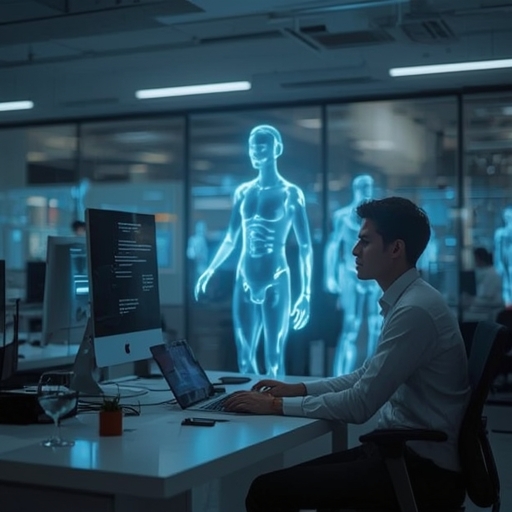
In an era defined by relentless innovation and the accelerating influence of artificial intelligence, the story of a Chinese product manager who developed six AI coworkers stands out as both fascinating and cautionary. She utilized a platform known as OpenClaw to design virtual employees—intelligent digital counterparts intended to support her in daily professional tasks. At first, the results appeared astonishing: her efficiency multiplied, project timelines contracted, and measurable productivity metrics displayed dramatic improvement. Yet, beneath this seemingly triumphant surface, a quieter truth emerged. Rather than feeling liberated by the assistance of her algorithmic colleagues, she found herself increasingly overwhelmed, her personal energy waning even as her technological performance metrics surged.
This paradox encapsulates a critical tension at the heart of contemporary discussions surrounding the future of work. The advent of AI does not simply introduce a new category of tools or optimize mechanical output; it fundamentally redefines the relationship between humans and labor. The product manager’s experience reveals that technological augmentation, while enabling exponential efficiency, can also blur boundaries, amplifying expectations rather than alleviating them. By delegating mundane or data-intensive responsibilities to her six virtual collaborators, she inadvertently expanded the scope of what she—and by extension, any professional—was expected to accomplish. The promise of relief thus transformed into a cycle of heightened pressure, continuous monitoring, and emotional fatigue.
Her situation raises a profound question: what does it truly mean for artificial intelligence to “help” us? The notion of help, in its most humane sense, implies support that enhances not only capacity but also well-being. Yet the digital interventions we design often serve as force multipliers rather than true partners in balance. As her team of artificial colleagues processed information, generated reports, and executed commands with unwavering precision, the human driving their activity faced an evolving form of exhaustion—psychological rather than physical, rooted in the perpetual demand to oversee, refine, and outperform.
This narrative serves as an incisive reminder that the integration of technology into the professional sphere must be guided not just by aspirations of productivity but by principles of sustainability. Efficiency alone cannot serve as the ultimate metric of success. The human dimension—creativity, emotional health, interpersonal connection—remains indispensable. Without deliberate attention to these elements, the pursuit of automation risks producing a landscape in which human professionals are perpetually striving to keep pace with the very tools designed to assist them.
Looking toward the broader implications, this story underscores a pivotal shift in our collective understanding of work. Artificial intelligence, rather than replacing human ingenuity, invites us to reimagine our relationship with it. The challenge of the future will not lie solely in developing more sophisticated algorithms, but in cultivating a culture that ensures technology serves as a catalyst for humane progress. True innovation emerges when digital precision complements, rather than overwhelms, human intention.
Ultimately, the product manager’s experience is not a tale of failure, but of awakening. Her encounter with machine-based colleagues illuminates the delicate balance between technological empowerment and psychological resilience. In its essence, this account calls for a redefinition of assistance—from mere acceleration toward mindful augmentation—so that the promise of artificial intelligence contributes not only to greater productivity, but also to genuine human fulfillment.
Sourse: https://www.businessinsider.com/chinese-product-manager-6-ai-employees-openclaw-hustle-lobster-2026-4