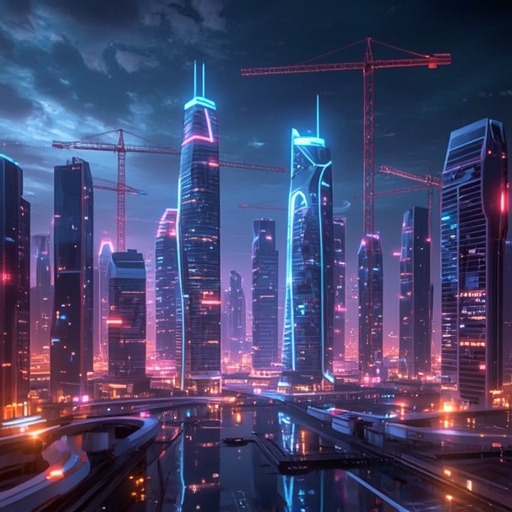
Across industries and societies, an undeniable truth is becoming increasingly clear: genuine progress is driven not by endless deliberation, but by the courage and determination to build. While policymakers and pundits continue to debate the long-term consequences of automation and artificial intelligence, a different group of individuals—innovators, entrepreneurs, and forward-thinking creators—are already shaping the systems that will define the decades ahead. Their message is unmistakable and empowering: the future will not be delivered through political inertia or bureaucratic reform; it will be realized through the ingenuity of those willing to act.
Automation and AI are advancing at a pace that far exceeds conventional governance structures. Traditional frameworks of legislation and policy, bound by the slow tempo of consensus, can no longer anticipate or regulate the transformations reshaping our economy, labor markets, and concept of work itself. In this widening gap between technological capability and public policy lies an extraordinary opportunity—a space where innovators are experimenting with bold new paradigms such as universal basic income, human–machine collaboration models, and agile systems of social support. These are not distant ideas or speculative hypotheses; they are active experiments in redesigning how society functions in the face of machine intelligence.
Where some see uncertainty, builders see potential. Visionary leaders across the globe are harnessing automation not as a threat to human employment, but as a catalyst for redefining productivity, creativity, and meaning in work. They are designing infrastructures that adapt to rapid technological evolution—frameworks capable of supporting both economic efficiency and human fulfillment. In doing so, they demonstrate that progress need not depend on top-down policy directives: it can emerge organically from those who innovate with empathy, precision, and foresight.
This movement is not confined to Silicon Valley or any single locus of innovation; it is global and decentralized. From local entrepreneurs crafting specialized tools that streamline essential labor, to global teams imagining entirely new economic ecosystems, the spirit of building transcends geography and ideology. Its essence lies in a shared belief—that humanity’s greatest asset is its creative will to adapt and improve.
So, while others wait for Washington to catch up, a new generation of builders quietly advances the frontier. They are the ones crafting prototypes, writing code, testing new governance models, and reimagining what labor, value, and purpose will mean in an era defined by intelligence both human and artificial. In their hands lies the promise of a brighter, more equitable, and dynamically evolving future. The builders remind us that meaningful change is never legislated into existence; it is constructed—one innovation, one experiment, one act of creation at a time. The true architects of progress are not the ones who merely forecast the future, but those who dare to build it.
Sourse: https://techcrunch.com/video/why-andrew-yang-is-building-instead-of-waiting-for-washington/