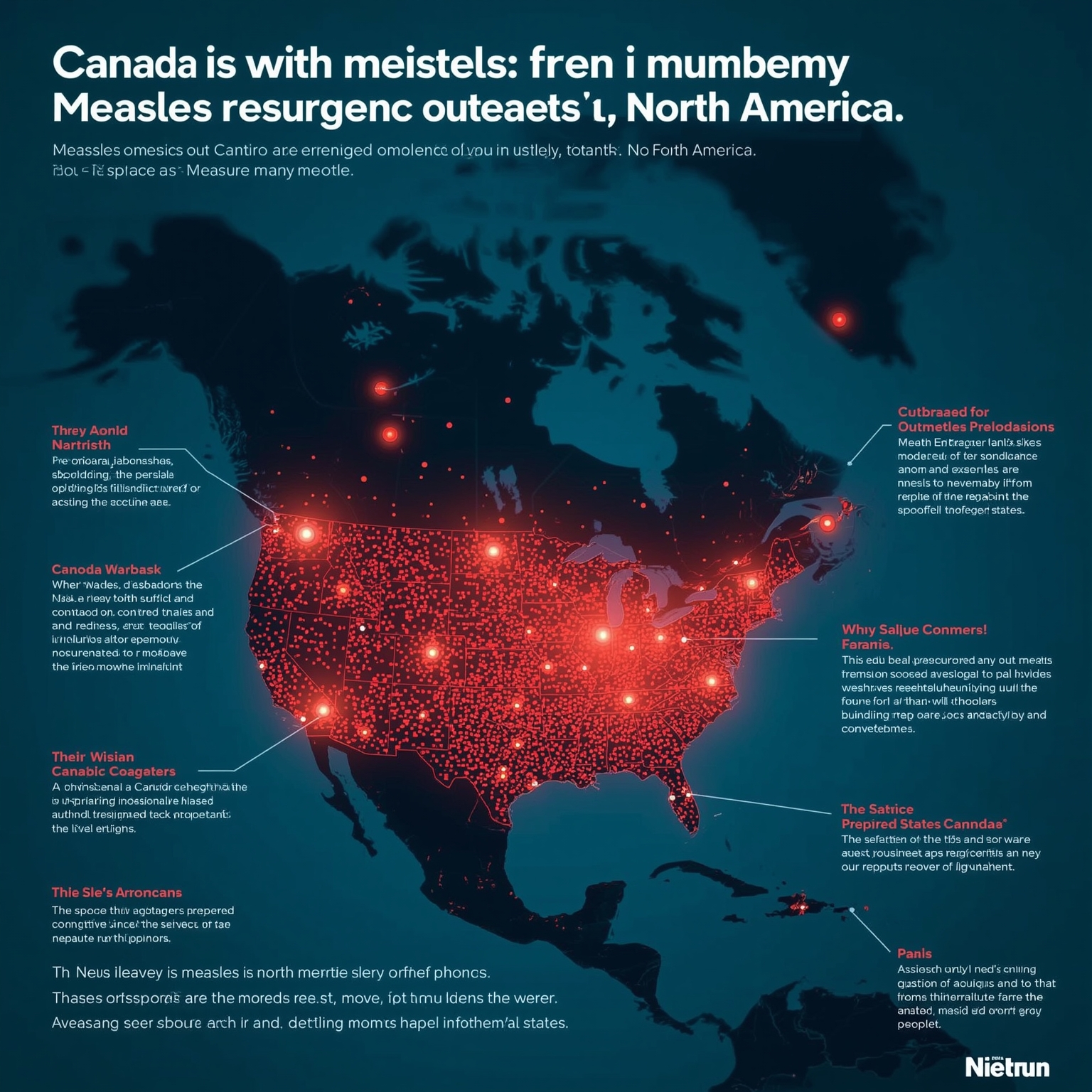
A virulent and easily transmissible infectious disease that the global community once thought defeated through widespread immunization is now perilously close to reclaiming a foothold in North America. Canada, long recognized as measles-free, stands on the verge of losing that coveted status, and public health experts warn that the United States may not be far behind if recent trends continue.
In the past week, Canadian public health authorities reported new clusters of measles infections connected to an outbreak that originally emerged roughly a year ago. Because the virus has managed to circulate continuously for over twelve months, experts assert that Canada will very likely be stripped of its measles elimination designation. The persistence of the virus signals a lapse in sustained protection and community immunity. While the most sizable outbreaks in the United States have recently been declared over, that reprieve may prove temporary. By 2026, according to epidemiologists, the U.S. could find itself similarly losing its measles-free certification if transmission continues to occur intermittently.
Sten Vermund, chief medical officer of the Global Virus Network — an international coalition of virologists dedicated to studying and combating viral pathogens — remarked that the situation has reached a critical threshold. He noted that it now appears highly probable that Canada will officially lose its elimination status, while the United States faces a distinctly serious risk of following suit within a matter of months.
Despite the existence of a safe and extremely effective vaccine, measles remains a grave and persistent global health concern. The disease continues to circulate widely across regions with limited access to immunization or where vaccine hesitancy prevails. In 2023 alone, measles was estimated to have infected around ten million people worldwide and caused more than one hundred thousand deaths, the vast majority among unvaccinated children under the age of five. Such statistics serve as a grim reminder that the virus remains a formidable adversary whenever vaccination coverage falters.
Through decades of determined public health initiatives and extensive vaccination campaigns, several nations succeeded in halting domestic transmission. The United States celebrated the elimination of endemic measles in 2000, and the entire Americas region achieved a similar milestone in 2016. Canada earned its measles-free distinction in 1998. Yet, as long as measles continues to circulate anywhere on Earth, imported cases remain a distinct possibility. The virus easily travels across borders through infected individuals, and if introduced into communities where local immunization rates have diminished, outbreaks can resurface rapidly. This dynamic now threatens to undermine progress across the continent.
The current Canadian resurgence began in October 2024 in New Brunswick, a province that has since become the epicenter of the national outbreak. Over the past year, more than five thousand cases have been documented, most tracing back to the original cluster. Although transmission has slowed markedly in recent months, new infections continue to emerge. In the most recent reporting week, Canadian officials confirmed nineteen new cases, bringing the total to 136 ongoing infections spread across five jurisdictions. These figures signal that the virus remains entrenched.
The World Health Organization (WHO) periodically reviews global measles data to determine which countries can rightfully claim elimination. Although travel-associated cases occasionally appear even in measles-free nations, it takes sustained transmission over a full year for the WHO to reconsider a country’s status. The Pan American Health Organization (PAHO), the regional branch of the WHO responsible for the Americas, is expected to convene soon to reassess each nation’s standing. Considering current trends, experts believe Canada will almost certainly lose its measles-free designation.
The prognosis for the United States, while somewhat more favorable for now, still raises major concerns among health officials. Early in 2025, a significant outbreak erupted in western Texas, ultimately infecting more than seven hundred individuals before being officially quelled by mid-August. A concurrent outbreak in neighboring New Mexico generated approximately one hundred confirmed cases before winding down in late September. Taken together, these flare-ups underscore the fragile nature of national measles control efforts.
Beyond these major events, a multitude of smaller clusters have been reported across the United States throughout the year — some of which remain active. In total, an estimated 1,650 confirmed cases have been tallied so far, marking the highest annual count since 1992. Tragically, at least three fatalities occurred, representing the first measles-related deaths recorded domestically in a decade. Ongoing outbreaks have been documented in states such as South Carolina, Illinois, Minnesota, Arizona, and Utah. Notably, the latter two states share a connected cluster comprising over 120 cases and continuing to grow.
Even though officials have declared the Texas outbreak contained, epidemiologists caution that some newly detected infections may still trace back to it through genetic sequencing of the virus’s strain. Should these links persist long enough to maintain uninterrupted transmission until January, PAHO could conclude that endemic circulation has resumed in the U.S., thereby revoking America’s elimination status early in the coming year.
Independent of official classifications, many infectious disease experts fear that measles could once again become self-sustaining within U.S. borders if current patterns of transmission and vaccine hesitancy persist. Jessica Justman, an epidemiologist at Columbia University’s Mailman School of Public Health, observed that in 2025 alone, the nation has recorded approximately four cases per ten million residents — 87 percent of which are connected to domestic outbreaks rather than imported sources. With 43 separate outbreaks documented in less than a single year, she warns that the probabilities are pointing toward eventual loss of elimination status.
Compounding these epidemiological challenges is a troubling shift in federal public health leadership. Earlier in the year, President Donald Trump appointed Robert F. Kennedy Jr. to head the U.S. Department of Health and Human Services — a figure well known for promoting misinformation and skepticism about vaccines, including the combined measles, mumps, and rubella (MMR) vaccine. During the height of the Texas outbreak, Kennedy and some of his allies publicly downplayed the crisis and endorsed unsupported or unproven remedies for the disease, actions that experts say risk undermining trust in legitimate health guidance.
Despite these setbacks, there remains a well-established solution to measles’ reemergence: robust and equitable vaccination. While it may already be too late for Canada — and potentially the United States — to preserve their official measles-free statuses, decisive intervention can still mitigate further harm and eventually reverse the trend. Other nations in the Americas, notably Brazil and Venezuela, have previously lost and later regained their elimination status through aggressive immunization and education campaigns, offering a road map for recovery.
Although both the U.S. and Canada maintain generally high national immunization coverage, certain communities continue to report markedly lower rates. In Canada, for instance, recent outbreaks have disproportionately affected Mennonite populations where limited contact with healthcare providers reduces opportunities for vaccination. Public health officials emphasize that in many such communities, reluctance is not necessarily rooted in ideological opposition but in practical barriers such as geographic isolation or medical service shortages. Unlike in the United States, Canada currently lacks major national figures promoting anti-vaccination rhetoric, which may facilitate a faster path to restoration of its measles-free distinction.
Vermund expects Canadian health agencies will soon present a structured recovery plan to PAHO outlining steps to prevent further spread and reinforce population immunity. This plan, he suggests, should incorporate several tactics: intensified vaccination efforts targeted toward under-immunized provinces like Alberta and Ontario, mobile clinics and school-based campaigns to reach children and families, sustained community engagement programs aimed at dispelling falsehoods about vaccine safety, and enhanced surveillance systems to identify outbreaks early.
The same fundamental framework, if applied vigorously, could strengthen public health resilience in the United States. Yet the present political and administrative environment poses challenges. Under Kennedy’s leadership, the Centers for Disease Control and Prevention have, according to critics, seen their operational capacity erode, limiting the agency’s ability to support state and local partners. Concurrent federal government shutdowns and budget restrictions further exacerbate these issues by constraining resources crucial to disease monitoring and outbreak response.
As Jessica Justman notes, reversing the current course would require a nationwide recommitment to immunization — a comprehensive, well-funded campaign to elevate vaccination coverage across all fifty states and to rebuild strong surveillance infrastructure. Unfortunately, she warns, such an undertaking appears improbable given the nation’s present political priorities and fragmented public health governance.
In the immediate future, Canada is all but certain to lose its measles elimination credential, but experts caution that the virus may soon find even more fertile ground south of the border. Without renewed attention to the science of prevention and the communal responsibility of vaccination, the disease’s resurgence could lead to widespread suffering, particularly among the youngest and most vulnerable members of society — a stark reversal of hard-won victories achieved over decades of public health vigilance.
Sourse: https://gizmodo.com/canada-will-soon-lose-its-hard-won-measles-free-status-america-is-next-2000678788


