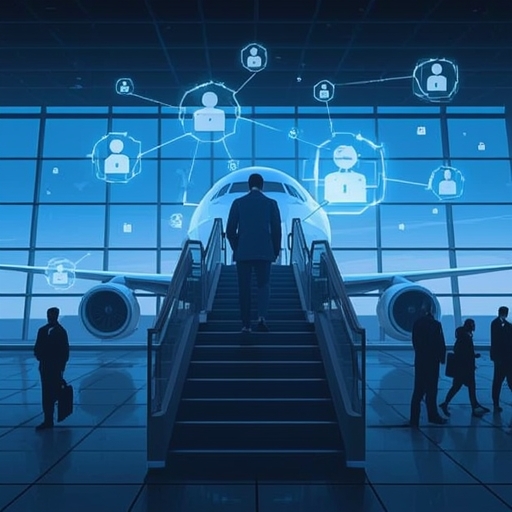
In a remarkable and unsettling incident that has captured attention across borders, American prosecutors have formally charged a Canadian citizen with wire fraud after he allegedly spent years masquerading as an airline employee. According to investigators, this individual—reportedly a 33‑year‑old resident of Toronto—managed to use falsified credentials to access hundreds of complimentary flights within the United States. If these accusations prove accurate, his actions point to an extraordinary and deliberate exploitation of aviation systems that rely heavily on trust, professional identity, and procedural verification.
Authorities indicate that by presenting himself as legitimate crew or ground staff, the suspect exploited the goodwill and protocol of numerous airlines. Each flight taken without payment not only defrauded those companies but also potentially jeopardized the integrity of airport and airline security systems. Beyond the immediate crime, the case underscores the increasing vulnerability of modern travel infrastructure to identity manipulation and document forgery—issues that have become more complex with digital booking, electronic identification, and automated check‑in technologies.
The accused now faces wire‑fraud charges in a U.S. federal court, a serious offense carrying the possibility of severe penalties under American law. Legal experts explain that this category of fraud extends to schemes in which communication networks—such as email and online portals—are used to carry out deceitful activities, a definition that neatly captures the alleged methods of this case.
For airlines, aviation regulators, and cybersecurity professionals, this episode serves as a stark reminder of how crucial vigilant identity verification has become. It invites a broader conversation about the balance between customer convenience and rigorous security requirements in high‑traffic environments like airports. Just as importantly, it raises public awareness of how human error or misplaced trust can be exploited by individuals intent on circumventing complex systems.
While the full extent of the investigation and any potential trial proceedings are yet to unfold, this dramatic story already functions as a cautionary tale in both the travel and cybersecurity sectors. It illustrates that in an age where digital credentials often stand in for physical identification, continuous improvement in fraud detection and inter‑agency cooperation is not just desirable but essential for protecting the integrity of global aviation.
Sourse: https://www.businessinsider.com/canadian-man-accused-posing-as-airline-staff-score-free-flights-2026-1