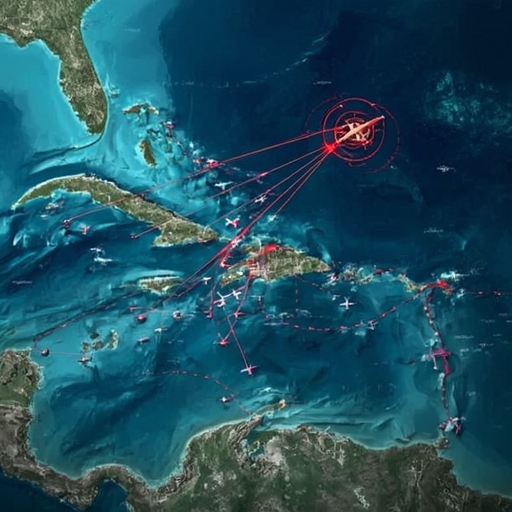
The Caribbean region has been thrown into an unprecedented state of aerial disarray, as nearly one thousand commercial flights have been abruptly canceled in the aftermath of the recent United States raid on Venezuela. This sudden halt in scheduled operations has left countless travelers stranded across multiple islands, creating scenes of confusion, uncertainty, and escalating frustration at airports that are ill-equipped to handle such a large-scale disruption. The impact extends well beyond immediate inconvenience; it has paralyzed critical tourism economies dependent on steady air connectivity, disrupted supply chains, and forced innumerable families and professionals to alter their plans with little or no warning.
In response to this rapidly evolving crisis, a number of major international and regional airlines have initiated emergency measures designed to stabilize the situation and assist affected passengers. Carriers are deploying additional aircraft and organizing a sequence of rapidly scheduled ‘rescue flights’ in a coordinated attempt to repatriate travelers and restore a sense of order to severely affected transit hubs. These extraordinary efforts underscore both the complexity and fragility of modern aviation networks, demonstrating how swiftly geopolitical developments can cascade into logistical turmoil with global consequences.
For travelers, this episode serves as a stark reminder of the intrinsic volatility of international air transport during moments of political upheaval. Passengers are being urged to remain patient, to monitor official airline communications diligently, and to avoid misinformation circulating on social networks. Travel authorities emphasize that the restoration of regular service across Caribbean destinations will likely be gradual and contingent on regional stability, aircraft availability, and airspace permissions.
From a broader perspective, this disruption has illuminated the strategic necessity for airlines and local governments to develop more resilient crisis-response frameworks. The ability to mobilize resources swiftly, communicate transparently, and collaborate across jurisdictions is proving indispensable. As emergency flights continue to depart, each carrying home hundreds who were previously marooned, the ongoing coordination among aviation authorities highlights a collective commitment to safety, efficiency, and the swift reestablishment of connectivity throughout the region.
In essence, while the Caribbean’s azure skies may temporarily reflect turbulence in both a literal and geopolitical sense, the region’s aviation sector is demonstrating remarkable adaptability. Through a combination of rapid operational adjustments and long-term planning, the industry is working tirelessly to transform what began as a moment of paralysis into a lesson in resilience and cooperative recovery.
Sourse: https://www.businessinsider.com/maps-show-scale-of-caribbean-flight-cancellations-and-extra-flights-2026-1