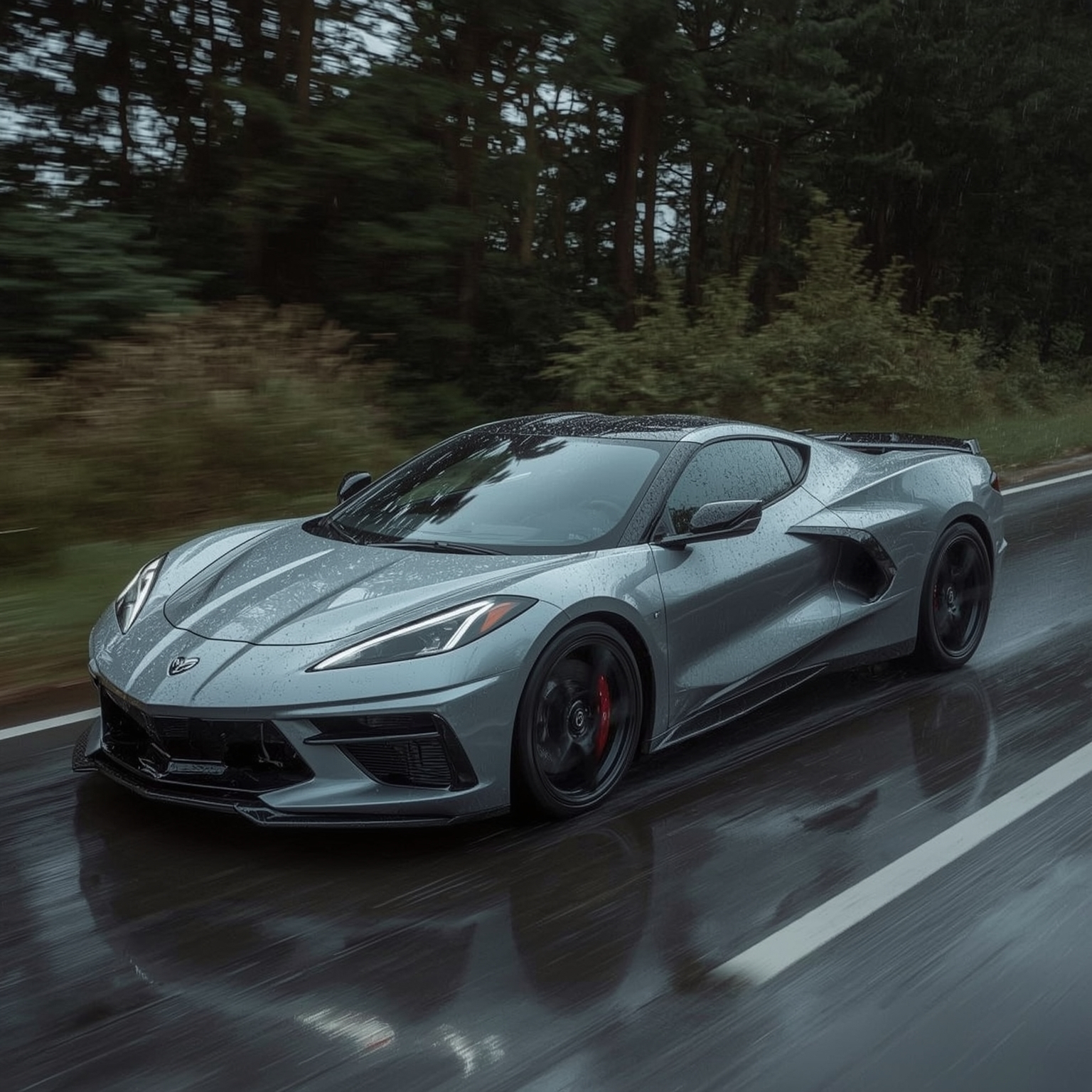
At the heart of the latest Corvette E-Ray lies a compact yet highly sophisticated 1.9-kWh lithium-ion battery, carefully integrated into the car’s already substantial and structurally rigid central tunnel. This installation ensures that the vehicle’s balance and center of gravity remain optimized, a crucial consideration in performance engineering. To guarantee the system’s reliability during intensive driving sessions and fluctuating weather conditions, engineers have implemented an enhanced cooling architecture dedicated to maintaining the battery’s ideal operating temperature. Supplementing this subsystem is an updated suite of control software designed to ensure perfect synchronization between every participating element of the hybrid powertrain, creating an orchestra of mechanical and electric harmony.
The result of this technical fusion is a hybrid system that contributes an additional 160 brake horsepower, elevating the total power output to an impressive 645 bhp. This figure nearly mirrors that of the ferocious Z06, signifying that Corvette’s electrified evolution has retained its signature ferocity. The vehicle also inherits the aerodynamically assertive and competition-inspired bodywork of the track-focused variant, wearing a broad and purposeful wide-body stance that exudes performance intent. Once optional carbon-ceramic brakes now come standard, offering exceptional fade resistance and weight savings under repeated high-speed stops. The tires, monumental in size and presence, measure 275/30ZR-20 in the front and an enormous 345/25ZR-21 in the rear—demonstrating the car’s mission to maximize traction and cornering stability. For those wishing to venture beyond fair-weather drives, specially formulated all-season Michelin Pilot Sport tires are available, offering a rare combination of endurance, comfort, and confidence in varied climates.
### Riotous Design
Although the engineering prowess behind the E-Ray is undeniable, opinions about its styling are somewhat divided. One might argue that its exterior aesthetics do not fully reflect the level of technical ambition displayed elsewhere. Since the Corvette’s introduction in 1953, its visual evolution has followed the broader arc of American automotive design culture, occasionally achieving moments of pure brilliance—such as the sensually sculpted C2 Sting Ray of the 1960s or the angular, futuristic C4 that dominated the 1980s. The newest iteration, however, expresses a more chaotic energy: a vivid collage of intersecting lines, exaggerated vents, and sharp geometric volumes. The result is undeniably dramatic and commands instant public attention, as evidenced by the crowds it attracted during WIRED’s recent test drive. Yet, despite its spectacle, its aesthetic may lack the timeless cohesion of classic design icons—it is striking, yes, but perhaps not conventionally beautiful.
Inside, the car continues its unapologetically expressive narrative. The cabin layout has been engineered with surprising accessibility; ingress and egress are made easy thanks to wide-opening doors and carefully contoured sills. The seats, more generously padded and upholstered in premium materials, provide a luxurious contrast to the spartan interiors of some rival supercars, emphasizing comfort as well as control. The steering wheel, cut into a trendy squared-off shape with downward-angled spokes, may appear unconventional at first glance, but it contributes to enhanced visibility of the digital display cluster. From the driver’s perspective, the seating position feels low and commanding, offering an unobstructed forward view aided by slender A-pillars that mitigate blind spots. Rearward visibility, typically a challenge in mid-engine cars, is alleviated by a well-implemented camera-based rear-view mirror, reducing anxiety during reversals or tight maneuvering.
Directly ahead, the driver is greeted by a customizable digital instrument cluster featuring multiple configurations tailored for different driving modes. A high-definition Head-Up Display projects key performance data directly onto the windshield, allowing quick reference without distraction. Dominating the center console is an inclined touchscreen interface that governs the infotainment system with crisp response and clear graphics. Running along the prominent central tunnel—a signature Corvette interior motif—is an elegantly swooping arrangement of controls. The leading edge houses a comprehensive strip of tactile switchgear responsible for climate control and various secondary functions. Although at first the configuration appears over-stylized and potentially impractical, actual operation reveals thoughtful ergonomics that make daily use intuitive rather than overwhelming.
### Electric Stealth
Among the many technological novelties introduced in the E-Ray, none embody the hybrid transformation more clearly than its so-called “Stealth” mode. This feature, as its name suggests, allows the car to glide silently away under full electric power, avoiding the rumbling thunder of its signature V-8. The sensation of piloting a Corvette that moves almost noiselessly—propelled only by its front-mounted electric motor—is both surreal and groundbreaking, particularly given the model’s long-standing reputation for auditory drama. Although the pure-electric range of this mode extends only a few miles, its real-world value lies in discretion and versatility: owners can depart early in the morning or return home late at night without disturbing neighbors, experiencing for a brief moment the novelty of an electric, front-wheel-driven Corvette. This fleeting silence, juxtaposed against the latent roar of its combustion counterpart, encapsulates the fascinating duality that defines the E-Ray: an icon of American performance now fluent in the language of electrification.
Sourse: https://www.wired.com/review/corvette-e-ray/