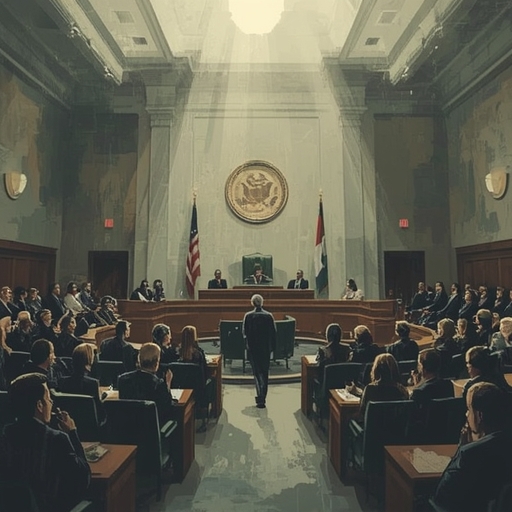
A visibly defiant Brendan Carr appeared before the Senate Commerce Committee on Wednesday, marking his first formal encounter with lawmakers since he drew public outrage for comments perceived as threatening toward broadcasters that aired comedian Jimmy Kimmel’s late-night program. His testimony, which stretched over nearly three hours, unfolded as an unusually charged display of political tension and legal interpretation. During this extended session, Carr—currently serving as Chairman of the Federal Communications Commission—found himself in the crossfire of intense partisan scrutiny. Exchanges with Democratic senators grew especially combative and ideological, whereas Republicans generally adopted a more restrained tone, asking procedural or peripheral questions. Yet despite their different approaches, legislators from both parties conveyed at least some concern that Carr’s rhetoric hinted at a troubling willingness to stretch or potentially distort the protections guaranteed under the First Amendment, even though few expected any immediate repercussions or meaningful change in his stance.
The controversy dominating the hearing centered on remarks Carr delivered back in September, following the highly publicized killing of conservative activist Charlie Kirk. In the aftermath of that tragedy, Kimmel had made a sardonic joke during his program regarding the suspect’s political leanings—a comment that provoked outrage among right-leaning figures. Seizing upon that moment, Carr told media commentator Benny Johnson that Kimmel’s words represented, in his view, “some of the sickest conduct possible.” He further suggested that the stations airing such material might face consequences under existing broadcasting rules, adding provocatively, “We can do this the easy way or the hard way.” Those remarks, laced with an unmistakable tone of warning, drew condemnation even from within Carr’s own political camp. Senator Ted Cruz, the Republican chairman of the Senate Commerce Committee, characterized them as reminiscent of “mafia-style” intimidation. Nevertheless, during the hearing Carr firmly rejected any insinuation of menace, insisting that his statement had been deliberately mischaracterized—“projection and distortion by Democrats,” as he phrased it. He repeatedly emphasized that his mandate as FCC chairman is to uphold the laws as enacted by Congress, which include a longstanding requirement that broadcast licenses operate “in the public interest.” From Carr’s perspective, this principle not only empowers but obligates the commission to act when it suspects news distortion or abuse of the public trust. Despite multiple invitations from senators to express remorse or moderation, Carr refused to retreat, declaring unequivocally, “My job is to enforce the law as passed by Congress … and broadcast television is fundamentally different from any other medium.”
Democrats, for the most part, adopted an aggressive posture, zeroing in on Carr’s past comments as evidence of partisan bias and authoritarian overreach. Cruz, to his credit, maintained his criticism of Carr’s earlier phrasing but simultaneously accused Democrats of opportunistic hypocrisy, arguing that they had remained conspicuously silent when similar allegations of governmental pressure arose under the Biden administration. He urged bipartisan cooperation to enact broader reforms aimed at strengthening transparency and consistency in the FCC’s enforcement of its “public interest” and “news distortion” guidelines. Outside observers, including several policy organizations, have long described those standards as vague and susceptible to misuse. Carr appeared beside his fellow commissioners—Democrat Anna Gomez and Republican Olivia Trusty—both of whom offered contrasting perspectives. Speaking to reporters after the proceedings, Gomez declared she would welcome a clarifying legislative intervention to redefine the public interest standard, asserting that the current interpretation has allowed regulators to weaponize the FCC and, in her view, to suppress speech. She argued that Republicans now in power have co-opted the term “public interest” as justification for targeting content deemed politically unfavorable—a practice, she warned, that contradicts the spirit and text of the First Amendment itself.
Most other Republicans sidestepped the controversy entirely, preferring to focus on technical matters such as broadband access mapping or efforts to counter robocall scams. This selective engagement contrasted sharply with Democratic senators, whose questioning often grew sharp and tangled, resulting in heated exchanges where multiple voices competed to be heard. Senator Amy Klobuchar pressed Carr directly, posing a hypothetical: would he have issued identical threats if a conservative figure had joked, in a similarly provocative fashion, about the killing of a liberal artist or filmmaker? She referenced a recent inflammatory post from former President Trump on Truth Social alleging, without evidence, that progressive filmmaker Rob Reiner had been killed due to “TRUMP DERANGEMENT SYNDROME.” Carr bristled at the question, accusing Democrats of inconsistency. “You’re accusing me of censorship,” he retorted, “and now you’re encouraging me to police speech on the internet. I’m not going to do it.” Senator Brian Schatz followed up, inquiring whether Carr had ever investigated conservative commentators for similarly offensive or misleading statements. Carr replied tersely that he does not target speech for being distasteful but rather evaluates whether it violates existing regulatory standards concerning public interest conduct.
As the questioning escalated, Carr sought to redirect attention toward alleged censorship practices by the prior Biden administration, but Senator Klobuchar rebuffed the attempt, reminding him pointedly that “Joe Biden is no longer president,” and that the immediate issue concerned Carr’s own authority and current role under President Trump’s administration. Several Democratic senators, including Senator Ben Ray Luján, pursued a different line of inquiry—examining the institutional independence of the FCC itself. Luján presented Carr with a printout of the FCC’s own website describing the commission as an “independent agency,” then demanded a simple confirmation. Carr hesitated, ultimately conceding that he did not regard the FCC as independent in the traditional sense. Luján then asked, “So is your website lying?” Notably, screenshots from the Internet Archive confirmed that the commission’s webpage had recently been altered to remove the term “independent,” though as of midmorning that Wednesday, versions of the site on social media platforms continued to display the older phrasing.
Further questions from Senator Andy Kim of New Jersey probed potential political interference at a deeper level. Kim asked directly whether Carr had held any conversations with the president or senior executive officials concerning possible use of FCC powers to target government critics. Carr invoked confidentiality, refusing to discuss specific interactions. When Kim reframed the question to focus on the propriety of such direction rather than its existence, Carr again declined, calling it a “hypothetical.” Frustrated, Kim responded, “This isn’t hypothetical—it’s about whether you understand that your accountability lies with the American people, not any single political leader. Trump is not your boss.” Kim reminded the panel that Trump himself had previously posted statements urging the FCC to revoke network broadcast licenses, citing coverage he regarded as biased. The exchange underscored the enduring tension between executive influence and regulatory autonomy.
Toward the conclusion of the hearing, Cruz and Kim momentarily found common ground in principle, if not in rhetoric. Cruz observed that the First Amendment cannot serve as a shield for one political faction while being denied to another, emphasizing that all Americans—conservative and liberal alike—are entitled to equal protection in matters of free expression. Kim concurred, expressing hope that bipartisan cooperation on this issue might restore public faith in the integrity of both Congress and the FCC. Nevertheless, Carr’s position remained secure. He had already dismissed demands from some Democratic senators that he resign, and there appeared little political will in Congress to attempt removal by other means. Cruz, meanwhile, appeared intent on leveraging the controversy to advance structural reforms that conservatives might later appreciate if political roles were reversed. Whether he can assemble sufficient cross-party support to translate that ambition into legislative action remains uncertain, but the confrontation left little doubt that the debate over the FCC’s authority and the meaning of “public interest” is far from resolved.
Sourse: https://www.theverge.com/policy/846845/fcc-senate-commerce-oversight-hearing-brendan-carr