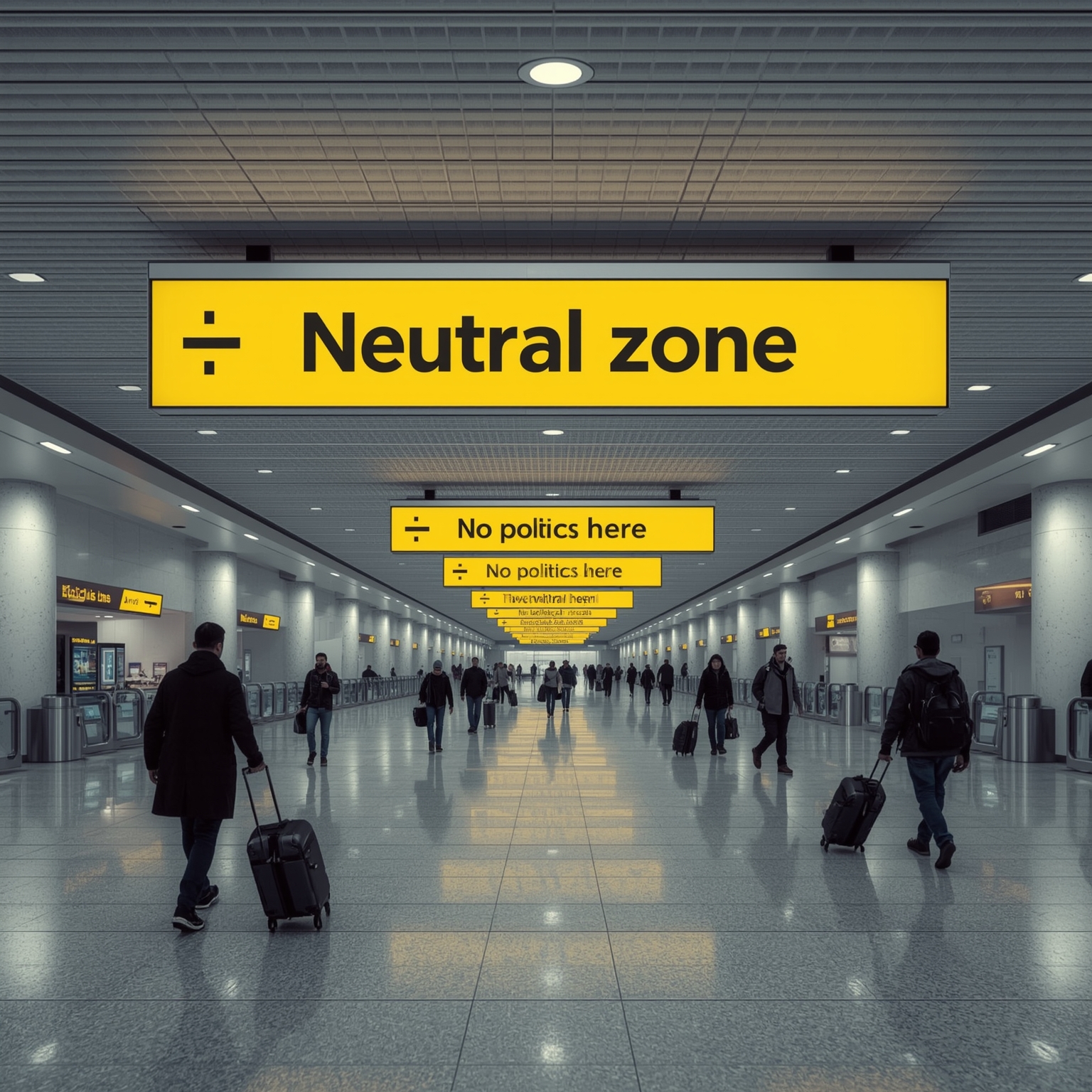
A growing dispute between federal authorities and several major airports has taken a particularly visible form in Detroit, where tensions surrounding a recent political message by Kristi Noem, the Secretary of Homeland Security, have become most apparent. At the heart of this disagreement lies a video message distributed through Transportation Security Administration (TSA)-controlled screens within airport security areas—content that Detroit Metropolitan Airport has officially distanced itself from. In an assertive and highly visible response, the airport has placed striking yellow signs at the entrances to its security checkpoints, explicitly informing travelers that it does not endorse or align with the opinions expressed in that federal broadcast.
These signs, designed to be impossible to overlook, bear a distinct message in uppercase lettering reading “ATTENTION,” followed by a clear disclaimer: “The views expressed in this TSA-controlled video do not represent the views of the Wayne County Airport Authority.” The declaration continues by reaffirming the airport authority’s commitment to nonpartisanship, stating unequivocally, “The Wayne County Airport Authority does not engage in partisan politics.” In issuing such a public statement, airport officials aimed to reinforce the institution’s longstanding dedication to maintaining a neutral space, free from political influence or advocacy.
The controversy stems in part from the complex administrative arrangement governing the airport’s public spaces. While the Wayne County Airport Authority operates Detroit Metropolitan Airport and manages many of its facilities, the security screening zones—and the display equipment inside them—fall under the jurisdiction of the TSA, which leases those particular areas. As a result, the local airport management lacks direct control over the video content shown on those federal screens, creating an unusual tension between local operational authority and federal oversight.
In a statement published on X, formerly known as Twitter, the Wayne County Airport Authority announced that it had formally requested that the TSA cease playing the controversial video. The authority further clarified that the TSA had never sought its consent or approval before displaying the message. The situation highlights a broader concern about the boundaries of federal messaging in public transportation hubs that serve millions of passengers each year.
Detroit Metropolitan Airport, which ranks as the twentieth busiest in the United States, processed approximately thirty-three million passengers last year. It holds strategic importance as Delta Air Lines’ second-largest hub and was recently named the second most popular “mega airport” in North America according to J.D. Power’s traveler satisfaction survey. Given such a prominent national standing, the airport’s public insistence on political neutrality sends a powerful message about the need to separate governance and public service from partisan discourse.
This dispute is not isolated to Detroit. In the days following the release of Noem’s message, airport authorities across the country issued statements expressing similar concerns or taking comparable measures. The video in question, recorded by Secretary Noem, implies that operations within the TSA were being negatively impacted because—according to her remarks—Democrats in Congress had refused to approve federal funding, which led to many TSA employees working temporarily without compensation. In her statement, Noem expressed hope that congressional Democrats would come to recognize the urgency of reopening the government and restoring full funding.
Airport operators in other major metropolitan areas responded by emphasizing their own commitments to maintaining political neutrality in publicly accessible spaces. The Port Authority of New York and New Jersey, which oversees several of the nation’s largest air travel hubs including John F. Kennedy International, Newark Liberty International, and LaGuardia airports, issued a formal communication to Business Insider explaining that its “longstanding policies prevent the airing of politically partisan messages at our facilities.” The agency further clarified that no such videos were being broadcast on any screens under its direct control.
Similarly, Hartsfield–Jackson Atlanta International Airport—the world’s busiest air travel complex and a key transportation artery handling over one hundred million passengers annually—announced that it would not display the Homeland Security video either. Citing both federal and local airport policies, officials stated that their goal was to uphold a space that feels “neutral and welcoming to all travelers,” thereby fostering an environment where individuals of any background or belief may move freely without encountering political messaging at a place designed for transit and safety.
A growing number of other airports have echoed these sentiments. Facilities serving Portland, Seattle, Chicago, Phoenix, Charlotte, and Boston each confirmed that the controversial video was not being shown on their airport-controlled screens. By doing so, they joined Detroit and other major transportation hubs in publicly reinforcing that, while their infrastructure may host federal operations such as TSA checkpoints, their own institutional stances remain resolutely apolitical. The collective response underscores a fundamental principle shared by airport authorities nationwide: travel spaces exist to facilitate movement, connection, and commerce—not to serve as conduits for partisan advocacy or political persuasion.
Sourse: https://www.businessinsider.com/detroit-airport-puts-up-signs-disapproving-of-kristi-noem-tsa-video-2025-10