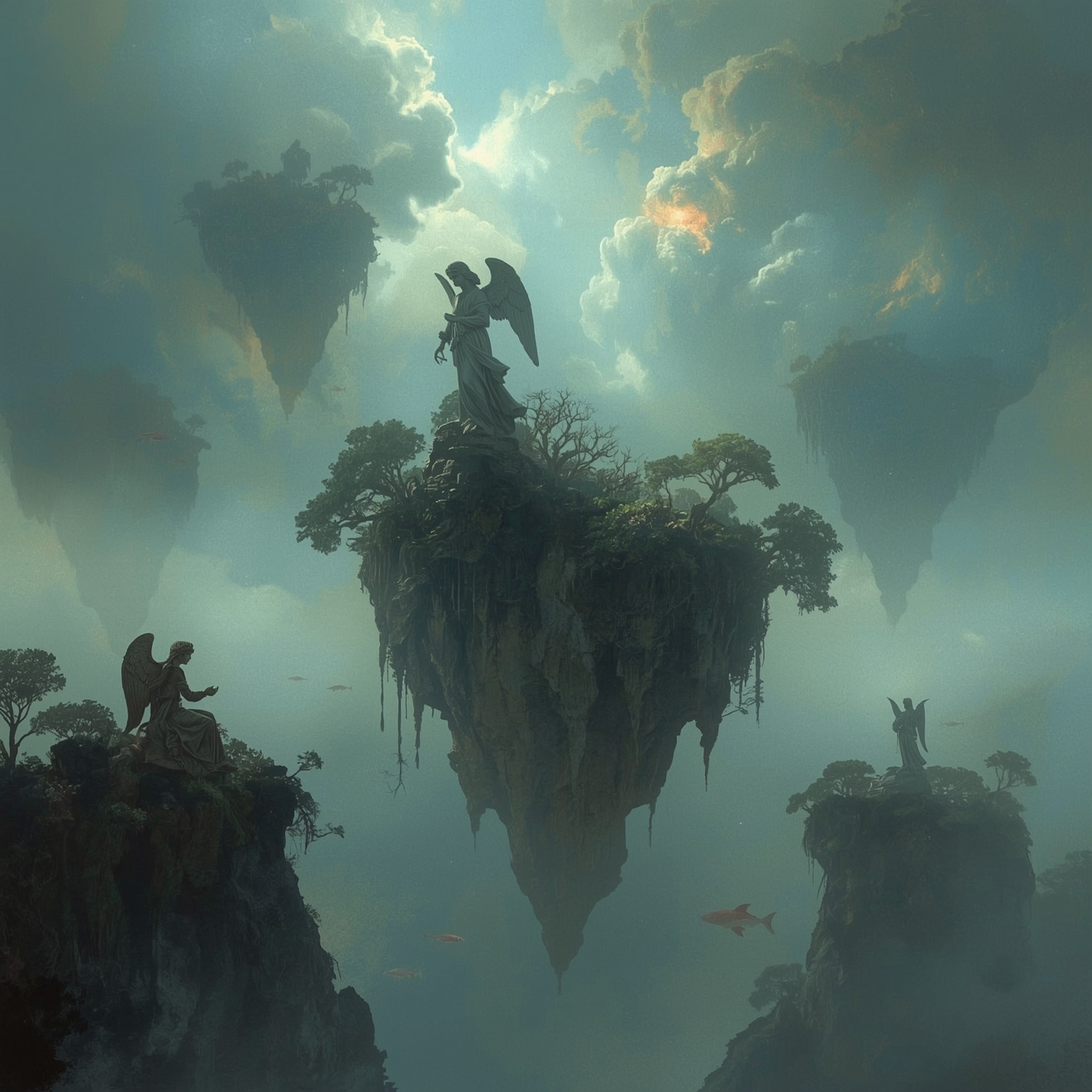
Dreams of Another unfolds like a waking dream painted across the screen, an interactive tapestry of imagination and abstraction that feels less like a conventional video game and more like inhabiting a living work of art. Every moment within it ripples with surreal unpredictability: disjointed vignettes flow into one another without warning, scenes dissolve into haze, and the world itself feels as though it could slip from your grasp at any instant. Landscapes shimmer like half-remembered memories, suspended between clarity and confusion, while the narrative drifts through sudden ruptures and unexpected reunions of meaning. Within these misty realms, you encounter angelic statues that murmur in the tones of the divine and wistful fish who long to abandon their confined pools to swim free into the open ocean. It is precisely this instability, this dreamlike fragility, that grants Dreams of Another its haunting memorability—it is as though the game has captured the elusive texture of dreaming itself.
Created by Q-Games, the studio behind PixelJunk, Dreams of Another places you in the soft slippers of an unlikely protagonist known only as the Man in Pajamas—a somnambulant figure whose name perfectly encapsulates his existence between waking and sleep. His only companion is a mysterious firearm bestowed upon him by an enigmatic character called the Wandering Soldier. Yet in the opening sequence, when the soldier attempts to fire the weapon, he discovers, almost helplessly, that it produces no lethal discharge. Paradoxically, when this same instrument rests in the hands of the Man in Pajamas, its purpose transforms: instead of destroying, it becomes an implement of creation, a tool that brings form out of nothingness, shaping the fragments of broken worlds into coherent structures.
The developers describe Dreams of Another as a “third-person exploration-action game,” but that classification feels almost insufficient, even misleading. The experience is not defined so much by its mechanics as by its atmosphere—a sequence of interconnected dreams or artistic sketches that fade in and out like recollections from another consciousness. When you find yourself dropped into a scene—and this descent is often abrupt, with no preliminary transition—you stand amid landscapes that appear half constructed, their forms scattered into tiny, luminous particles of color. By firing your generative weapon at these kaleidoscopic fragments, you coax them into solidity: a tree might sprout where once there was chaos; a bench may take shape from a storm of fragments; a shipwreck, a human figure, or the corner of a dilapidated building might coalesce before your eyes. Yet even when constructed, these forms remain delicate, trembling at the edges of dissolution, as though reality itself were a borrowed illusion that could collapse into dust without warning—and at times, it does.
As creation emerges from your hand, the world becomes conversational: you speak not only with the Wandering Soldier or the eccentric clown who sculpts grand monuments from the rings of separated lovers, but also with inanimate entities—a reflective bench that muses about the nature of thought, for instance—each conversation thick with surreal poetry and melancholy humor. Dialogue unfolds in hesitant, fragmented language, as if every speaker were struggling to recall the rules of speech itself. In one striking moment, an elderly woman snaps a photograph of her husband, only to remark, with eerie nonchalance, that the image will make a fine portrait for his funeral. Each of these scenes lasts but a brief interval, just long enough to suggest meaning before drifting apart; as the environment dissolves once more into a wash of white, you are cast into an entirely new setting—or returned suddenly to the tranquil main menu, where the Man in Pajamas lies asleep, his peaceful posture suggesting that all you witnessed may have been the flickering contents of his dreams.
The game’s unconventional structure can make comprehension elusive. Narrative coherence is not its primary ambition; instead, Dreams of Another is preoccupied with exploring vast philosophical and aesthetic ideas—questions surrounding art, creativity, consciousness, and the fragile threads that bind human nature to perception. It often resists the notion of entertainment as mere diversion, choosing instead to confront the player with experiences that feel puzzling, sometimes even uncomfortable, yet intellectually stimulating. This unpredictability imbues every moment with tension and wonder. During my six-hour journey through its ethereal sequences, I could never predict what would emerge next: a fragment of cosmic serenity, a sudden existential epiphany, or an absurd encounter that challenged my sense of narrative continuity. And like the enigmatic residue of a real dream—those fleeting but profound impressions that linger long after awakening—Dreams of Another leaves behind an indelible sense of beauty, melancholy, and reflection.
This delicate and deeply artistic title from Q-Games is available now on PlayStation 5 and PC, inviting players everywhere to step into the soft glow of its surreal universe and lose themselves within the borderlands of imagination and art.
Sourse: https://www.theverge.com/games/795553/dreams-of-another-review-ps5-pc