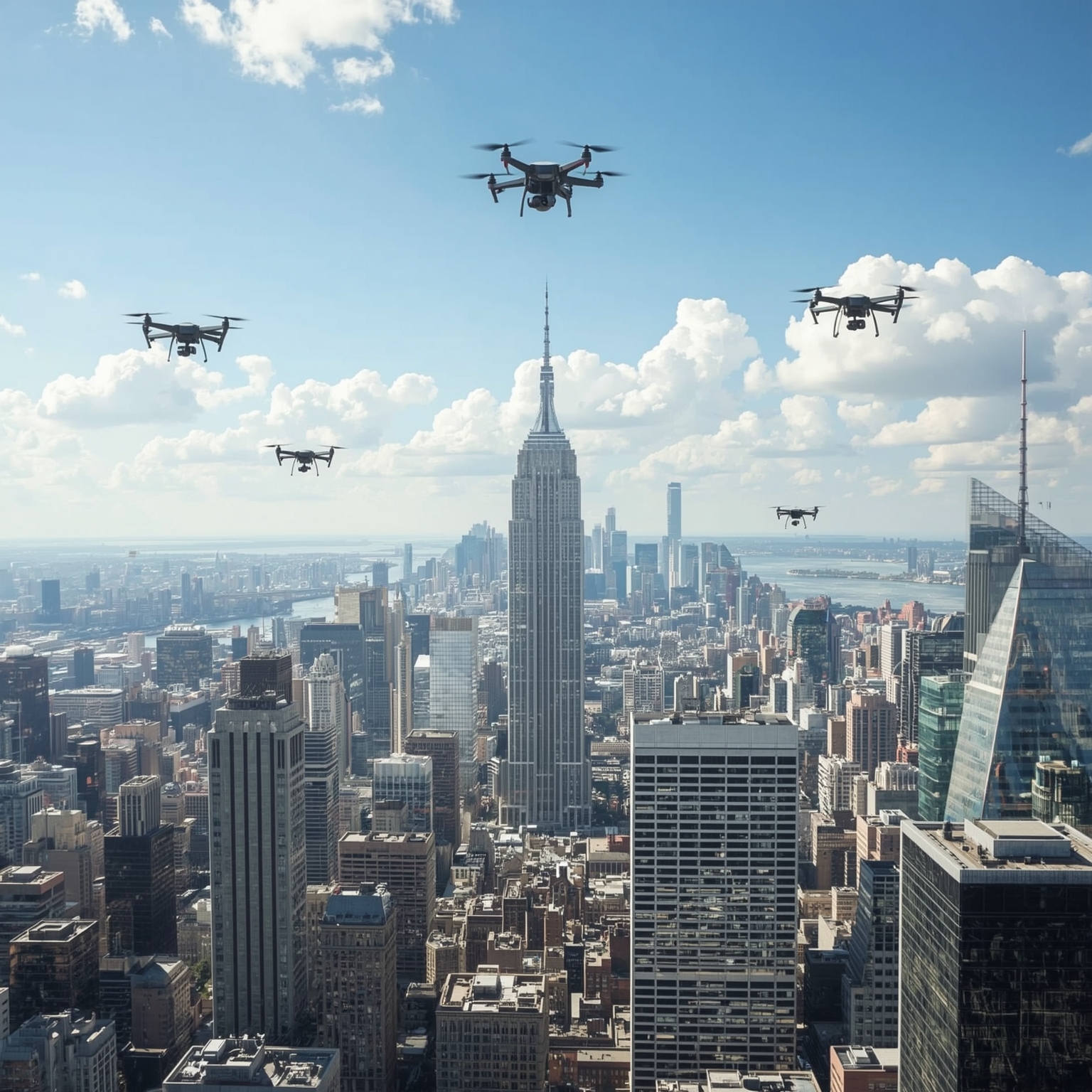
After countless years of stagnating prototypes, aborted test runs, and labyrinthine regulatory obstacles, the long‑anticipated dream of mainstream drone delivery in the United States is finally beginning to ascend beyond the experimental stage. What was once confined to limited demonstrations and speculative discussions has started to materialize as a practical component of the nation’s evolving logistics landscape.
In a clear signal that interest among major restaurant brands is intensifying, Chipotle launched a collaboration in August with drone logistics pioneer Zipline. The purpose of this alliance is deceptively simple yet technologically profound: to ensure that fans throughout the Dallas metropolitan area can receive their favorite burritos and bowls at virtually any time and location—from sprawling suburban neighborhoods to urban green spaces—without the delays or limitations of traditional ground transport. Earlier that summer, in June, GoTo Foods embarked on a similar path by joining forces with DoorDash and Wing. This venture extends the reach of its well‑known portfolio of brands, including Auntie Anne’s and Jamba, across three busy Texas markets—Frisco, Fort Worth, and Plano—signaling an intent to make air‑based delivery a familiar aspect of everyday life.
These new pilot initiatives build directly upon a decade of shorter, less successful forays into aerial delivery that began with excitement but faded abruptly. Notably, the Flytrex and El Pollo Loco partnership briefly soared in 2021 before being quietly discontinued. Yet this current wave feels distinctly different in both tone and scale. According to five industry insiders interviewed by Business Insider, this juncture may represent a true turning point. Kent Ferguson, Wing’s head of partnerships, described the moment as an inflection point—an era in which improved regulations, flexible infrastructure, and the availability of thousands of operational aircraft collectively create genuine conditions for growth. He emphasized that the industry now possesses the planes, technology, and regulatory backing to serve millions of consumers efficiently and sustainably.
At present, multiple innovators—including Zipline, Wing, Flytrex, and DroneUp—are engaged in a race to define how unmanned aerial vehicles, commonly known as UAVs, will serve the commercial market. The designs they introduce range from sleek, miniature aircraft evocative of passenger planes to compact, four‑rotor drones familiar to hobbyists. Each platform features unique payload mechanisms and flight systems optimized for specific delivery contexts, from lightweight meals to packaged groceries.
Operationally, insiders stress that the logistical considerations required for merchants remain fundamentally the same as those governing human‑driven deliveries. GoTo Foods’ chief commercial officer, Kieran Donahue, likened the process to any other order picked up and transported by a driver or robotic courier. The core tasks—accurately assembling the order, ensuring the food is freshly and properly prepared, and maintaining quality during transit—remain unchanged. Whether the courier is a driver in a DoorDash vehicle or a drone hovering hundreds of feet above, the customer’s expectations of reliability and freshness are identical.
Nevertheless, for retailers, the benefits are compelling and multifaceted. Drone delivery promises quicker service, reduced labor expenses, and enhanced consumer satisfaction, outcomes that together could reshape the economics of food delivery. Unsurprisingly, the movement is expanding beyond restaurant chains. Retail giants such as Walmart and Amazon are initiating their own large‑scale trials, envisioning a near future in which receiving dinner ingredients via drone will feel as normal as placing a takeout order through Grubhub or Uber Eats.
While technological enhancement has played a role in this surge, the recent acceleration owes much to regulatory transformation. As WhiteFox Defense Technologies founder and U.S. Chamber of Commerce Drone Committee vice chair L. R. Fox explained, a crucial catalyst emerged with a June executive order signed by President Donald Trump. That directive simplified the tangle of federal guidelines that had long impeded widespread commercial adoption. Central to this policy breakthrough is permission for what aviation experts term Beyond Visual Line of Sight, or BVLOS. This authorization liberates drone operators from the outdated requirement of maintaining uninterrupted visual contact with their aircraft. Before this rule change, fleets operated in a literal relay: one operator would lose sight over the horizon while another took control from a nearby rooftop. The new regulatory environment allows for continuous, remotely monitored flight paths, paving the way for scalable, automated operations supervised by the Department of Transportation and the Federal Aviation Administration.
The early results from these regulatory pilot programs show measurable success. Both GoTo Foods and Chipotle representatives told Business Insider that their deliveries are completing in notably less time. Curt Garner, Chipotle’s chief technology officer, elaborated that geography no longer limits service reach. A single drone‑equipped restaurant can now cover the same territory that previously required five or six car‑bound couriers, ensuring efficient area coverage without duplication of resources.
Texas, with its combination of favorable weather, broad suburban layouts, and generally flat terrain, has emerged as an ideal proving ground. Harrison Shih, who directs the DoorDash Drone Program, explained that such environments—dominated by single‑family homes and spacious yards—allow drones to lower packages with ease and accuracy. The program has also expanded to Charlotte, North Carolina, another location that provides valuable comparative data in testing. According to Shih, these trials will inform eventual scaling into more densely populated metropolitan zones, with expectations that by 2026 the technology will spread across major U.S. cities.
Despite its promise, widespread adoption still faces practical and societal obstacles. Public skepticism remains substantial. A 2024 survey conducted by the Vanderbilt Policy Accelerator for Political Economy and Regulation revealed that 70 percent of respondents worry drones could disrupt neighborhoods or introduce safety risks, while over half opposed any legislative effort to open additional airspace for such deliveries. Fox underscored the limitations of current law by noting that local or state authorities possess virtually no power to intercept or neutralize rogue drones—even in extreme cases of potential threat—because such actions are governed exclusively by federal statutes. This legal ambiguity leaves both practitioners and policymakers in need of clearer jurisdictional frameworks. Legislation aimed at expanding local enforcement authority is under consideration but not yet enacted.
Fox and other experts warn that as companies eventually deploy hundreds or even thousands of drones daily across populated regions, the likelihood of an operational incident will increase. Establishing precise protocols for responding to such events—without stalling the entire industry—remains a central concern. Beyond safety, quieter yet pressing issues include identifying permissible drop‑off areas and tackling the acoustic annoyance that can accompany constant propeller activity. Fox candidly admitted that doorstep or window‑level drone delivery remains a distant prospect and could stay outside the realm of everyday experience for decades to come.
Currently, platforms like Wing and Zipline rely on customer‑designated drop zones—flat, unobstructed surfaces roughly the size of a picnic blanket, located under clear skies—to ensure accuracy and safety. According to Garner, Zipline engineers are addressing noise sensitivity through both aeronautical design and operational strategy. Because the drones typically release their payloads from a considerable altitude, the characteristic buzzing sound associated with close‑range drone flight is largely inaudible to recipients on the ground.
Even with these remaining hurdles, the optimism among participating companies suggests a tangible shift. For the first time, the technology’s progress is being measured not by promotional hype but by concrete performance—faster deliveries, lower operational costs, and newfound opportunities for off‑premise dining extending from suburban cul‑de‑sacs to local sports fields. What was once a futuristic novelty is maturing into a viable component of last‑mile logistics. Should these trials continue to succeed, the next stage of convenience commerce may not arrive by car or bicycle but descend gracefully from the skies above, transforming the very meaning of doorstep delivery.
Sourse: https://www.businessinsider.com/drone-delivery-accelerating-test-programs-pilot-markets-texas-wing-zipline-2025-10