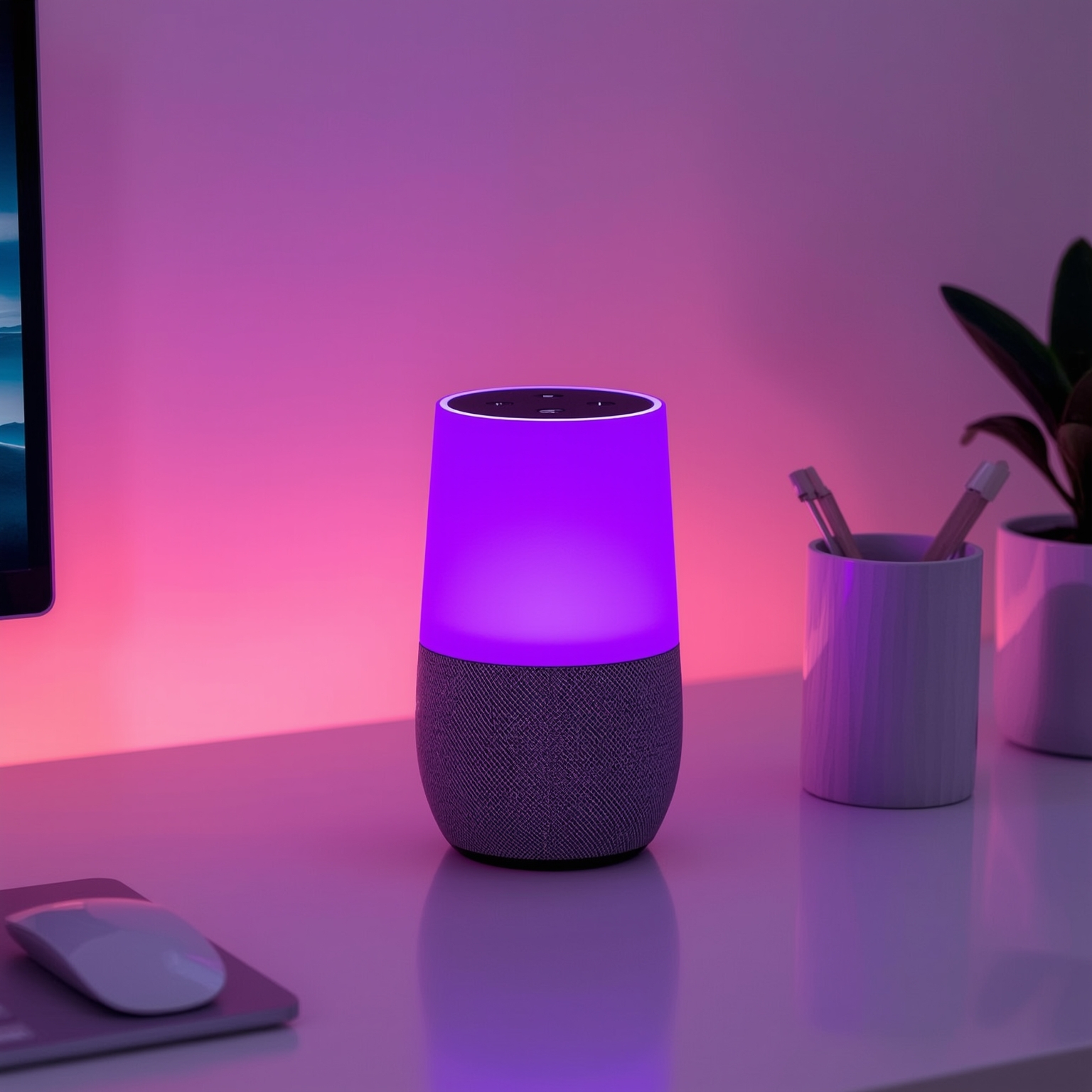
I absolutely adore the Echo Dot Max — a product that feels like the culmination of Amazon’s evolution in compact smart speakers. It’s far more than a simple upgrade; it’s an artful blend of solid engineering, aesthetic charm, and thoughtful design. The speaker’s audio performance is impressively robust for its size, offering clarity and resonance that elevate daily listening. More than just a sound device, it listens with impressive precision, capturing voice commands even in less-than-optimal conditions. And yes, it arrives in a striking purple finish that radiates personality and fun — a refreshing departure from the monotonous grays and blacks that dominate the smart home market.
Beyond its color, the Echo Dot Max introduces redesigned controls that are more intuitive and tactile, making them genuinely easier to use. Amazon also equips it with an expanded suite of smart home sensors and wireless communication radios, broadening its range of functionality compared to earlier models. This device is among the earliest built to host Alexa Plus — Amazon’s experimental, AI-powered assistant. While Alexa Plus remains optional (and currently limited to U.S. users), its inconsistent performance slightly dampens the overall experience of what is otherwise a highly refined and capable speaker.
It’s important to note that the Echo Dot Max isn’t here to replace the existing Echo Dot line. The beloved Dot continues, while the Max takes the baton from the fourth-generation Echo, originally launched in 2020. At its $99 price point, identical to that of the orb-like 2020 Echo, the new Max squarely targets the same audience but brings a decidedly fresher perspective. The old model, though reliable, is beginning to show its age. Now its successor steps in with a more compact frame, a stylish full-knit fabric enclosure, and a faster, more efficient processor. It additionally includes built-in support for emerging smart home standards like Matter, Thread, and Zigbee — essential for those building future-proof home networks.
In terms of design hierarchy within the Echo lineup, the Dot Max occupies the middle ground between the $50 fifth-generation Dot and the $220 Echo Studio. Even so, its value proposition feels generous. Available in white, grey, and the remarkable purple, it carries every hallmark of a great Alexa speaker — intuitive physical buttons, dependable voice response, excellent sound quality, and meaningful smart home capabilities. Since it lacks a display, you’re spared the intrusive full-screen ads or unnecessary distractions often present in Echo Show devices.
For pure audio enthusiasts, the Echo Studio remains the premium choice, especially if one’s budget allows. Yet, for its category, the Dot Max astonishes: its soundstage is powerful enough to fill an open-concept living room and kitchen with ease, while its bass depth surpasses expectations for a speaker of its scale. Though slightly larger than the fifth-gen Dot and more compact than the fourth-gen Echo, the Max delivers a balanced acoustic profile. Its separate tweeter and woofer — a first for the Dot line — provide greater fidelity. During a playful moment testing it, my daughter and I found its crispness remarkable, even compared to the Echo’s older dual-tweeter configuration.
The device also integrates neatly with other Echo units, allowing stereo pairing or, in the near future, multi-speaker setups within an Alexa Home Theater group. Its microphone array, powered by Amazon’s new AZ3 processor, demonstrates notable accuracy. The system filters ambient sound efficiently, improving response time and accuracy by roughly fifty percent compared to earlier models. Even when music blares in the background, I didn’t find myself raising my voice to get its attention.
Aesthetic refinement runs throughout the design. The 3D-knitted mesh completely encapsulates the body, granting a soft, seamless exterior, while front-facing controls provide better accessibility when the unit is placed on a shelf or mantelpiece. The LED indicator, repositioned to the front, glows more softly than in previous generations, signaling Alexa’s activity discreetly rather than intrusively. Even the power components now show a level of refinement — the smaller, color-coordinated cords and power brick blend tastefully with each unit. Unfortunately, there’s still no 3.5mm audio jack, an omission carried over from previous Echo Dots, which will disappoint users who favor wired connections.
As a smart home hub, the Dot Max confidently extends Amazon’s ecosystem. By integrating Thread and Zigbee radios and supporting the Matter protocol, it becomes a universal translator for smart home devices. In practical terms, this means it can act as both a Matter controller and a Thread Border Router, linking your Alexa environment with supported accessories more directly and reliably. Testing it with an Eve Energy smart plug revealed rapid and stable control through Thread. Furthermore, the Dot Max doubles as a Wi-Fi extender for users running an Eero mesh system, ensuring broader coverage and smoother performance.
The device houses several sensors — including the familiar temperature and ultrasound motion detectors, plus new Wi-Fi-based sensing meant to interpret subtle movements. Although the real-world performance of this ambient detection can vary, the intent behind it is ambitious: to make the device responsive to your mere presence in a room. In practice, my light automation routine performed reliably, though occasionally overly eager, switching off a lamp while I was quietly typing beside it.
Yet, not all aspects prove ready for prime time. Alexa Plus, the anticipated next-generation voice assistant, remains a mixed experience. On the Max, it functions out of the box in the U.S. and showcases markedly improved conversational understanding. The system interprets complex phrasing and allows multi-command requests delivered in a single breath — features earlier versions struggled with. Still, despite its enhanced comprehension, execution lags behind. Tasks occasionally take longer, routines fail to trigger, and the assistant can lose track of context during longer exchanges. While Amazon plans to refine this system and eventually charge a monthly fee, it’s currently complimentary for Prime subscribers.
Among its promising abilities, Alexa Plus can converse naturally without constant wake words and manage sequential tasks — a significant step toward genuine contextual understanding. However, reliability remains inconsistent. Even with better language processing and expanded general knowledge, the assistant occasionally stalls when fetching information or coordinating connected devices like smart plugs or coffee makers. Similarly, building and running routines can be hit-or-miss, forcing users to verify that automation commands executed correctly.
Despite this unpredictability, Alexa Plus hints at Amazon’s larger vision: an environment where devices intuitively serve household needs without explicit prompts — what Amazon describes as “ambient computing.” The Echo Dot Max, powered by the AZ3 processor and designed to support edge processing through Amazon’s Omnisense fusion platform, represents a step toward that horizon. Its internal hardware is primed for future machine learning models capable of local decision-making, paving the way for faster, more personal responsiveness. Presently, though, these aspirations exist mostly as potential rather than tangible benefit.
When measured as a whole, the Echo Dot Max embodies Amazon’s best hardware effort yet within this product class. Though double the cost of the base Dot, the enhancement in sound quality, processing power, and smart home integration justifies the difference. For owners of older fourth-generation Echos, the upgrade is sensible and rewarding. Those seeking even superior audio may gravitate toward the Echo Studio, which integrates the same AI architecture with more substantial internal components. According to detailed expert reviews, the Studio even rivals costlier Apple alternatives.
This year marks one of Amazon’s strongest showings in hardware design, spanning the Echo and Show lines alike. Still, the defining narrative revolves around Alexa Plus — an assistant reaching for human-like fluency yet hampered by immaturity. The Echo Dot Max confirms that Amazon has perfected the physical aspects of its smart speaker range: balanced sound, streamlined form, and user-centered functionality. What remains is for its software counterpart to catch up, so that the intelligence promised by Alexa Plus can finally match the excellence of the hardware that now houses it.
Sourse: https://www.theverge.com/tech/808747/amazon-echo-dot-max-smart-speaker-review


