In a 2016 interview with the *New York Times*, Whoopi Goldberg was asked to share her perspective on marriage. Her response was characteristically candid and instantly memorable: she declared that she simply did not want another person living in her home. That single sentence, both humorous and deeply revealing, encapsulated an entire philosophy of independence and personal space that resonated with many people who had long questioned society’s insistence on partnership as a universal life goal.
Recently, someone brought up Goldberg’s quip in conversation, and I found myself replying, without hesitation, “Same.” It was a brief but wholehearted agreement, one that perfectly captured how I feel about my own life. Later that evening, I returned home, sank comfortably into my couch, and immersed myself either in the pages of a good book or one of the countless streaming series on my ever-expanding watch list. Such quiet evenings are the rhythm of my life—moments of calm that others might readily label as lonely. Yet, to me, they are moments of profound tranquility and self-contentment, luxurious in their solitude.
I am forty-one years old. Most of my friends have by now settled into marriages or long-term relationships that define the conventional adult experience. By contrast, I remain single—a state that, for quite some time now, has felt not like a deficit but like a conscious and satisfying choice. This serenity, however, is hard-earned. It was not always part of my story. From my teenage years through much of my early thirties, I agonized over the idea of finding a partner. It seemed predetermined, even expected: you meet someone compatible, form a pair, and face life’s unpredictabilities together. The cultural script left little room for deviation; almost no one seemed eager to tackle the messiness of existence alone. But as the years unfolded, I discovered something transformative—that singleness does not equate to loneliness, and solitude need not be synonymous with isolation.
Like many people, I used to believe that marriage or deep romantic commitment was a necessary condition for stability and companionship, one of the pillars upon which a full life rested. Yet when I examined my true motivations, I realized how little they applied to me. Many marry because they wish to raise children—a worthy purpose, but one that never resonated with my own desires, as motherhood was never part of my life plan. After years of dating individuals with whom I could not envision sharing a household, I was compelled to ask myself a difficult question: why, exactly, did I want to marry? The unsettling—but ultimately freeing—truth was that I had very few convincing answers. Beneath my attempts lay a simple fear of being alone.
Over time, that fear softened and eventually transformed into a source of strength. I began to see that a partner was not the sole avenue toward companionship. Life, approached with openness, offers innumerable opportunities to forge bonds—deep, sustaining connections that often arise when and where we least expect them. My own lesson in this came shortly after college, when I decided to pursue graduate studies in Dublin, Ireland. A week before classes began, I was engulfed by panic at the realization of how utterly alone I was, a stranger in a city where no one knew me, my history, or my rhythms. I have never been the sort of person who easily initiates conversation with strangers, yet the magnitude of my solitude compelled me to step beyond the borders of my comfort.
One afternoon, while riding a bus between the main university campus and the smaller satellite campus where I lived, I overheard three women speaking with accents that sounded much like my own. They chatted about the upcoming term, their voices full of excitement and uncertainty. Summoning every ounce of courage, I asked if they were new and whether they happened to be attending my school. That simple, tentative question opened an unexpected doorway: within minutes, I was invited to join them for dinner. Eighteen years later, one of those women remains one of my dearest friends—someone I visited just last month in Atlanta. That frightened but hopeful outreach all those years ago became the seed of a lifelong friendship and the first proof that connection can flourish outside romantic frameworks.
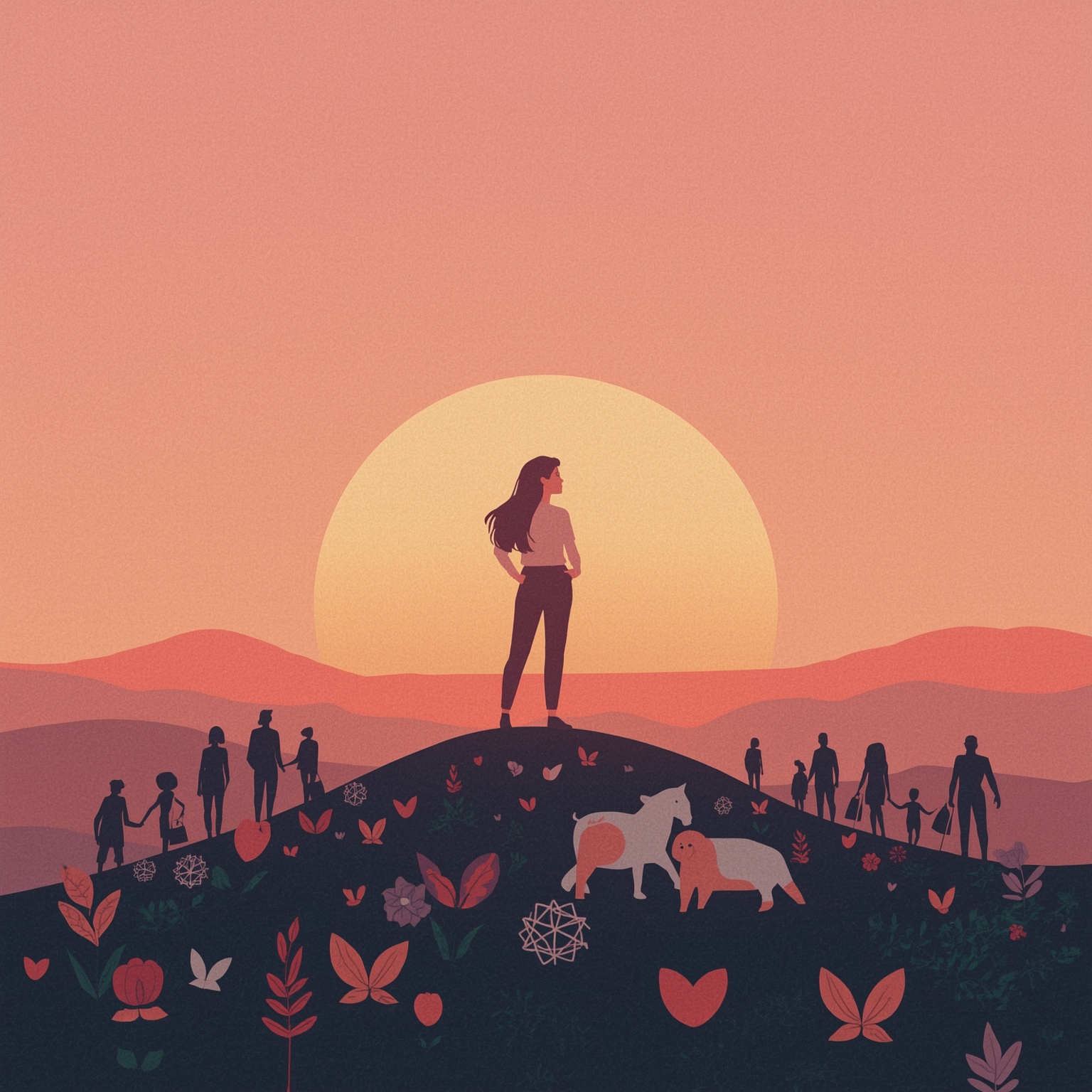
Since then, I have built my existence around a philosophy that values community over coupledom. My emotional life is not anchored by one singular person but by a constellation of meaningful relationships—family members, friends, acquaintances—all of whom form a vibrant network of care and support. I am deeply fortunate to live near close family, which provides a foundation of familiarity and belonging. Beyond that, I’ve cultivated friendships through the pursuits that genuinely inspire me. My involvement in local theatre has introduced me to a circle of creative, expressive souls, while online groups centered on shared interests have blossomed into face-to-face camaraderie. I extend effort to keep in touch with friends who have known me since childhood, preserving the continuity of my personal history. Through these interactions, I’ve learned two invaluable lessons: first, that I am surrounded by people I both love and value; and second, that I thoroughly enjoy my own company.
Although I do not entirely dismiss the possibility of entering a committed romantic partnership one day, I no longer chase it. Instead, I embrace the equilibrium that my current life provides—a balance between introspection and connection, independence and community. Living without a partner has required me to develop an unshakeable sense of self-reliance, to solve my own problems, and to trust in my capabilities. There is an undeniable power in that discovery, in realizing that independence can coexist harmoniously with fulfillment.
When difficulties inevitably arise, I’ve learned to ask for help and to recognize with gratitude the generosity of those around me. It is heartening to see how many people are willing to extend kindness and support when I reach out. These gestures remind me that connection is not defined by cohabitation or marital status but by the willingness to care. And while I may not want someone permanently occupying my home, my door—and my heart—remain open to friends and family who come and go, bringing laughter, reassurance, and the reminder that even in solitude, I am never truly alone.
Sourse: https://www.businessinsider.com/in-my-40s-single-by-choice-built-support-network-2025-11


